


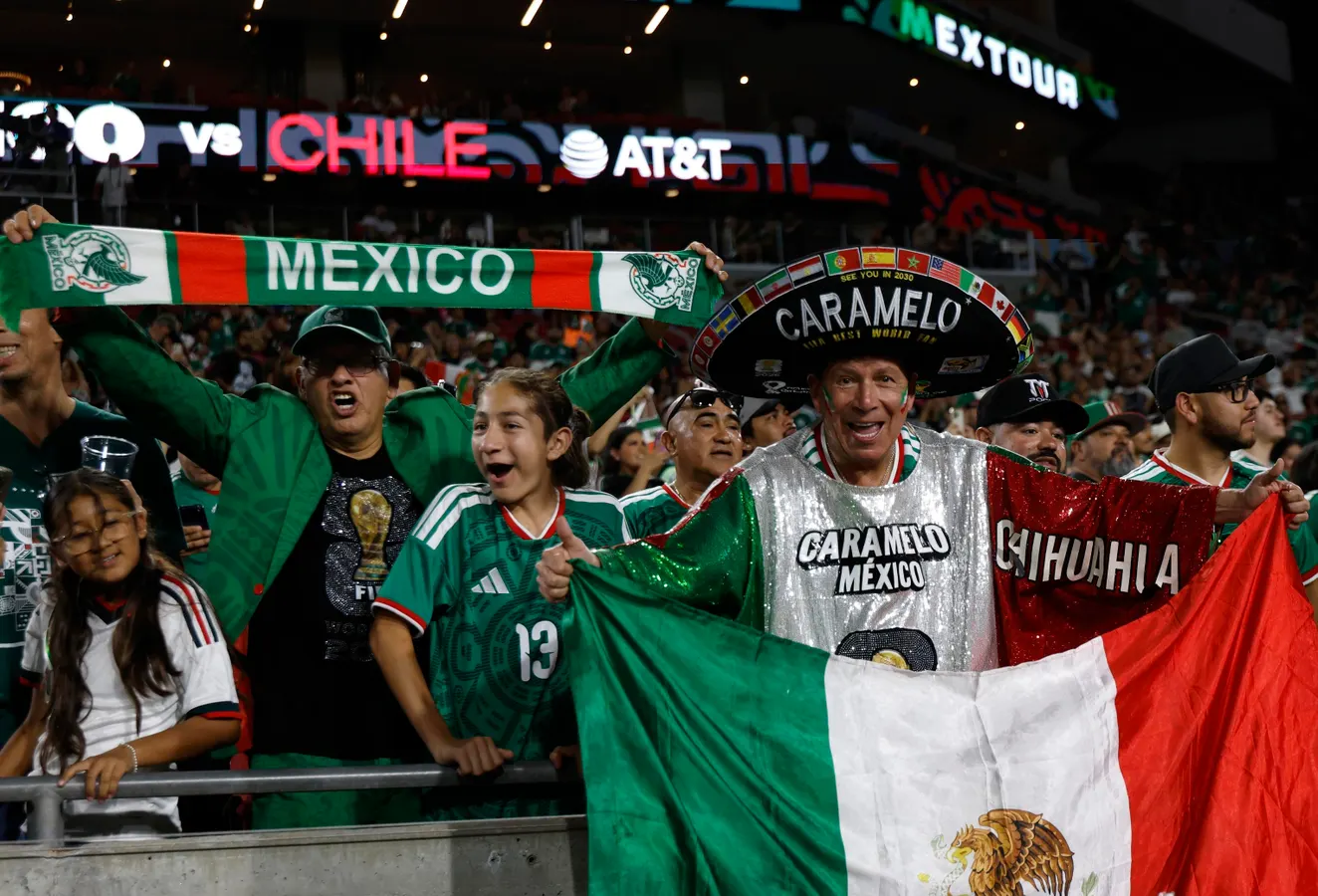

LOS ANGELES, CALIFORNIA – OCTOBER 06: Mexican fans before a friendly match against Chile at Los Angeles Memorial Coliseum on October 06, 2026 in Los Angeles, California. (Photo by Harry How/Getty Images)
Getty Images
A 93-degree evening and an extreme heat warning for Southern California couldn’t stop 56,529 fans from packing into the storied Los Angeles Memorial Coliseum for Mexico’s recent friendly against Chile.
Amid a sea of green jerseys and the smell of beer, the vast majority of those in attendance were ultimately left disappointed: Chile won 2-0.
It’s an all-too-common sight over the last two decades. Over that time, the United States has functioned as a second home — and a highly profitable one — for Mexico’s national team. The stadiums are larger, ticket prices higher and sponsors willing to pay for access to one of North America’s most valuable sports fans.
The Chile game on Oct. 6 was marketed to Mexican fans under the tagline “somos locales,” which translated from Spanish as “We are local.” In other words, Mexico is the home team in many parts of the U.S. As a result, millions of Mexican and Mexican American fans repeatedly turn out to see El Tri.
The games are a business model that has become central to the finances of the Mexican Football Federation. Mexico’s relationship with the U.S. market dates to 2003, when Soccer United Marketing, the commercial arm of Major League Soccer, began working with the federation to stage and market games. By 2022, the federation said its U.S. tours had brought 4.4 million fans to 98 matches. The U.S. is home to 36 million people of Mexican descent.
The broader economic impact has also been substantial. By 2024, the FMF-SUM relationship had generated hundreds of millions of dollars, with one estimate putting revenue from tickets, merchandise, sponsorships and related sources at nearly $400 million during the partnership’s first 12 years. Those figures are estimates rather than publicly audited FMF financial statements, but they show the scale of the commercial operation.
These numbers help explain why Mexico keeps coming back. The economics are straightforward: Put Mexico in a major American stadium, market the event to a deeply invested fan base and sell tens of thousands of tickets. Layer on top of that sponsorships, concessions, merchandise and media exposure and it all equals a big payday for all involved.
There is, however, a trade-off. Mexico’s frequent American friendlies have generated criticism from south of the border because some matches are viewed as commercially motivated rather than competitively meaningful.
Financially, the logic is hard to ignore. The U.S. provides Mexico with something its domestic market often cannot: Large stadiums filled with fans willing to spend money. The commercial infrastructure surrounding those games then adds sponsorship and media value. Separately from the SUM deal, the Mexican federation also has a handful of sponsorships with U.S.-based companies, including The Home Depot, AT&T, Burger King and Amazon.
Despite the criticism, this relationship isn’t expected to end anytime soon.
In 2015, an agreement between the FMF and SUM guaranteed Mexico $2 million per game for a minimum of five U.S. friendlies each year. That was roughly three times what the federation would earn from a friendly played at home. The precise terms of subsequent agreements have not been publicly disclosed.
However, the importance of the American market has only increased over the last few years. When the FMF announced a new six-year agreement with SUM in 2022, then-president Yon De Luisa said revenue from U.S. sponsors and SUM-organized tours accounted for more than one-third of the federation’s annual budget – an extraordinary level of dependence on a foreign market for a national sports federation.
Many of these matches have been labeled by critics as “moleros,” which translates into “money-making friendlies.” But de Luisa said at the time that it gave El Tri more chances to play together as a team in preparation for tournaments such as the World Cup.
“I will always support these matches and hopefully we can have more of them,” De Luisa said in an interview with W Deportes.
Mexico has repeatedly filled NFL and college football stadiums. In 2024, for example, Mexico drew 85,249 spectators for a friendly against Brazil at Texas A&M’s Kyle Field. Across 10 matches played in the United States that year, Mexico averaged more than 54,000 fans.
Even less glamorous opponents can generate substantial crowds. That consistency is what makes this an attractive business model. A national team does not have to play against Lionel Messi every time to create a marketable event because Mexico’s brand itself is the draw.
SUM’s role has been crucial. The company holds the exclusive U.S. commercial rights to Mexico’s national teams, including the men’s and women’s MexTour properties. Its responsibilities include commercialization, marketing, promotion and operational execution. That creates an ecosystem in which the game is only one product. A Mexico match offers sponsors access to a massive and unusually loyal consumer base.
For the federation, the money does more than pay for the senior men’s team. The FMF has said U.S.-generated revenue supports its broader national team programs. The federation’s 2022 agreement with SUM also expanded the commercial relationship to include the women’s national team, reflecting the growing value of the Mexican soccer brand in the United States.









Leave a comment