


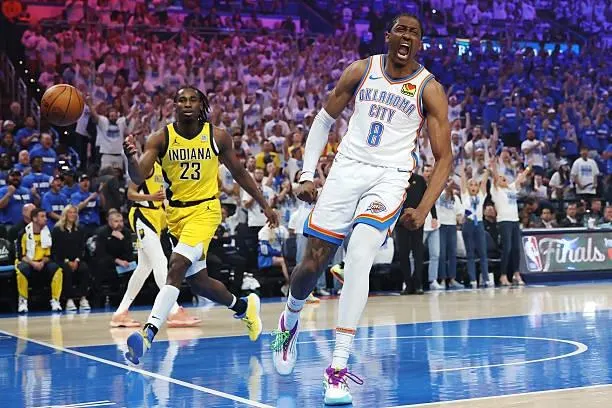

OKLAHOMA CITY, OKLAHOMA – JUNE 16: Jalen Williams #8 of the Oklahoma City Thunder celebrates a dunk against the Indiana Pacers during the first quarter in Game Five of the 2025 NBA Finals at Paycom Center on June 16, 2025 in Oklahoma City, Oklahoma. NOTE TO USER: User expressly acknowledges and agrees that, by downloading and or using this photograph, User is consenting to the terms and conditions of the Getty Images License Agreement. (Photo by Matthew Stockman/Getty Images)
Getty Images
For decades, college basketball recruiting revolved around the same basic questions: Can a player fit the system? Will he develop? How much playing time is available? Now there is another consideration: How much room is there in the school’s athlete compensation budget?
The House v. NCAA settlement changed that equation. Beginning with the 2025-26 academic year, participating Division I schools could provide direct financial benefits to athletes through a revenue-sharing pool. The initial cap was about $20.5 million per school, with the money available across the athletic department rather than reserved for a particular sport. For 2026-27, the cap rose to $21.58 million after the settlement’s annual increase and an audit that found more than $44 million in additional revenue. Each participating school received another $131,438 in available spending.
That is a substantial figure, but it is not a $21.58 million basketball recruiting budget. Football, basketball and the rest of an athletic department are competing for the same pool. That distinction has become central to how programs evaluate recruits.
High school prospects are being valued against the rest of the roster
The first recruiting cycle under the new system showed how quickly the economics could change.
In August 2025, ESPN reported that only nine prospects in its ESPN 100 for the 2026 class had committed before the July recruiting period, compared with 17 at the same point a year earlier. Coaches and recruiting families were still trying to understand how much money would be available and how much could realistically be offered to freshmen.
The uncertainty was especially important because programs were also trying to preserve money for the transfer portal. ESPN reported that high-major coaches were rethinking player valuations, with some expecting far less money to be available for freshmen than during the previous cycle. One coach estimated the actual money available to players could be 40% to 50% lower.
CBS Sports reached a similar conclusion in September 2025, reporting that the 2026 recruiting cycle was moving slowly because coaches were deciding how much of their budgets should go toward high school prospects, transfers and returning players. The outlet cited a high-major source who said programs needed to be more certain that a highly paid freshman would work out.
The result is a different calculation for top recruits. A prospect is no longer being evaluated only against his peers in the recruiting rankings. He is being evaluated against the cost of keeping an experienced player or bringing in a transfer who has already produced at the college level.
ESPN described this as an increasingly NBA-style approach to roster construction, with programs looking at players across different valuation levels rather than assuming the highest-ranked recruit should receive the biggest offer.
The transfer portal has changed the math
The transfer portal is a major reason high school recruiting has become harder to price.
Programs now have another way to fill a roster with proven college production. In ESPN’s analysis of the 2025 Final Four, 11 of the 20 starting spots were held by transfers, while only three starters were freshmen.
That does not make high school recruiting irrelevant. It means schools have to weigh the long-term value of a recruit against the relative certainty offered by a transfer.
The timing of the portal also complicates recruiting. Coaches may need to know what their roster will look like after the spring transfer window before committing substantial money to the next class. That can encourage programs to delay decisions, while recruits have a reason to wait as well. A prospect who commits early may worry that the school will later add older players at his position and change his path to playing time.
The financial pressure works in the other direction, too. A program that spends heavily on a high school player has less flexibility when a proven transfer becomes available. Roster construction has become a balancing act rather than a straightforward race for the highest-ranked recruits.
Revenue sharing has not replaced NIL
Revenue sharing has not eliminated the broader NIL market.
Revenue sharing is money paid directly by a school under the settlement framework. Third-party NIL deals are separate agreements involving brands, businesses and other entities. The College Sports Commission reviews certain associated-entity deals through NIL Go.
That market remains substantial. The commission approved more than $227 million in NIL deals in July and August 2026, according to The Associated Press. About $188.6 million of that total involved associated entities.
For basketball programs, a recruit’s financial package can therefore still contain several pieces. There may be direct school compensation along with third-party NIL opportunities. The balance between those sources matters as schools manage the limits of the revenue-sharing pool.
Opendorse data cited by On3 estimated that power-conference men’s basketball rosters cost between $7 million and $10 million on average during 2025-26. On3 also reported that men’s basketball received an average revenue-sharing allocation of about $4.2 million during that first season.
Those figures show why the school pool cannot simply be handed to a few elite recruits. Even at programs where basketball receives a large share of athletic-department resources, there are multiple financial obligations competing for that money.
The recruiting pitch is becoming more financial
The biggest change may be less visible than the headline numbers.
Coaches now have to explain the financial picture more carefully. A recruit and his representatives want to know the school’s direct offer, the NIL opportunities available and what the roster could look like a year later.
Schools are responding in different ways. Some are allocating a larger portion of their institutional pool to basketball, while others are prioritizing football and trying to supplement basketball spending through outside NIL activity. Those choices can produce very different recruiting strategies even within the same conference.
The rules are still moving, too. In September 2026, the Senate advanced the Protect College Sports Act, legislation that includes a proposed retention pool and other changes to the current system. The bill still faces additional steps before becoming law.
For now, the basic shift is clear. Revenue sharing has turned roster construction into a financial exercise that begins well before a player steps on campus. High school recruits are part of that calculation, transfers are part of it and returning players are competing for the same limited resources.
The recruiting pitch is therefore no longer just about what a coach can promise a player on the court. Increasingly, it starts with what the program can afford, where that money comes from and what it leaves available for everyone else.















Leave a comment