


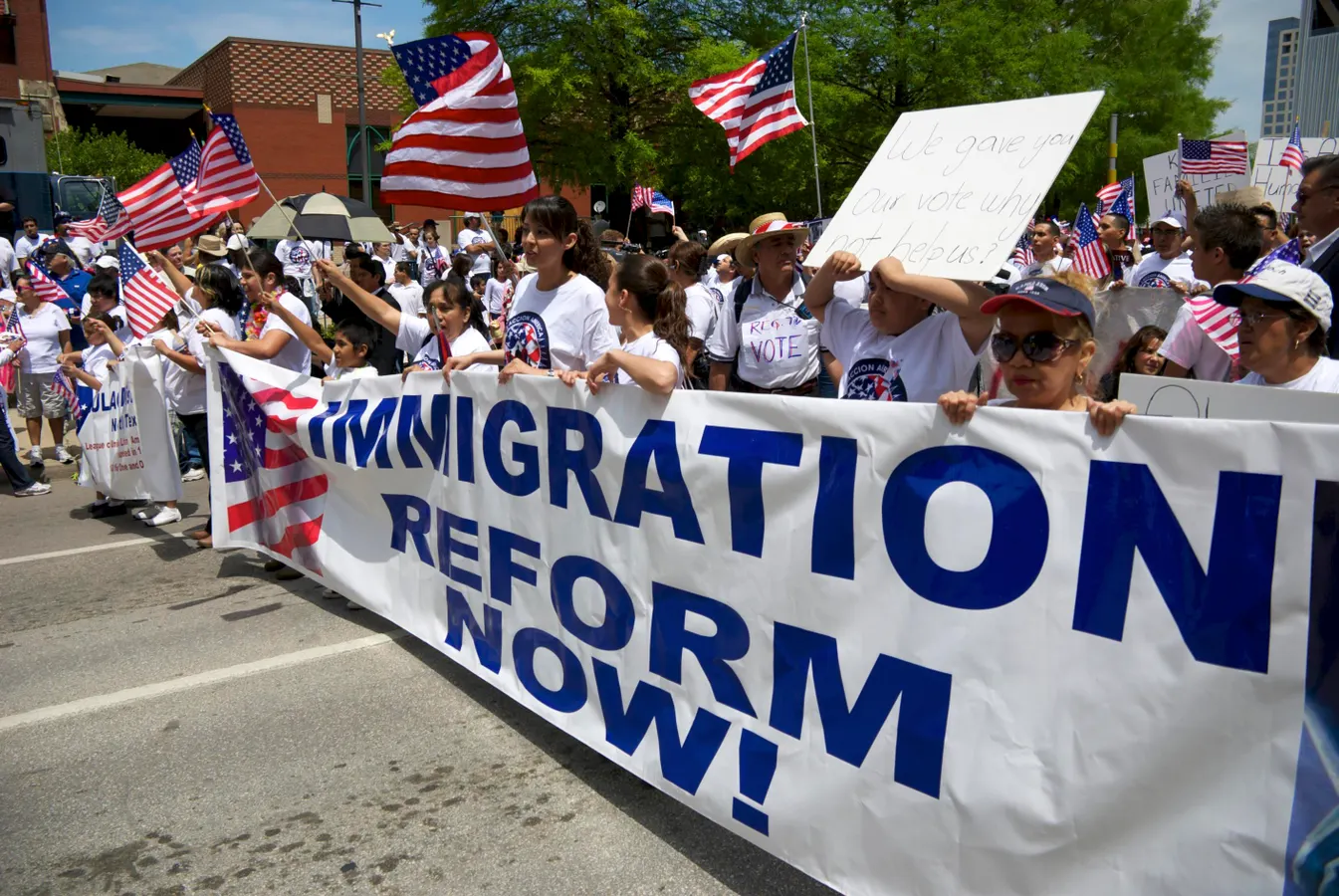

Many would argue that the current enforcement of immigration laws is not working. Reform and a new playbook are needed.
getty
America has spent decades trying to solve illegal immigration through a familiar playbook: strengthen the border, increase detention, accelerate deportations, restrict access to benefits and make life sufficiently difficult for undocumented immigrants that they either leave or are eventually removed.
There is an obvious problem with this strategy. Millions remain.
The Pew Research Center estimates that the unauthorized immigrant population reached a record 14 million in 2023. Importantly, those 14 million people are not all in the same circumstances. Some entered recently. Others have been living in the United States for decades. About 6 million had some form of temporary protection from deportation, including asylum applicants, parolees, Temporary Protected Status holders and DACA recipients.
Treating all of these people as though they present exactly the same immigration problem ignores an important question: At what point should prolonged, peaceful residence become a fact that immigration law recognizes?
There may be a more realistic way forward.
Immigration Enforcement Has Practical Limits
The starting point should be something lawyers and law-enforcement officials already understand: no legal system achieves perfect enforcement.
Police do not catch every thief. Prosecutors do not prosecute every crime. Tax authorities do not uncover every unreported dollar. Courts do not remedy every wrong. Government works by establishing laws, enforcing them seriously and deciding how finite resources can best be used.
Immigration enforcement is no different.
Indeed, ICE itself acknowledges that enforcement actions necessarily reflect agency priorities, funding and capacity.
In fiscal 2024, ICE removed 271,484 noncitizens, a substantial increase over the previous year. That is significant enforcement. But ICE’s own annual report puts the number in perspective. Even removals on that scale represent only a small fraction of an unauthorized population measured in the millions.
That does not mean immigration laws should be ignored. Borders matter. Immigration laws matter. Countries have both the right and the responsibility to determine who may enter and remain.
But there is a difference between enforcing immigration law going forward and believing that every immigration violation accumulated over several decades can eventually be corrected through removal.
The arithmetic makes that exceedingly difficult.
At some point, policymakers have to distinguish between enforcement that preserves the integrity of the immigration system and an expectation of perfect retrospective enforcement that government is unlikely ever to achieve.
The question becomes whether the United States should devote the same enforcement resources to someone who crossed the border last month as it does to someone who entered decades ago, raised American children, worked, paid taxes and has no serious criminal record.
America Already Has The Legal Idea
Fortunately, the United States does not have to invent an entirely new legal concept to address this problem.
It already exists.
Section 249 of the Immigration and Nationality Act contains a provision immigration lawyers call registry. Under existing law, certain people who entered the United States before January 1, 1972, and have continuously resided here since then can obtain lawful permanent residence if they satisfy the statutory requirements.
The USCIS rules governing registry require applicants to demonstrate both entry before January 1, 1972, and continuous residence thereafter.
The principle is therefore already embedded in American immigration law.
The problem is the date.
Someone relying on registry today would need to establish more than half a century of continuous American residence. The provision has become almost meaningless as a practical immigration remedy because Congress has left the cutoff date frozen in 1972.
There is a straightforward way to make it relevant again.
Move the registry date to January 1, 2010.
That would mean that someone who has been continuously living in the United States since before that date—more than 16 years by 2026—could apply for permanent residence, subject to clearly defined requirements.
This would not legalize everyone.
Applicants could be required to demonstrate continuous residence, good moral character and compliance with tax obligations. A requirement to do a certain amount of community service work before getting the relief and to pay a fine for not complying with the law on entry, such as helping out in hospitals, could be included as a requirement. Serious criminal convictions, fraud, national-security concerns and other specified grounds could disqualify an applicant. Background and security checks would remain mandatory.
Most importantly, the January 1, 2010 date would be fixed.
A person arriving unlawfully today could not simply wait another 16 years and automatically become eligible. Congress would be drawing a line under an old problem rather than promising future entrants that another legalization program would inevitably come along.
Recognizing De Facto Residence
Consider two hypothetical cases.
One immigrant crosses the border unlawfully in 2026.
Another entered in 1998 and has lived in Texas for 28 years. He owns a small business, employs workers, has American children and grandchildren, pays taxes and has never been arrested.
Both may technically lack lawful immigration status.
But it is difficult to argue that their circumstances are identical.
After decades in America, the second individual has developed something that could reasonably be described as de facto residence.
That term does not erase the original immigration violation. Nor does it suggest that simply remaining unlawfully should itself create a legal entitlement.
It recognizes something more practical: time changes facts.
Families form. Children are born. Businesses are created. Mortgages are paid. Communities develop. People grow old. What began decades earlier as an immigration violation eventually becomes intertwined with a person’s entire life and with the lives of American citizens around them.
Immigration law already recognizes the relevance of time and establishment in other contexts. Registry does it. Cancellation of removal considers periods of physical presence and family hardship. Various humanitarian remedies take account of accumulated ties and equities.
Updating registry would address those considerations systematically.
Bring People Out Of The Shadows
There is another advantage.
A large population living indefinitely outside lawful immigration status benefits almost no one.
Workers may be vulnerable to exploitation because they fear reporting abusive employers. Legitimate employers face uncertainty about employment authorization. Families live knowing that an encounter with immigration authorities could abruptly separate them. Government does not have the same degree of reliable information it would have if these residents came forward and were screened.
A registry program would reverse the incentives.
People who qualified could be required to identify themselves, provide fingerprints, undergo criminal and national-security screening, document their years of residence, address outstanding tax obligations and enter the formal immigration system.
Instead of hiding from the government, they would have an incentive to come forward.
Economically, immigration itself cannot honestly be reduced to either “immigrants cost America money” or “immigrants make America rich.” Both the costs and contributions are real.
For example, the Congressional Budget Office estimated that the recent immigration surge would increase federal revenues by about $1.2 trillion between 2024 and 2034 while increasing mandatory spending and interest costs by about $300 billion. On its projections, immigration reduced federal deficits overall, although CBO emphasized substantial uncertainty and also recognized significant pressures on government services.
That is the kind of balanced accounting this debate needs.
What About Amnesty?
The strongest objection to this proposal deserves to be taken seriously.
Why should someone who violated immigration law eventually receive permanent residence while millions of others waited abroad, followed the rules and immigrated legally?
That is a legitimate question.
There is also the danger that repeated legalization programs can encourage future migrants to believe that today’s violation will eventually become tomorrow’s lawful status.
Those concerns argue for strong border enforcement, effective workplace enforcement and a fixed cutoff date.
But they do not resolve the separate question of what America should do about people who have already been living here for 16, 20, 30 or even 40 years.
Keeping millions of people permanently in unlawful status does not undo the original violation.
It simply preserves it.
Reason Over Rhetoric
None of this is likely to be popular in many quarters.
For some Americans, any legalization of undocumented immigrants will be characterized as amnesty. Others will argue that even a 2010 cutoff is too restrictive and leaves too many deserving people behind.
That political reality should be acknowledged rather than wished away.
But immigration policy should ultimately be judged by whether it works.
America does not have to choose between open borders and trying indefinitely to deport every undocumented immigrant in the country. There is considerable ground between those extremes.
The United States can enforce its border against new unauthorized entry. It can remove people who present serious criminal or national-security concerns. It can insist that legal immigration rules mean something.
At the same time, Congress can confront the reality of a population that has already become deeply established in American society.
Moving the registry date from January 1, 1972, to January 1, 2010, with rigorous screening and a fixed cutoff, would be one way to do that.
It would not solve every immigration problem. No law can.
That may be precisely the point.
Just as the justice system cannot catch every criminal or remedy every wrong, immigration enforcement cannot realistically correct every violation accumulated over generations. Government must enforce the law, but it must also make rational judgments about priorities, resources and realities that cannot simply be wished away.
The proposal will undoubtedly encounter resistance. But this is a moment when reason deserves a place alongside rhetoric. America needs an immigration system that controls the future without remaining permanently trapped by the past.
Updating registry would not abandon immigration enforcement.
It would recognize its limits—and provide one possible path toward putting America’s immigration system on a more workable footing.
















Leave a comment