


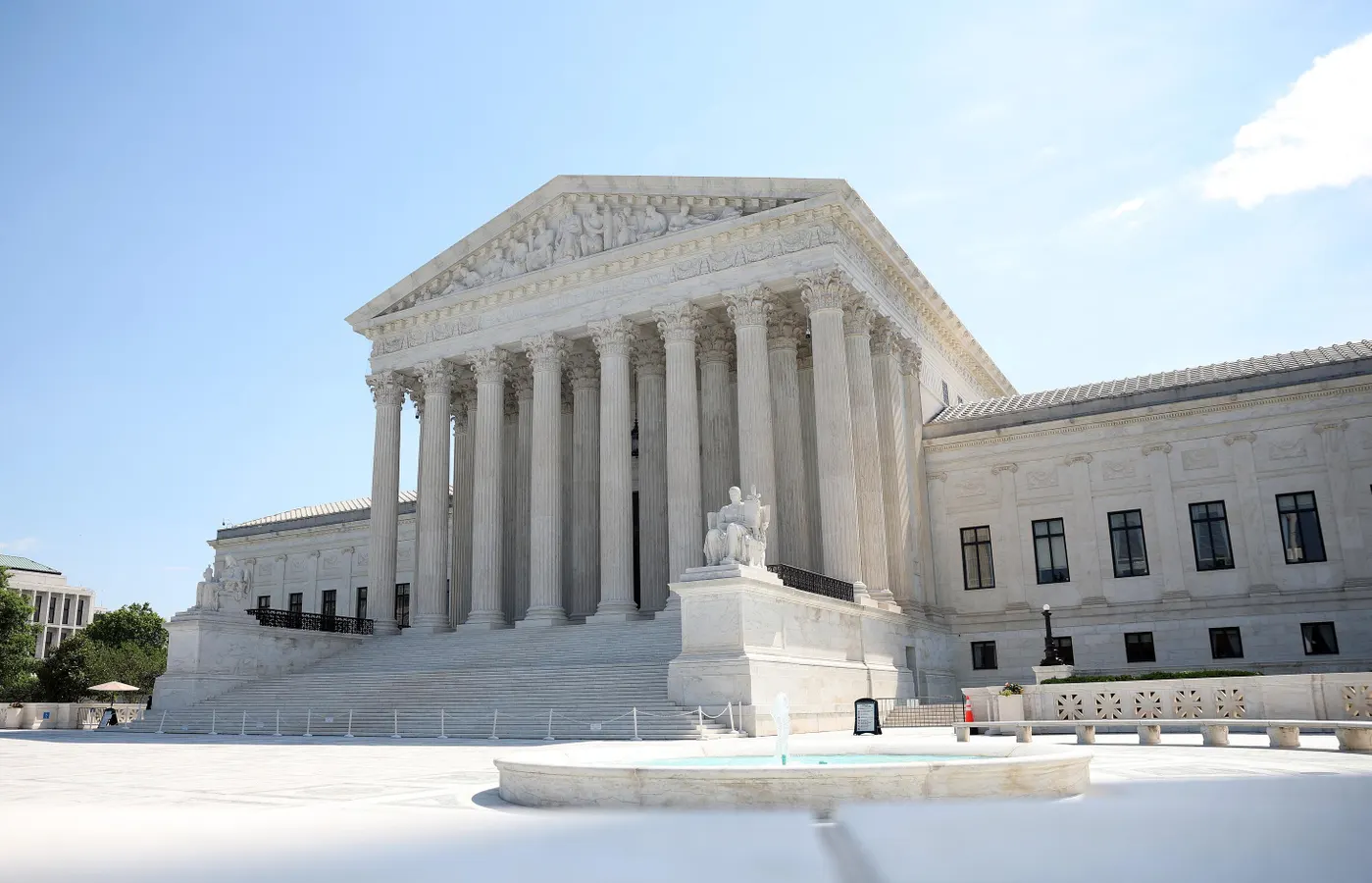

WASHINGTON, DC – JUNE 25: The U.S Supreme Court is seen on June 25, 2026 in Washington, DC. The Supreme Court ruled 6-3 in Mullin v. Doe, clearing the way for the Trump Administration to remove protection status and set up deportation for Haitian and Syrian immigrants. The high court also issues opinions in Wolford v. Lopez, Mullin v. Al Otro Lado, and Monsanto Company v. Durnell. (Photo by Kevin Dietsch/Getty Images)
Getty Images
On October 5th, the Supreme Court will review a case (Suncor v. Boulder) that could shape the future of climate litigation against energy companies. And arguably much more.
Which is the problem, one that brings with it a potentially very dangerous national precedent. Boulder, CO, Boulder County, and San Miguel County (all three from now on “Boulder” for the purposes of this piece) more broadly are attempting to use local law to pursue claims tied to fossil-fuel production and emissions occurring across the United States and around the world.
For background, in 2018 Boulder filed a lawsuit in Colorado’s state court system against oil company giants ExxonMobil and Suncor Energy. The lawsuit claimed that the oil companies knowingly contributed to global warming, and having done so, should help foot the bill for the local environmental implications of the warming, severe weather implied in it, and disaster recovery. Said another way, and according to Boulder, taxpayers shouldn’t shoulder a burden allegedly imposed on them by oil companies.
It calls for a pause. Specifically, this opinion piece will in no way comment or presume to comment on global warming theory.
Instead, it will be stated that whether it’s Boulder, or Boston, or Beijing, what happens in one or all three cities won’t alter what is a global challenge of global warming, or not. For evidence supporting the previous claim, we can merely pivot to the expressed goal of the Paris Agreement on climate: “limit the increase in the global average temperature to well below 2°C above pre-industrial levels, while pursuing efforts to limit the increase even further to 1.5°C.” Explicit in the Agreement, whether one agrees with it or not, is that the battle (or not) against global warming or climate change is a global one, not something local to Boulder, or Boston, or Beijing.
Which speaks to the peril of the Boulder lawsuit. It signals an attempt to legislate a global challenge from a city that can claim a population just a shade above 100,000. Keep in mind that the global population is 8.3 billion humans. Only for the story to get worse.
Consider the precedent of one U.S. locale litigating the alleged costs of warming. As University of Virginia law professor Saikrishna Prakash put it, “If Boulder can attach liability to these two companies…it can attach liability to thousands of others as well. So essentially, Boulder claims that Colorado can reach around…the entirety of the United States, and to my mind, regulate production everywhere by attaching liability to it. Further, Boulder claims that Colorado can regulate worldwide production by attaching liability to it.”
On its own, Boulder and Boulder County’s efforts to foist their local viewpoint on a matter that affects the world is troubling, but that’s only the beginning. Assuming Boulder prevails, there are roughly three dozen other local lawsuits resembling the Boulder lawsuit. To say these other locales would be emboldened by a Supreme Court ruling in Boulder’s favor is a statement of the obvious.
Which is why the stakes of Suncor v. Boulder are so substantive. Hopefully the justices on the Supreme Court’s bench feel the same way.
Suncor v. Boulder is about more than oil companies and their alleged impact on global warming. If local governments can substitute themselves for the rest of the U.S. and the world in addressing global problems, real and perceived, soon enough the very few will possess the ability to burden the world with their own values. The latter is tyranny, and it’s something the Supreme Court must stop.















Leave a comment