


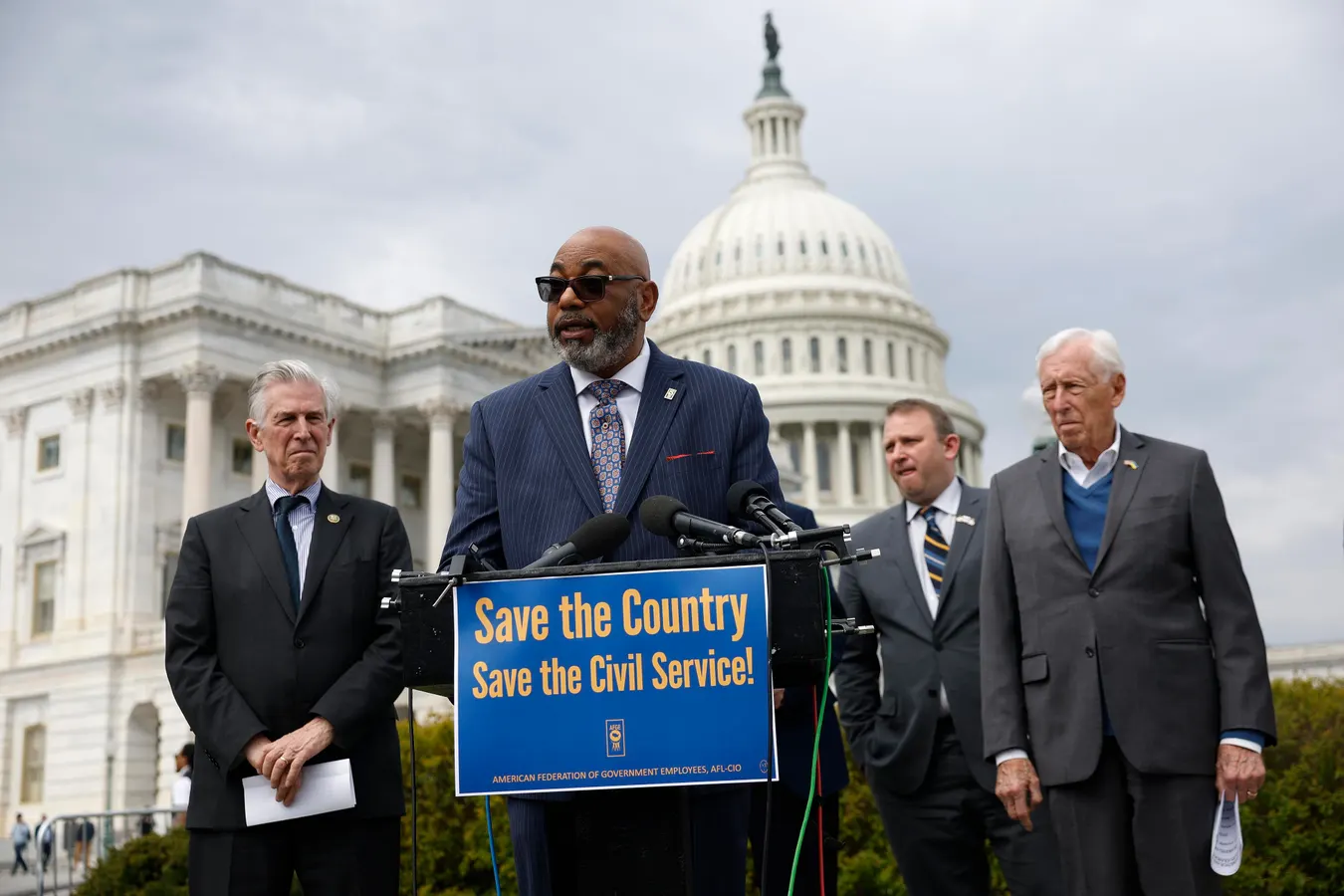

WASHINGTON, DC – MARCH 28: American Federation of Government Employees (AFGE) President Everett Kelley speaks alongside Rep. Don Beyer (D-VA), President of the National Federation of Federal Employees (NFFE) Randy Erwin and Rep. Steny Hoyer (D-MD) at a press conference on federal workforce rights outside the U.S. Capitol on March 28, 2025 in Washington, DC. Lawmakers and union leaders spoke out against President Donald Trump’s executive order ending collective bargaining with federal labor unions. (Photo by Kevin Dietsch/Getty Images)
Getty Images
A federal judge has ordered the Federal Bureau of Prisons (BOP) to reinstate its collective bargaining agreement with the union representing tens of thousands of agency employees, reversing, at least temporarily, one of the most consequential management decisions made by BOP Director William K. Marshall III.
On September 29, 2026, U.S. District Judge Vernon D. Oliver of the District of Connecticut granted a preliminary injunction sought by the National Council of Prison Locals, American Federation of Government Employees, known as CPL-33, and AFGE Local 1661, which represents employees at FCI Danbury.
The order requires the BOP to reinstate not only the collective bargaining agreement, but also amendments, local supplemental agreements and memoranda of understanding that existed under it. The agreement is to remain in place for the remainder of its existing term, which runs through May 28, 2029.
The decision represents a significant development in the ongoing struggle over organized labor inside the BOP, an agency already confronting persistent challenges involving staffing, employee morale, prison safety and aging infrastructure.
How BOP Collective Bargaining Was Eliminated
President Donald Trump signed Executive Order 14,251 on March 27, 2025. The order excluded numerous federal agencies and subdivisions from federal collective bargaining requirements based on a determination that they perform intelligence, counterintelligence, investigative or national-security work. The Department of Justice, including the BOP, was among those covered by the order.
However, the executive order did not require the BOP to terminate its existing collective bargaining agreement. After Trump issued the order, the BOP continued operating under its agreement with CPL-33 for months. The agency continued approving official time for union officials, recognizing employee representation rights, responding to grievances and negotiating with the union.
Then, on September 25, 2025, Marshall terminated the agreement effective immediately.
Union dues would no longer be deducted from employee paychecks, union officials could no longer receive official time, negotiated agreements and memoranda of understanding were terminated, and employees lost certain contractual rights to union representation.
Marshall also issued a public message explaining his decision. “For too long, the Federal Bureau of Prisons has been ranked among the worst places to work in the federal government,” Marshall wrote.
He acknowledged that CPL-33 had a long history of representing BOP employees but said the contract had “too often slowed or prevented changes” that could improve working conditions. Marshall said he supported unions generally but believed a union should be a partner rather than an impediment to management.
The BOP has subsequently pointed to the termination of the agreement as helping accelerate changes inside the agency. In March 2026, for example, the BOP announced that it had completed 37 updated policies in approximately 90 days and specifically linked that effort to Marshall’s decision to terminate the master agreement.
Judge Critical of Marshall’s Explanation
Ironically, Marshall’s unusually candid public explanation for eliminating the union agreement became important evidence in the litigation challenging his decision.
The formal termination letter relied on Trump’s executive order. Marshall’s public message, however, presented a different rationale. It focused heavily on his dissatisfaction with the union and his belief that the collective bargaining agreement interfered with the changes he wanted to make at the BOP.
The court concluded that the BOP had discretion over whether and when to terminate the agreement. Government counsel acknowledged during oral argument that the executive order did not specifically direct BOP leadership to terminate the CBA on a particular date. Office of Personnel Management guidance similarly said agencies “may choose” to terminate collective bargaining agreements.
That meant the BOP’s decision was an agency action subject to review under the Administrative Procedure Act. The court then examined the two explanations given by the BOP on September 25, 2025.
The termination letter cited Trump’s executive order. Marshall’s public statement said the purpose of ending the contract was that the union had become an obstacle to progress and the agreement had slowed or prevented changes.
Judge Oliver concluded that the explanations were sufficiently inconsistent that CPL-33 was likely to succeed in arguing that the BOP’s action was arbitrary and capricious under the APA. The court wrote that it could not “ignore the disconnect between the decision made and the explanation given.”
Trump Executive Order Still In Place
Judge Oliver did not invalidate Trump’s executive order.
“This case does not concern the validity of EO 14,251,” the court specifically stated, noting that litigation over the executive order continues elsewhere.
The ruling instead addresses how the BOP used the authority provided by that executive order when it terminated an existing agreement that otherwise extended until 2029.
The September 29 decision grants a preliminary injunction rather than a final judgment on the merits. The court concluded that the union demonstrated a likelihood of success on its claim, irreparable harm without an injunction, and that the balance of equities and public interest supported preliminary relief.
The government can continue litigating the case and may seek appellate review.
For now, however, the BOP has been ordered to restore the agreement.
Changes For BOP Employees
CPL-33 represents a bargaining unit of approximately 30,000 BOP employees, including correctional officers, case managers, psychologists and other staff working throughout the federal prison system.
The agreement governs work assignments, schedules, overtime procedures, workplace safety, grievance procedures and employee representation during certain disciplinary investigations. It also provides mechanisms for union officials and BOP management to meet over national and local workplace issues.
The court cited evidence submitted by the union concerning what happened after the agreement disappeared.
According to the Union’s evidence described in the order, employees faced changes to schedules, procedures and performance evaluations without union input, while the contractual grievance procedure was replaced by an internal process. The plaintiffs also alleged difficulties obtaining union representation in disciplinary matters and restrictions on union advocacy.
The BOP disputed the broader legal significance of those developments, but Judge Oliver concluded that the loss of collective bargaining rights and declining union membership constituted irreparable harm sufficient to support an injunction.
Complicated Moment For The Bureau Of Prisons
Marshall has emphasized moving the agency faster, updating policies that in some instances had remained unchanged for decades and removing administrative barriers that he believes prevented reform. The BOP has publicly argued that eliminating the collective bargaining agreement contributed to its ability to modernize policy more rapidly.
Union representatives have presented a different view, arguing that collective bargaining provides important protections for employees working in inherently dangerous environments and gives front-line staff a formal voice in decisions affecting safety, staffing and working conditions.
Those competing views will now have to coexist again, at least for the moment.
The court’s ruling does not say that BOP management cannot change policies, nor does it determine whether Trump’s broader executive order eliminating collective bargaining requirements at certain federal agencies is lawful.
Instead, it addresses something more fundamental about government decision-making, which is when a federal agency takes consequential action, the reason it provides for doing so is significant.
Marshall wanted the BOP to move faster. His September 2025 message made that clear. Now, one year later, a federal judge has ordered the agency to bring the union back to the table.













Leave a comment