


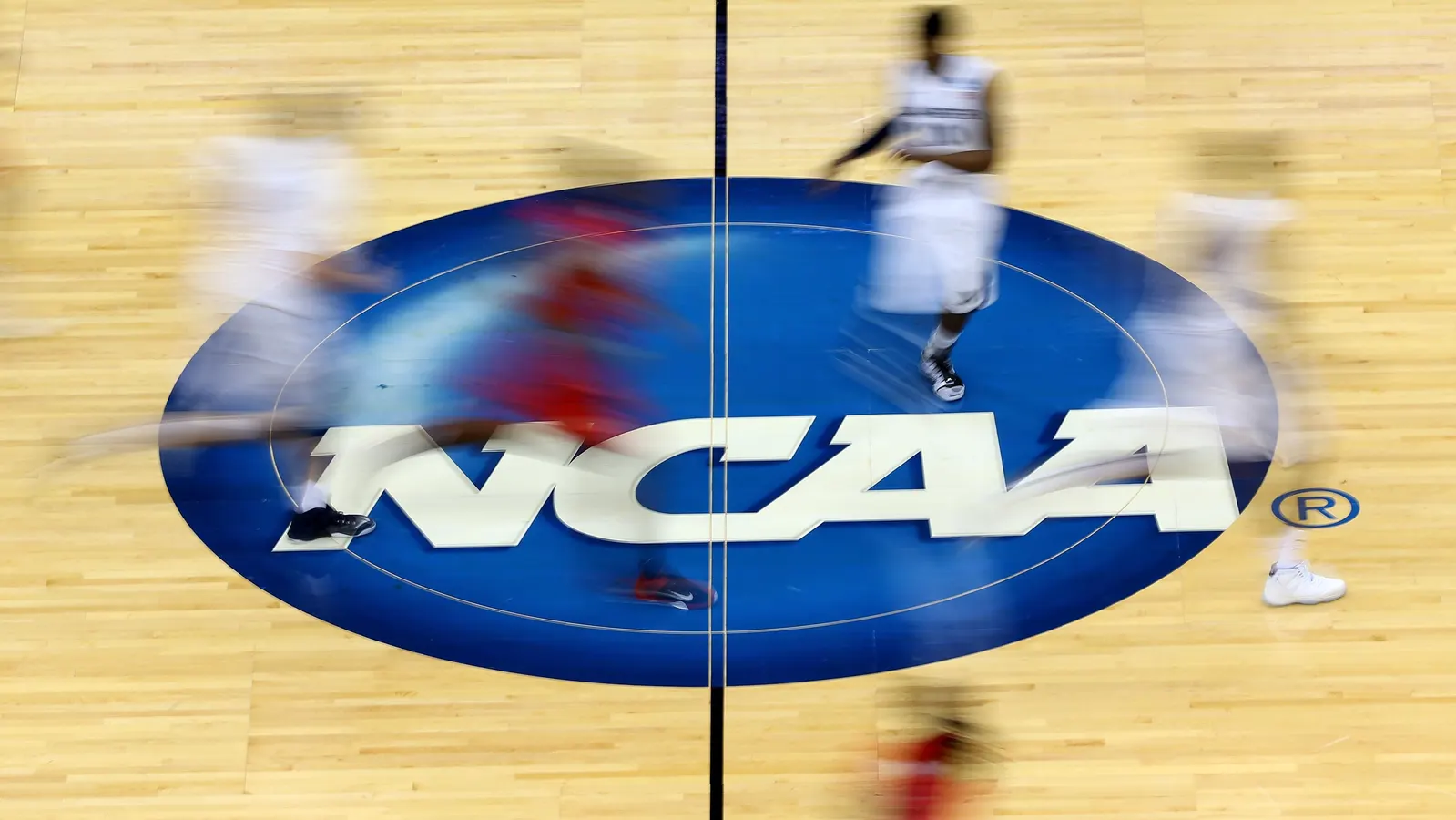

With new proposed legislation, Congress wades into an age-old debate: Are college athletes on-campus pros or ordinary joes?
Getty Images
For decades, the NCAA governed college sports through a relatively simple premise: college athletes were students, not professionals; schools could restrict how they were compensated (largely limiting that compensation to athletic scholarships); and the NCAA could impose nationwide rules governing everything from recruiting and transfers to eligibility.
In recent years, that model has been steadily dismantled.
Court decisions, state legislation and billions of dollars flowing through major college football and basketball have transformed college athletics into something increasingly resembling professional sports. Athletes can now earn millions through name, image, and likeness (NIL) agreements. Schools can directly share revenue with players. The transfer portal has created something approaching free agency. And courts have repeatedly questioned whether restrictions imposed collectively by the NCAA and its member schools violate federal antitrust law.
Congress is now considering an extraordinarily consequential attempt to impose order on that systemic disorder.
The Protect College Sports Act of 2026, or S. 4668, passed the Senate on September 28, 2026 by a bipartisan 77-22 vote. Sponsored by Senators Ted Cruz, Republican of Texas, and Maria Cantwell, Democrat of Washington, the legislation would establish the first comprehensive federal regulatory framework governing college athletics. It now faces an uncertain path to passage through the House of Representatives, a step required for the proposed Act to become law.
The comprehensive nature of its significance is difficult to overstate.
The legislation would protect athletes’ right to earn NIL compensation, preserve the revenue-sharing system established following the landmark House v. NCAA settlement, regulate agents, establish national eligibility and transfer rules, guarantee scholarships and post-eligibility healthcare, protect women’s and Olympic sports, and preempt conflicting state laws.
But its most important consequence may be something less conspicuous: Congress would give the NCAA and its members significant protection from the antitrust lawsuits that have progressively dismantled the NCAA’s regulatory authority.
The Protect College Sports Act therefore represents an unusual bargain. Athletes would receive federally guaranteed economic rights that would have been unthinkable a decade ago. In exchange, the NCAA would regain something it has increasingly lost in the courts: the ability to make and enforce uniform rules.
Why Congress Is Getting Involved
The immediate catalyst is the legal chaos that followed the Supreme Court’s 2021 decision in NCAA v. Alston. Alston was fundamentally an antitrust case about whether the NCAA could collectively restrict the compensation and benefits that member universities provide to college athletes. The Supreme Court unanimously held that certain NCAA restrictions on education-related benefits violated § 1 of the Sherman Antitrust Act of 1890. Although Alston technically addressed restrictions on education-related benefits, its implications were much broader. In his concurrence, Justice Brett Kavanaugh notably questioned whether the NCAA’s compensation system could survive ordinary antitrust scrutiny.
The ensuing five years have validated that concern.
Athletes challenged restrictions on compensation, eligibility and transfers. States enacted competing (and contrasting) NIL laws. Collectives affiliated with major college athletic programs began arranging lucrative NIL agreements. The transfer portal transformed recruiting, resulting in an oftentimes chaotic flow of college football and basketball players from one year to the next.
Most importantly, four years after Alston, the 2025 House v. NCAA settlement permitted Division I schools to share substantial amounts of athletic revenue directly with athletes.
NCAA = The New NFL?
The NFL has a players’ union and collective bargaining. The NCAA historically has had neither.
Getty Images
The NCAA has now found itself attempting to operate what essentially amounts to a national sports league under rules that could be challenged under federal antitrust law or contradicted by legislation enacted in individual states.
The NCAA has never before had the need to rely upon the nonstatutory labor exemption from federal antitrust law traditionally relied upon by the major sports leagues in the United States (NFL, NBA, Major League Baseball, etc).
Ordinarily, if 32 competing employers (like the owners in the NFL) collectively agreed that they would cap what they pay employees, restrict employees’ ability to move between employers and allocate new employees through a draft, that arrangement would raise obvious concerns under the Sherman Act, which was expressly enacted to protect trade and commerce against unlawful restraints and monopolies.
Professional sports leagues can do those things because the restrictions are generally established through collective bargaining between the league/teams and the players’ unions.
The Supreme Court recognized the breadth of this protection in Brown v. Pro Football, Inc.(1996). The Court explained that federal labor law creates an implicit—or “nonstatutory“—antitrust exemption where necessary to permit collective bargaining to function.
This is precisely what makes the proposed Protect College Sports Act so interesting.
The NFL has a players’ union and collective bargaining. The NCAA historically has had neither.
So when NCAA member universities collectively agree to restrict how much athletes can receive—or restrict where athletes can transfer—they potentially look like competing purchasers of athletic labor agreeing among themselves to constrain the price and mobility of that labor.
That is the fundamental antitrust problem that has haunted the NCAA.
In Alston, Justice Kavanaugh essentially identified this problem: antitrust law generally does not permit businesses to avoid paying workers a market rate simply because they believe their product depends upon paying those workers less. Kavanaugh’s proposed alternatives were telling: the NCAA could potentially obtain relief from Congress, or colleges and athletes could resolve compensation rules through collective bargaining.
The Protect College Sports Act effectively pursues the first route rather than the second.
Congress would give the NCAA, conferences and schools targeted statutory antitrust protection for specified rules governing compensation, transfers, recruiting, and eligibility without first requiring college athletes to unionize and collectively bargain those restrictions. The Protect College Sports Act is Congress’s proposed answer to the problem highlighted by Justice Kavanaugh.
It would create a nationwide NIL regime and expressly protect athletes’ ability to receive compensation for use of their name, image, and likeness. NIL agreements above $600 would generally be subject to disclosure requirements, while agent fees would be capped at 5%. The legislation also seeks to distinguish legitimate commercial NIL transactions from payments masquerading as endorsements but actually functioning as recruiting inducements.
Athlete protections extend considerably further.
Schools generally could not revoke scholarships because of injury, athletic performance, or roster decisions. Division I athletes would receive coverage for certain sports-related medical expenses for five years following their eligibility, while former athletes would receive as much as ten years of assistance to return to school and complete their degrees.
The bill also attempts to preserve women’s and Olympic sports at a moment when the new economics of college athletics threatens the “non-revenue generating sports”: programs that generate little or no revenue for their universities. More than 100 women’s and Olympic programs have reportedly been eliminated since 2023. That particular issue is greater than a college sports issue, given the fact that 184 of America’s 257 medalists at the 2024 Summer Olympic in Paris had competed in college athletics.
A Lifeline for the NCAA
The legislation could therefore transform the NCAA from a private regulator constrained by antitrust law into something closer to a federally sanctioned regulator operating within boundaries established by Congress.
Getty Images
For the NCAA, however, the legislation may provide something even more valuable than regulatory uniformity: legal protection and insulation.
The bill provides limited antitrust protection to the NCAA, conferences, and institutions for enforcing specified rules concerning matters including compensation, NIL, eligibility, transfers, and recruiting. It would also preempt conflicting state and local laws in important areas.
That would fundamentally change the NCAA’s position.
For years, athletes have successfully used antitrust litigation as an instrument of reform. Rules restricting compensation or mobility could be challenged as agreements among competitors—the universities—to suppress the economic rights of athletes supplying the labor that produces their product.
Under the Protect College Sports Act, Congress would effectively declare that certain forms of coordination are lawful.
That could mark the beginning of a striking institutional rehabilitation.
The NCAA would not return to its pre-NIL dominance. Congress would itself prescribe many of the rules, and athletes would retain economic rights the NCAA once prohibited entirely. But the association could again become an effective national regulator rather than an organization perpetually defending its regulations courthouse by courthouse.
The legislation could therefore transform the NCAA from a private regulator constrained by antitrust law into something closer to a federally sanctioned regulator operating within boundaries established by Congress.
That distinction also creates one of the bill’s most interesting constitutional questions, which my forthcoming piece will explore.











Leave a comment