


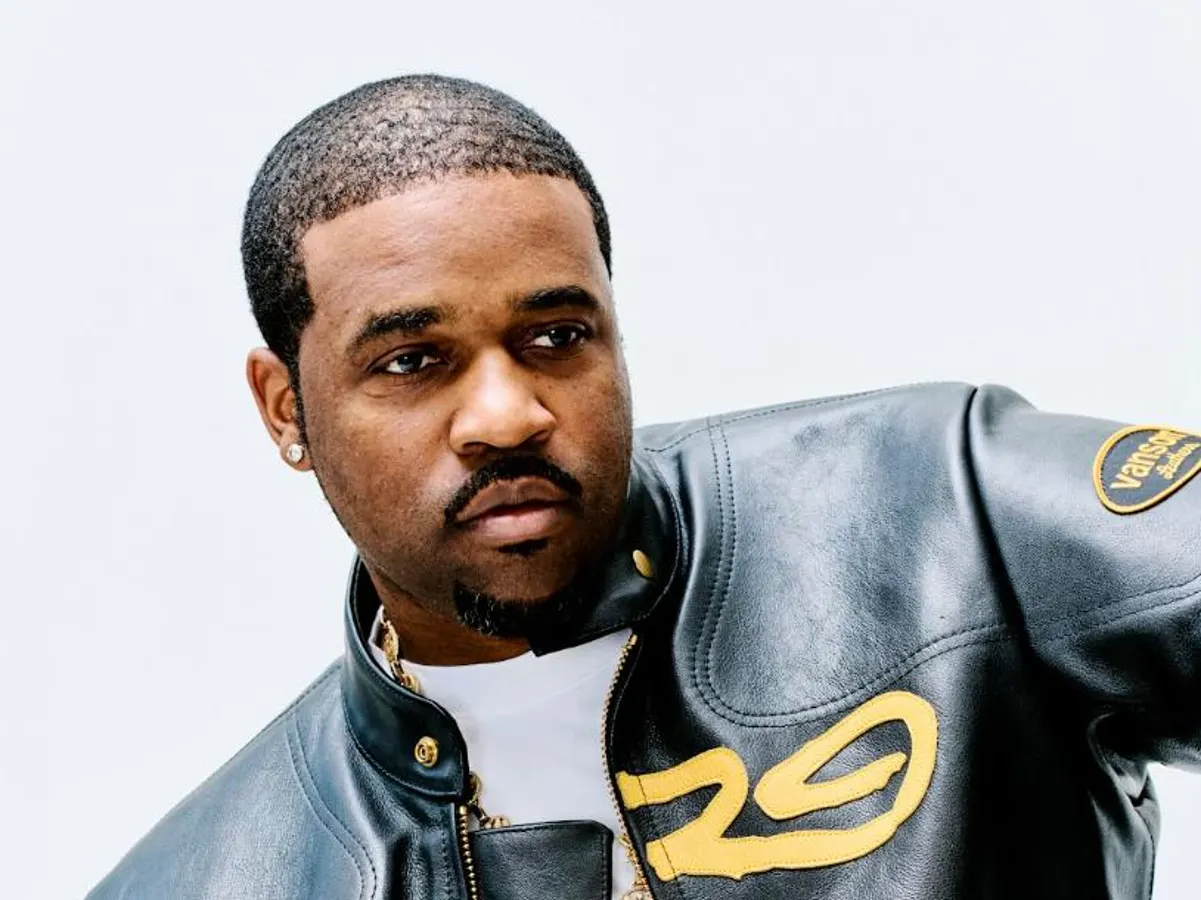

Ferg looks to the side wearing a black leather jacket.
(Photo Credit: Will Cherry)
In Harlem, style is a language of its own, and Ferg has never been one to speak in just one voice. From the clothes he pulls together to the sounds he brings into the studio, the rapper draws inspiration from the world around him, moving between music, fashion and whatever else catches his eye. Lately, that curiosity has taken him beyond the studio and into fitness, mental health and the ways movement can bring people together.
That shift found its way into ‘Cycle,’ his latest single, inspired by the cycling classes he began attending. With music pumping and the room moving in sync, the studio felt less like a place to work out than a party on two wheels. For Ferg, the appeal went beyond the ride. And he saw a chance to bring that same energy into hip-hop, where the right beat can turn a room full of strangers into a community.
Ferg wears a white and off-white outfit while looking into the camera.
(Photo credit: Will Cherry)
How Ferg Is Taking Hip-Hop For A Spin
The idea for ‘Cycle’ emerged from Ferg’s experience at cycling classes, where the energy reminded him of a party. Around the same time, his friend and producer NEZ sent over some beats, prompting Ferg to land on a phrase: “Come meet me at cycle.”
Ferg recorded the song that day and sent it to two cycling coaches. By the following day, it was playing in class. His friends are often the first audience for his music. “It’s a hit to me first,” he explains, “then it goes to the friend group, and then it goes to the world.”
That willingness to try something new is part of what collaborator and Capitol Records SVP of A&R Tariq Stewart sees as central to Ferg’s artistry. “Ferg has always been an innovator. He’s never scared to try new sounds & experiment in a unique way were it never feels forced. His music always brings the community’s together,” Stewart shared via Instagram DM.
Ferg approaches music as a form of self-expression. While he values collaboration and recognizes the contributions of other writers, he sees his own music as a direct extension of himself. “My music is my therapy,” he reveals. “It’s just the way I talk.”
That same range carries over to what he plays on repeat. His “Brown Lounge” playlist features artists including Sade, Aaliyah, Groove Theory and Soul II Soul, alongside jazz musicians Miles Davis and Herbie Hancock. His wider rotation ranges from eclectic sounds by artists like Willow Smith to early-2000s hip-hop, including Ma$e and other Bad Boy records.
Ferg Wants To Put The Life Back In Lifestyle
Ferg’s understanding of health is rooted in the memories of loved ones whose lives have shaped his own. His father died in 2005, a loss that remains part of how he thinks about health and well-being. “My father passed away from kidney failure,” he says. “He was on dialysis. He died under the treatment.”
Moreover, he remembers his father getting upset with him for putting too much salt on a sandwich. Ferg recalls, “I was like, damn. He really, really mad at me.” At the time, he didn’t fully understand his father’s reaction. Looking back, he sees it as an early lesson in the importance of diet.
He also recalls friends dying for reasons he associates with harmful lifestyles, experiences that have shaped his perspective on wellness. Studies suggests that stress can also influence everyday health habits. A 2026 review of research on Black adults found that stress was associated with unhealthy eating habits and lower levels of physical activity, underscoring the connection between mental well-being and physical health.
Ferg poses with his hands over his head in a black-and-white portrait, looking to the side.
(Photo credit: Will Cherry)
The artist continues to run, skate, dance and spend time outdoors, finding ways to stay connected to his inner child rather than letting adulthood take over. He also wants to bring more movement back to hip-hop parties and clubs, where he believes dancing has become less central. “I really feel like I’m here to save hip hop for real,” he says, clarifying that he means the culture, not just the music.
For Ferg, that means loosening up and letting people be more than the image they project. “We don’t gotta be thugging all the time,” he says. “We can have fun. Like, thugs have fun too…thugs dance.” It’s a reminder that toughness and tenderness, swagger and silliness, can share the same dance floor. His work with Project Healthy Minds around World Mental Health Day reflects that philosophy, making room for the lighter side of life alongside the practices that help him stay grounded.
Ferg’s First Order Of Business, A Clear Mind
Ferg has incorporated meditation into his life at different points, including a five-year stretch when he practiced consistently. After stepping away, he explored other practices, including chanting Namu Myōhō Renge Kyō, a Buddhist practice.
Eventually, he found his way back to meditation. In the morning, he avoids checking his phone, using it only to set a timer for 15 to 20 minutes. “That really helps me get through the day,” he says. “When I don’t do that, I’m not really balanced.”
That same emphasis on balance carries into how he approaches food. Rather than restricting what he eats, Ferg believes people should enjoy their food while staying mindful of their overall habits. With Thanksgiving approaching, he encourages people to enjoy the holiday meal without feeling they have to deprive themselves. They can always adjust their routines or work harder afterward, he says.
As for his own routine, Ferg follows a plant-based diet and keeps his usual bodega order simple: water, gum, Tic Tacs and a banana. New York City staples like chopped cheese and honey turkey sandwiches, he says, aren’t part of his routine.
Dressing Darold: The Many Sides Of Ferg
Ferg’s style has shifted through different eras and influences, but he doesn’t see it as reinventing himself. “I’m always just me, Darold,” he says.
His Flip Phone Shorty era pulled from a mix of Southern hip-hop, BMF and early-2000s Harlem: oversized 6X T-shirts, Versace-inspired shades picked up on Canal Street, and a little bit of everything that made that era feel larger than life. These days, he’s looking to the 1980s for inspiration.
Ferg walks toward the camera in a white jacket, white shirt and dark pants.
(Photo Credit: Will Cherry)
That instinct comes through when he goes thrifting with friends. He likes digging through pieces people have inherited from their parents but no longer want, seeing potential where someone else might see old clothes. The right find might be a vintage gem—or something worth trading for a Mark Buchanan Pelle Pelle jacket.
That same instinct to explore carries into other parts of Ferg’s life. He makes a point of leaving room for curiosity, whether that means experimenting with color, doing backflips on the beach or throwing himself into something new. “I allow myself to play,” he says. He believes that sense of freedom also means resisting the pull of nostalgia. “We’ll get stuck in the old times because it’s like, ‘Oh, those was classic times,’ because everything was new,” he says. “But you gotta keep making new things.”
For Ferg, Harlem Has Always Been The Map
For all the new things Ferg explores, Harlem remains his home base. But he takes issue with the idea that he’s trying to put the neighborhood back on the map. “Harlem is always on the map,” he says. “I can’t put Harlem back on the map ’cause it is the map. I’m just showing people what we’re doing.”
If he were giving someone a tour of Harlem through his eyes, he wouldn’t necessarily start with the landmarks. He’d take them to his grandfather’s house, pull out photographs and let his grandfather cook some West Indian food. They might end up on the couch watching YouTube videos of Chinese women farming, one of his grandfather’s favorite pastimes.
Maybe that’s the Harlem Ferg wants people to see: not a neighborhood frozen in its greatest hits, but one that keeps making noise, making moves and finding new ways to surprise you. It’s in his grandfather’s living room, in the vintage Pelle Pelle jackets passed from one generation to the next, and in a cycling studio where a rapper can turn a workout into a party. In Ferg’s world, the old and the new don’t compete for the aux cord. They trade verses. And somewhere in that mix, there’s always another beat to catch.












Leave a comment