


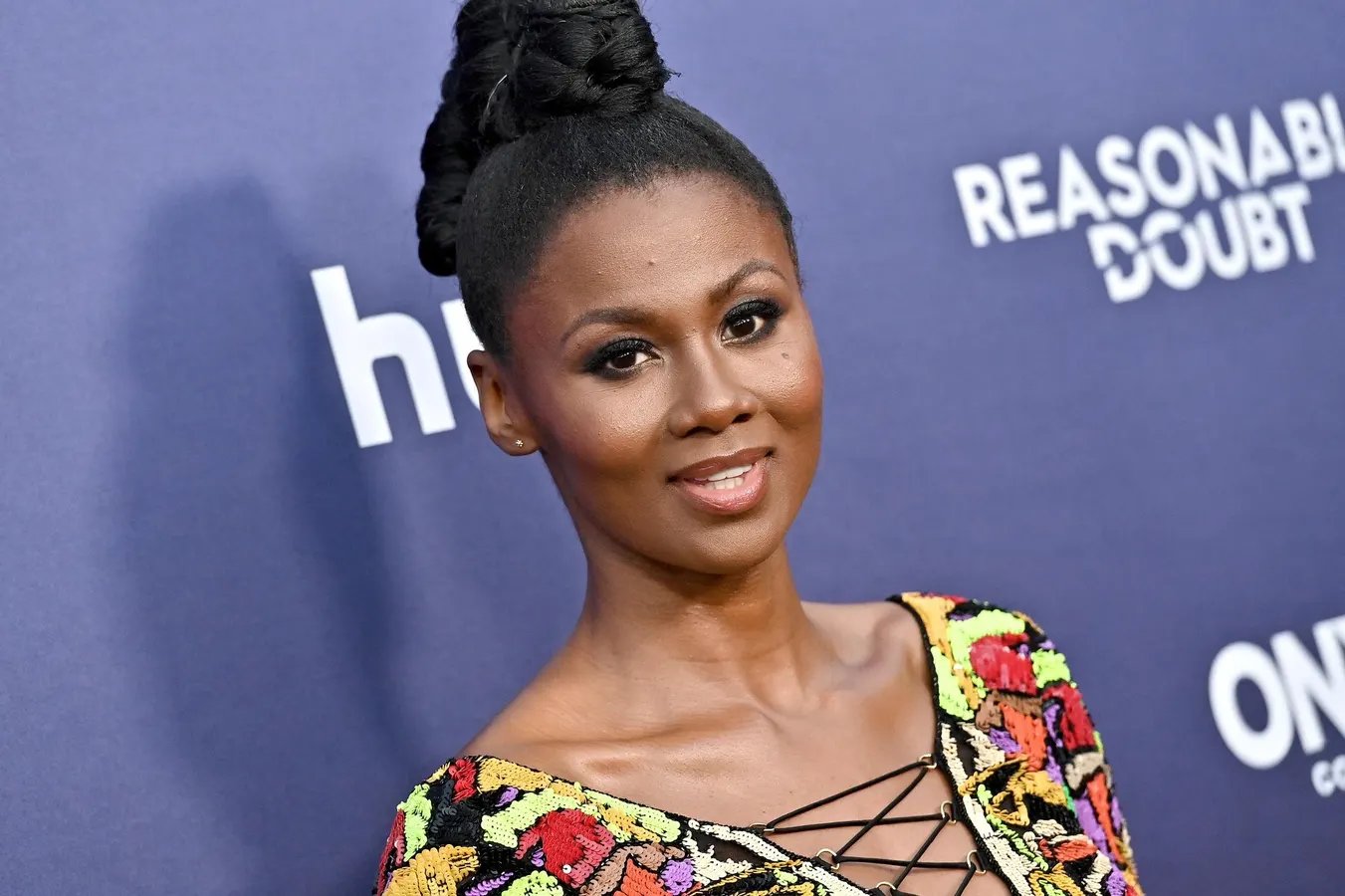

HOLLYWOOD, CALIFORNIA – SEPTEMBER 22: Emayatzy Corinealdi attends the Premiere of Hulu’s “Reasonable Doubt” at NeueHouse Hollywood on September 22, 2022 in Hollywood, California. (Photo by Axelle/Bauer-Griffin/FilmMagic)
FilmMagic
By now, fans of Hulu’s Reasonable Doubt know that the legal drama rarely lets its characters escape completely unscathed. Following an explosive Season 3 finale, the series returns for Season 4 with new faces, complicated client relationships, and a central question: What happens when the people who pride themselves on having everything under control are forced to confront their own vulnerabilities and powerlessness?
The new season introduces Durrell “Tank” Babbs, La La Anthony, Taylor Polidore Williams, DeVaughn Nixon, Rutina Wesley, Alexxis Lemire, and Meagan Good, expanding the world surrounding Los Angeles defense attorney Jacqueline “Jax” Stewart, played by Emayatzy Corinealdi.
The first three episodes waste little time addressing the fallout from last season’s cliffhanger. After being shot by Monica (Brande Evans), Jax survives but falls into a medically induced coma. Meanwhile, The Stewart Firm faces mounting financial and operational pressures, creating an opportunity for defense attorney Corey Cash (Morris Chestnut) to step in and help stabilize the business in an effort to provide relief.
As Jax begins her recovery, the firm takes on a high-profile case involving music industry figure Eric Cropper, played by Tank. Eric’s legal troubles and contentious relationship with his wife, Brooke (Taylor Polidore Williams), add new complications for the firm. For Jax, the challenge is not simply navigating another courtroom battle. She must also contend with the physical and psychological consequences of her own trauma and result of previous shooting.
Under the leadership of creator and showrunner Raamla Mohamed, Reasonable Doubt continues to explore the contradictions that make its characters compelling: ambition and vulnerability, power and accountability, and the difference between controlling a situation and confronting the truth.
Ahead of Season 4, I spoke with Corinealdi, Chestnut, Tank and Williams about Jax’s recovery, the new legal battle, the season’s recurring theme of reckoning and what it means to work on a series centered on complicated Black characters.
For Jax, surviving the shooting is only the beginning this season. Her instinct has always been to push through adversity, compartmentalize her emotions, and keep moving. This season challenges whether that approach can continue to serve her.
“She definitely leans on what she knows best: ‘Everything is fine. I’m going to power through this. I’m going just to get it done,’” Corinealdi says. “That’s how she handles things. It’s almost as if it just isn’t there. But we get to see, does that really work?”
She suggests the answer may be more complicated than Jax expects. Although the attorney has weathered difficult personal and professional circumstances before, her latest experience forces her to confront deeper issues. Rather than simply returning to business as usual, Jax must process with what happened to her.
“She has to truly, truly face herself,” Corinealdi says. Jax may not have chosen that process for herself. Her determination to maintain control has long been central to her identity, making vulnerability particularly difficult. But the circumstances surrounding her recovery leave her with little choice.
“She’s being forced to do that kind of work,” Corinealdi says, referring to Jax’s self-reflection. “I don’t think it’s something she would choose, even on her best day, when she wants to do all the self-care and self-reflection. I don’t think she would choose it.”
The stakes extend beyond her personal healing. With the firm under pressure and new professional challenges emerging, Jax must determine how to show up for her clients and colleagues while navigating her own recovery.
“She has to rise to the challenge; otherwise, she may lose everything,” Corinealdi says. For the actress, that tension reflects the strength of Mohamed-Hunter’s storytelling. Corinealdi says the showrunner has been developing the story for years, allowing the characters’ individual journeys to intersect in increasingly consequential ways.
“When I see scripts come in, my heart is just breaking over it,” she says. “She’s able to craft the story on this journey so easily. Even though she knows where it’s going, it still feels like it’s happening for the first time. And I think that’s what makes great storytelling.”
Jax’s professional instincts remain intact, even as her personal life gets harder to navigate. Her new client, Eric, presents a particularly complicated challenge.
“He’s similar to Jax in a lot of ways,” Corinealdi says. “They’re used to getting their way. They’re used to getting things done. They make it happen.”
But Eric’s influence and power have also created their own problems. As his legal situation intensifies, he must confront the consequences of how he has wielded that power.
“He is definitely one of those who’s used his power, his influence, to do things, and now he’s having his own reckoning,” Corinealdi says.
For Jax, the case offers the familiar challenge of a courtroom fight at a time when nearly every other aspect of her life demands attention. It’s the kind of high-stakes situation that appeals to her instincts as a defense attorney, even as the personal cost becomes harder to ignore.
Brooke Cropper enters the story amid a contentious divorce from Eric, her husband of 15 years. Williams plays Brooke, who is determined to secure what she believes she deserves, even if her methods raise questions.
REASONABLE DOUBT – “First Look” (Disney/Wilford Harewood) MORRIS CHESTNUT, DURRELL “TANK” BABBS
Disney
“I love playing complicated women, and I love playing women who are trying to win something,” Williams says. “Brooke is very much in pursuit of getting what is hers. She’s in a messy divorce with Tank, and I think that she deserves vindication.”
The question is how far Brooke will go to get it. “She’s ruthless,” Williams says. “But so is he. It’s kind of like twin flames. It’s fun to watch, but very fun to play.”
That dynamic places Brooke and Eric in a relationship where neither character can be easily categorized as the sole source of the conflict. Their history, competing interests, and determination to prevail make their separation another arena in which power becomes a defining issue.
REASONABLE DOUBT – “First Look” (Disney/Wilford Harewood) TAYLOR POLIDORE WILLIAMS
Disney
For Williams, the appeal lies in playing a woman whose motivations extend beyond the immediate circumstances of her divorce. Brooke wants respect, and years of knowing exactly who her husband is inform her pursuit of it.
“Respect,” Williams says when asked what drives her character. “Everybody has their different justifications for why they want their vindication. But specifically for Brooke, she’s been married to Eric for 15 years, and she knows exactly the type of man that she married, which we’ll find out in further episodes.”
The role also marks Williams’ arrival in an established ensemble. The actress says she was already a fan of the series before joining the cast, so working alongside Corinealdi and the returning performers is especially meaningful.
“Everyone has been so gracious, and Emayatzy has been so warm, so nice,” Williams says, referring to Corinealdi. “Watching her perform is a master class. I am a fan of hers and her work and her body of work, even outside this show.”
Williams also credits the environment Mohamed and the production team created for making the transition seamless. “Working with Raamla, oh my goodness, she’s a force,” Williams says. “I think one of the reasons why this show is so amazing is because a brilliant, intelligent Black woman is at the head of it, and the excellence seeps out into every other department.”
She says that leadership is reflected in the series’ attention to its characters and its portrayal of women navigating complicated personal and professional lives.
Williams also appreciates the show’s distinctly Los Angeles setting and its women-centered storytelling, which she says makes the characters’ experiences feel recognizable.
For an actress drawn to layered roles, Brooke offers an opportunity to explore the complicated space between justified anger and destructive behavior. Her desire for vindication may be understandable, but how she pursues it could ultimately reveal as much about her as it does about Eric.
As The Stewart Firm faces mounting pressure, Corey Cash returns with his own approach to problem-solving. Chestnut plays Corey, who is confident, capable, calm, and collected, and sometimes takes up more space than the situation requires. But his decision to support Jax reveals the respect underpinning their professional relationship.
“I’m just really excited. I’m always excited to be back on the show,” Chestnut says. “Last season was incredible, and this season is getting better and better.”
Corey’s willingness to help stems from his respect for Jax as both an attorney and a person.
“He’s very concerned because he has crazy respect for Jax,” Chestnut says. “He appreciates her as a woman, a lawyer, a mother, and a wife. When he got the call to come help her firm, he jumped at the chance because of the respect that he has for Jax.”
That loyalty does not mean the two attorneys will always agree. Corey has a strong personality and his own ideas about how to resolve the firm’s challenges. His presence introduces another layer of negotiation as Jax works to reestablish control.
“Corey does try to take away just a little bit, but he and Jax come to a situation where they have differences of opinion,” Chestnut says. “It’s her firm, so he has to back off in certain instances, because it’s her firm.”
The dynamic creates an interesting balance between Corey’s desire to solve problems and his need to respect Jax’s authority. To help the firm succeed, he has to understand that supporting a strong leader doesn’t mean becoming the center of the story.
Chestnut says he also draws inspiration from the broader production environment, particularly the number of Black women occupying leadership positions behind the scenes and in front of the camera.
“The entire cast inspires me,” he says. “We have a lot of Black females in positions that you normally don’t see, and so that inspires me.”
That environment extends to the women joining the ensemble this season, including Williams and Good. Their presence adds further dimension to a series already invested in women whose professional confidence often exists alongside deeply personal conflicts.
For Chestnut, returning to Reasonable Doubt is not simply about revisiting a character. It is also the chance to contribute to a production in which the ensemble and the people shaping the story are integral to its creative identity.
Known for his music career, Tank plays Eric Cropper, a powerful entertainment industry figure whose professional success doesn’t necessarily translate into control over his personal life.
Eric’s legal troubles put him directly in Jax’s path, but they also establish him as a character with his own complicated relationship to power. Difficult circumstances have shaped his instincts, and he is accustomed to finding a way through adversity.
“Eric works well under harsh conditions,” Tank says. “He was born and bred in harsh conditions. But this particular darkness is going to test him.”
That darkness becomes a defining feature of Eric’s storyline as his legal challenges collide with his divorce from Brooke. He must navigate a situation where his usual strategies may no longer be enough to protect his reputation, interests, or sense of control.
Joining a successful series in its fourth season also carries its own pressure. By this point, Reasonable Doubt has established a devoted audience with strong expectations for its characters and storytelling. Tank says he understands the responsibility that comes with entering an already established world.
“The most exciting thing is that I do get a call to join at this point in the show, because at this point in the show, if you’re gonna join this, you better be good,” he says. “The people who watch this show and love this show, they’re not playing around with whoever comes on this show. You have to come through. You have to come all the way correct.”
For Tank, being trusted with a role at this stage in the series is an opportunity he does not take lightly. “The fact that I was called and trusted to do just that at this point, and as they continue to ascend, I’m just thankful,” he says. “I’m just thankful and blessed.”
Tank also credits Mohamed with establishing the creative environment that makes the production feel welcoming. He says his connection with the showrunner was immediate. “It was always like kindred spirits,” he says. “That’s what I felt around her. Like, ‘Oh, she’s one of us.’ She gets it in every sense of the word.”
He describes the atmosphere on set as collaborative and supportive, emphasizing the importance of having the freedom to create within a production led by a Black woman. “She is the reason why the culture is the way it is,” Tank says. “We’re in an awesome creative space where we get to create and have fun doing it. I love coming to work, and it starts with her.”
That appreciation is personal for Tank, who says generations of women raised him. “For me, it’s easy to appreciate and recognize when great women are at work because my mom is my best friend,” he says. “I was raised by my mom, my grandmother, my great-grandmother, my auntie Betty in the church, my aunt Joyce in the church. That’s what I expect from Black women. I expect excellence.”
Across the new season’s central storylines, the characters share a common challenge: confronting the consequences of their own decisions. Jax must reconsider the instinct to push through trauma without addressing it. Corey has to balance his desire to solve problems with the need to respect another attorney’s leadership. Eric and Brooke are locked in a battle over vindication, influence, and the terms of their separation.
These conflicts reflect the larger questions that have helped distinguish Reasonable Doubt within the legal drama genre. Its characters are not defined solely by whether they win or lose a case. Their personal relationships, ambitions and contradictions are inseparable from the professional battles they wage.
The series also continues to center Black women as complicated protagonists and creative leaders, allowing their ambitions, flaws and vulnerabilities to exist without requiring them to be perfect.
For Williams, the season’s recurring theme is a reckoning that touches every character, whether it leads to personal destruction or the possibility of change. Tank’s comments about Mohamed’s leadership underscore how that approach extends beyond the scripts to the production’s culture itself.
As Season 4 unfolds, the question is not simply whether Jax can save her firm or whether Eric and Brooke will prevail in their legal and personal battles. It is whether these characters can confront the parts of themselves they’ve allowed their success to avoid. In the world of Reasonable Doubt, winning the case may be only the beginning. Learning to live with the truth could prove much harder.















Leave a comment