


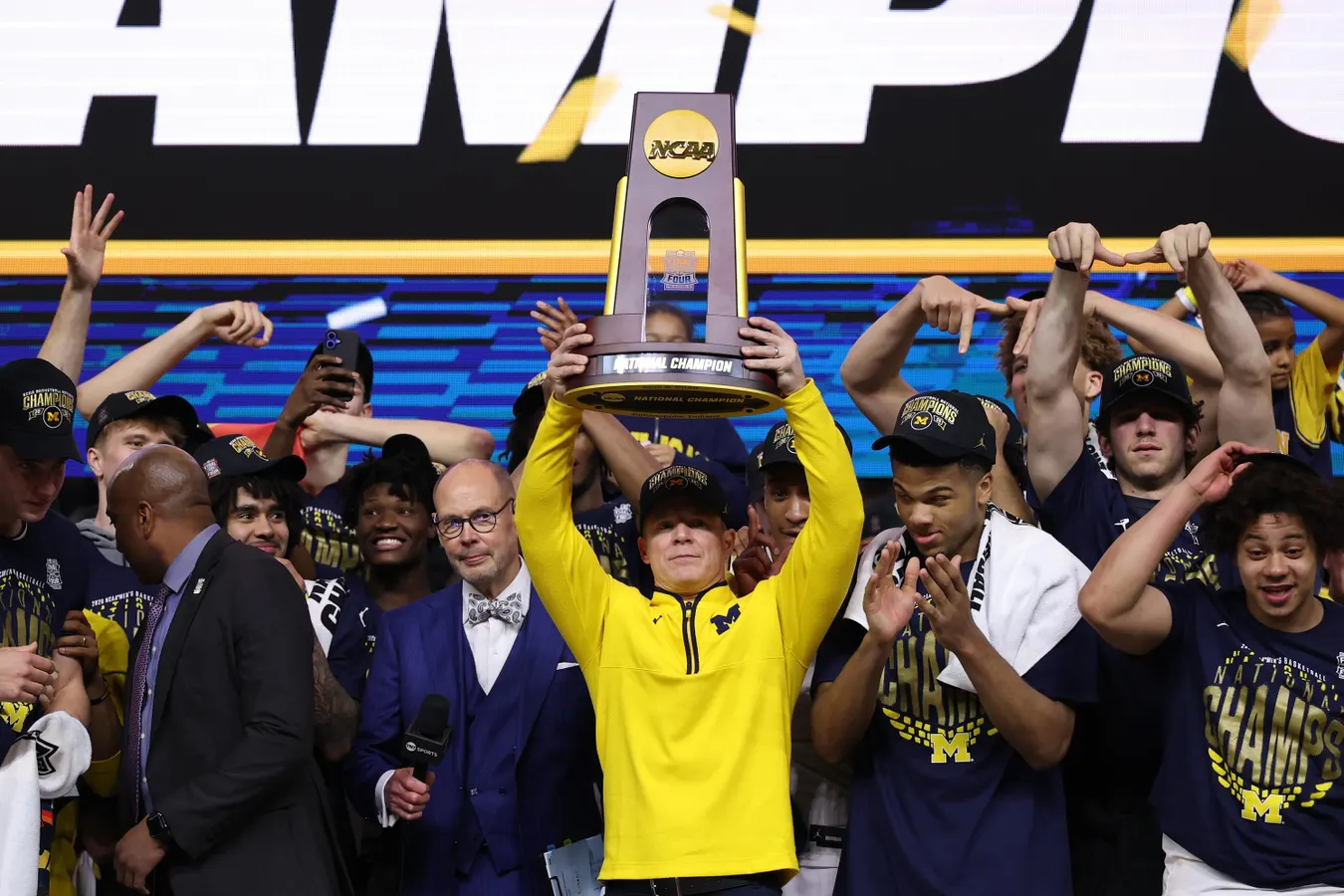

INDIANAPOLIS, INDIANA – APRIL 06: Head coach Dusty May of the Michigan Wolverines hoists the trophy after defeating the UConn Huskies 69-63 in the National Championship of the 2026 NCAA Men’s Basketball Tournament at Lucas Oil Stadium on April 06, 2026 in Indianapolis, Indiana. (Photo by Michael Reaves/Getty Images)
Getty Images
It’s never been a better time to be a college athlete.
The College Sports Commission (CSC) announced Thursday that the College Athlete Payment System (CAPS) recorded $1.8 billion in direct payments from schools to student-athletes during the first year of revenue sharing. Participating schools reported their distributions through CAPS, covering 34,915 student-athletes at 307 schools across 33 conferences and 45 sports.
“The players will continue to be incredibly well-compensated for the stage of development that they’re at as principal players,” UConn men’s basketball coach Dan Hurley, who has led the Huskies to three of the last four NCAA championship games, winning two titles, said Thursday at Big East Media Day in New York.
He added: “It’s never been better to be a college basketball player or college football player, or a college football or basketball coach, so I think we’re just all very grateful.”
Each participating school could share up to $20.5 million with its athletes in 2025-26 and decide how to divide that money across its sports and rosters. The total amount of distributions tracked in CAPS was $1,975,973,365, which included $1,770,453,776 in revenue-sharing payments, $42,034,090 in Alston Awards and $163,485,499 in new and incremental scholarship spending. Of the 319 opted-in schools, 307 compensated student-athletes directly and 68 reached the cap or came within five percent of it.
“The implementation of the House Settlement has resulted in $1.8 billion in direct payments from schools to student-athletes across college athletics, on top of billions in scholarship benefits. The College Sports Commission operated the system that facilitated these payments, allowing student-athletes to benefit from the new system while ensuring compliance with the rules,” said Bryan Seeley, CEO of the College Sports Commission.
Revenue-sharing payments come from the school itself. They are different from third-party name, image and likeness (NIL) deals, which student-athletes enter into with noninstitutional entities and which the CSC reviews through its software platform, NIL Go. Together, the two systems provide distinct pathways for student-athletes to earn money and provide greater transparency into how those payments are made.
College football programs like Ohio State, Oregon and Texas reportedly have payrolls ranging from $45-$54 million.
The top college basketball programs are spending in excess of $20 million on their rosters.
Asked how much a Division 1 college basketball program needed to spend to make a deep run in the NCAA Tournament, Marquette coach Shaka Smart said:
“I don’t know the exact number because people aren’t exactly honest about it. You know, there’s a number that you floated your players and then particularly at some of these programs where it’s not all revenue sharing, there’s the number that your players are going to get. That’s something that you guys need to write about. Some of these NIL deals for guys that are at places that are quote/unquote above their revenue sharing cap, some of those will not go realized [because] it’s not through the school. It’s NIL.”
Asked if the idea of Cinderella teams making a run in the NCAA Tournament was dead, Smart said:
“Yeah, you do gotta spend a certain amount to be competitive. Is Cinderella dead? No, because at the end of the day, it still is a 40-minute basketball game in the NCAA Tournament where anything can happen.”
The 2026-27 cap year began July 1, 2026, and because the revenue-sharing cap increases annually under the settlement, each participating school can now share up to $21.58 million with its student-athletes.











Leave a comment