


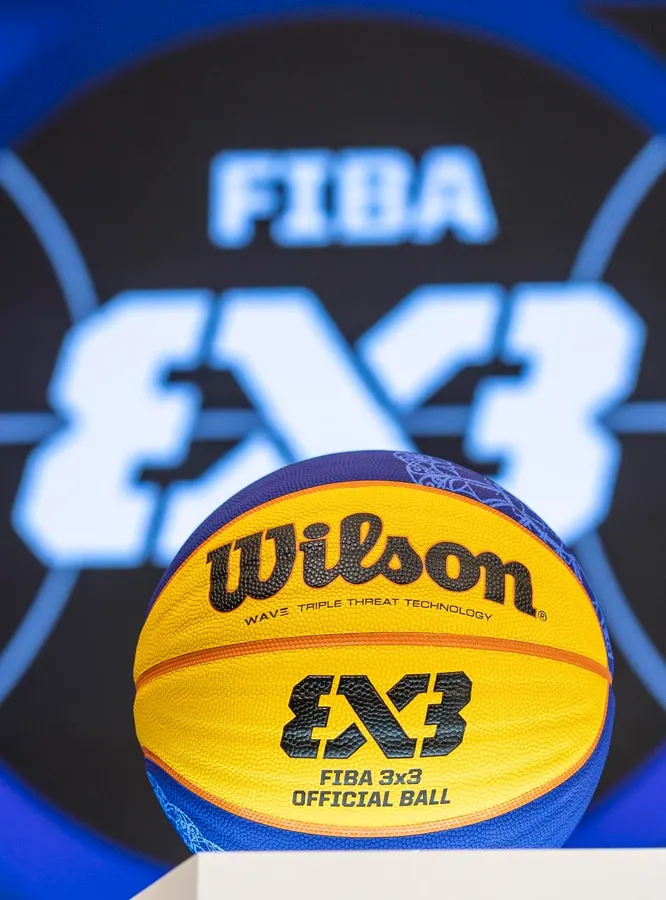

HONG KONG, CHINA – JANUARY 22: The FIBA 3×3 official ball (Paris 2024) is seen during the FIBA 3×3 universality olympic qualifying tournament 1 – Press Conference on January 22, 2024 in Hong Kong, China. (Photo by Yu Chun Christopher Wong/Eurasia Sport Images/Getty Images)
Getty Images
FIBA 3×3 basketball is coming to LA28 with an intimate, festival-style Olympic experience designed around fans, digital audiences and the fast-paced culture of Los Angeles.
(This is part two of a two-part story based on a Forbes exclusive interview with Alex Sanchez on September 22, 2026. All quotes are taken directly from a transcript of the interview.)
Basketball has never been only about what happens on the court.
Great basketball environments (beyond great basketball itself) have often included music, personalities, energy, passionate fans and a sense that something is happening beyond the scoreboard. FIBA 3×3 basketball has taken that idea and made it part of the discipline’s DNA. Alex Sanchez, managing director of FIBA 3×3, describes the experience as “spectator centric.” That objective will be tested when 3×3 basketball returns to the Olympic stage in Los Angeles in 2028.
A Cirque Du Soleil Approach To Basketball
SEVILLE, SPAIN – JANUARY 15: Acrobats of ‘Kooza’ by Cirque Du Soleil dress rehearsal on January 15, 2020 in Seville, Spain. (Photo by María José Lópe/Europa Press via Getty Images)
Europa Press via Getty Images
At a FIBA 3×3 basketball event, the game is only part of the experience. Sanchez explained that an event is approximately two-thirds games and one-third entertainment. There is continuous music. There are entertainment segments between breaks. And FIBA has staff whose job is specifically to think about how to make those breaks more entertaining. Sanchez offered an unexpected comparison.
“We are sometimes, I think, closer to Cirque du Soleil than any other sport,” he said.
PERTH, AUSTRALIA – AUGUST 08: (Editorial Use Only) The cast of Cirque du Soleil performs Corteo at RAC Arena on August 08, 2025 in Perth, Australia. (Photo by Brittany Long/WireImage)
WireImage
Cirque du Soleil, for anyone who has attended their shows, combines athleticism with visual presentation, music, choreography and entertainment. FIBA 3×3 is attempting something similar around basketball. The discipline still has to satisfy basketball purists. The competition still matters. But the event is also intended to attract someone who may not consider himself or herself a basketball fan.
Not Everyone At A 3×3 Event Is A Basketball Fan
FIBA conducts surveys at many of its larger events. The organization asks spectators about their age, gender, location, what they liked and what they would change. Sanchez said the results show something interesting. The audience is not necessarily made up primarily of hardcore basketball fans. Instead, FIBA sees what Sanchez describes as a broad cross-section of the population. Women and men. Younger and older spectators. Families. Groups of teenagers. Entertainment seekers.
Spectators watch the FIBA 3×3 World Cup 2026 match in Warsaw, Poland. (Photo by Marek Antoni Iwanczuk/NurPhoto via Getty Images)
NurPhoto via Getty Images
And that is precisely the objective.
Sanchez said significant numbers of spectators stay for multiple games, sometimes two or three or more, and that the percentage saying they would return if the event came back the following year is above 95%. Those numbers are based on FIBA’s event surveys, according to Sanchez. FIBA 3×3 basketball is running a continuous feedback loop.
What did spectators enjoy?
The mascot high-fives fans during the FIBA 3×3 World Cup 2026 event in Warsaw, Poland. (Photo by Marek Antoni Iwanczuk/NurPhoto via Getty Images)
NurPhoto via Getty Images
What did they dislike?
What kept them in their seats?
What might bring them back?
Fans are seen during the FIBA 3×3 World Cup 2026 group stage match at Plac Defilad in Warsaw, Poland, on [Month Day, Year]. (Photo by Marek Antoni Iwanczuk/NurPhoto via Getty Images)
NurPhoto via Getty Images
The answers will in turn influence the next event.
Designing A Discipline For The Attention Economy
This approach extends to the digital audience. The same discipline that has spectators standing close to the court in a festival-like environment can also be consumed on a smartphone thousands of miles away. Sanchez said the half-court format, six players on the court and the camera angles required for 3×3 all lend themselves to mobile viewing. The short games also produce an unusually high number of moments that can be turned into social-media highlights. Sanchez compared the experience with the popularity of short NBA clips.
“In reality, what we are producing is two-minute clips in every game,” he said.
Djordje Simeunovic during the FIBA 3×3 Novi Sad Challenger 2026 Tournament in Novi Sad, Serbia, on July 18, 2026. (Photo by Maxim Konankov/NurPhoto via Getty Images)
NurPhoto via Getty Images
That is a powerful proposition in an era in which sports organizations compete not only against other sports but against virtually every form of digital entertainment. The competition for attention is continuous. Fiba 3×3 basketball was designed with that reality in mind.
The Olympic Test
Now the experiment reaches another stage: Los Angeles 2028. For Sanchez, the objective is not simply to participate in the Olympic Games. He wants 3×3 to reproduce the kind of atmosphere the discipline experienced in Paris 2024. At the Paris final, Sanchez recalled, the demand for tickets was so strong that International Olympic Committee members were unable to enter the venue because it was full. There were queues outside.
“I would like to have the same problem that we had in Paris 24,” Sanchez said.
Why Los Angeles Fits 3×3
Sanchez believes Los Angeles is a particularly natural setting for the discipline. Basketball is deeply embedded in the city’s sporting culture. Outdoor basketball is part of Los Angeles’ identity. For Europeans, Sanchez said, when they think about outdoor sports in the United States, Los Angeles and Venice Beach immediately come to mind. That connection between urban culture, outdoor recreation and basketball is precisely what 3×3 has been built around.
SAN PEDRO, CA – DECEMBER 28: A lone silhouetted basketball player tries to dunk the ball during a shootaround game on the outdoor basketball court at Angels Gate Park in San Pedro on Friday, Dec. 28, 2018. (Photo by Scott Varley/Digital First Media/Torrance Daily Breeze via Getty Images)
MediaNews Group via Getty Images
The LA28 Games therefore represent more than another Olympic competition.
They provide an opportunity for the discipline to showcase the concept FIBA has spent more than a decade developing. A global audience. A professional competition. Music and entertainment. Digital engagement.
All in a format that can be watched in person or on a phone.
An Intimate Olympic Experience
FIBA intends to significantly increase the size of its Olympic venue in Los Angeles. Sanchez said the organization is targeting more than 8,000 spectators, roughly twice the size of its Paris venue. But bigger doesn’t necessarily mean less intimate. In 3×3, the court remains remarkably close to the audience. Sanchez described spectators at existing venues as being perhaps six to eight feet from the court. That creates a very different Olympic experience from sitting high above a traditional arena floor.
“You also need to understand that the three venues are very packed here,” Sanchez said. “And this intimate setting with 8,000 people is going to be an amazing feeling.”
That intimacy may become one of the defining characteristics of Olympic 3×3 basketball.
Sanchez says Fiba 3×3 basketball already has more than 10 million social-media followers and approaches 2 billion annual views across its dedicated channels.
LA28 And The Olympic Future Of 3×3
Some sports arrive with centuries of tradition. Others arrive because they represent where sport is going. Fiba 3×3 basketball occupies an interesting space between those two worlds. Basketball itself has an enormous history. Three-on-three basketball feels almost timeless because people have been playing informal versions of it for generations. Yet the organized FIBA version is remarkably modern. And it has in its present form been designed around the spectator.
Netherlands players Evelien Lutje Schipholt, Ilse Kuijt, Noortje Driessen, and Janis Boonstra celebrate with the trophy after winning the Women’s FIBA Basketball 3×3 Champions Cup 2026 final match against Azerbaijan in Bangkok, Thailand, on March 15, 2026. (Photo by Anusak Laowilas/NurPhoto via Getty Images)
NurPhoto via Getty Images
For Sanchez, the goal is simple.
He wants people to show up and stay. He wants them to enjoy the basketball even if they did not arrive as basketball fans. And he wants them to leave wanting to come back. In 2010 when Sanchez came on board, FIBA wanted to know whether 3×3 basketball as a discipline was more than a gimmick. Sixteen years later, the question is no longer whether 3×3 basketball belongs on the Olympic stage.
It is rather: how far can a discipline built from a simple street pickup game go?













Leave a comment