


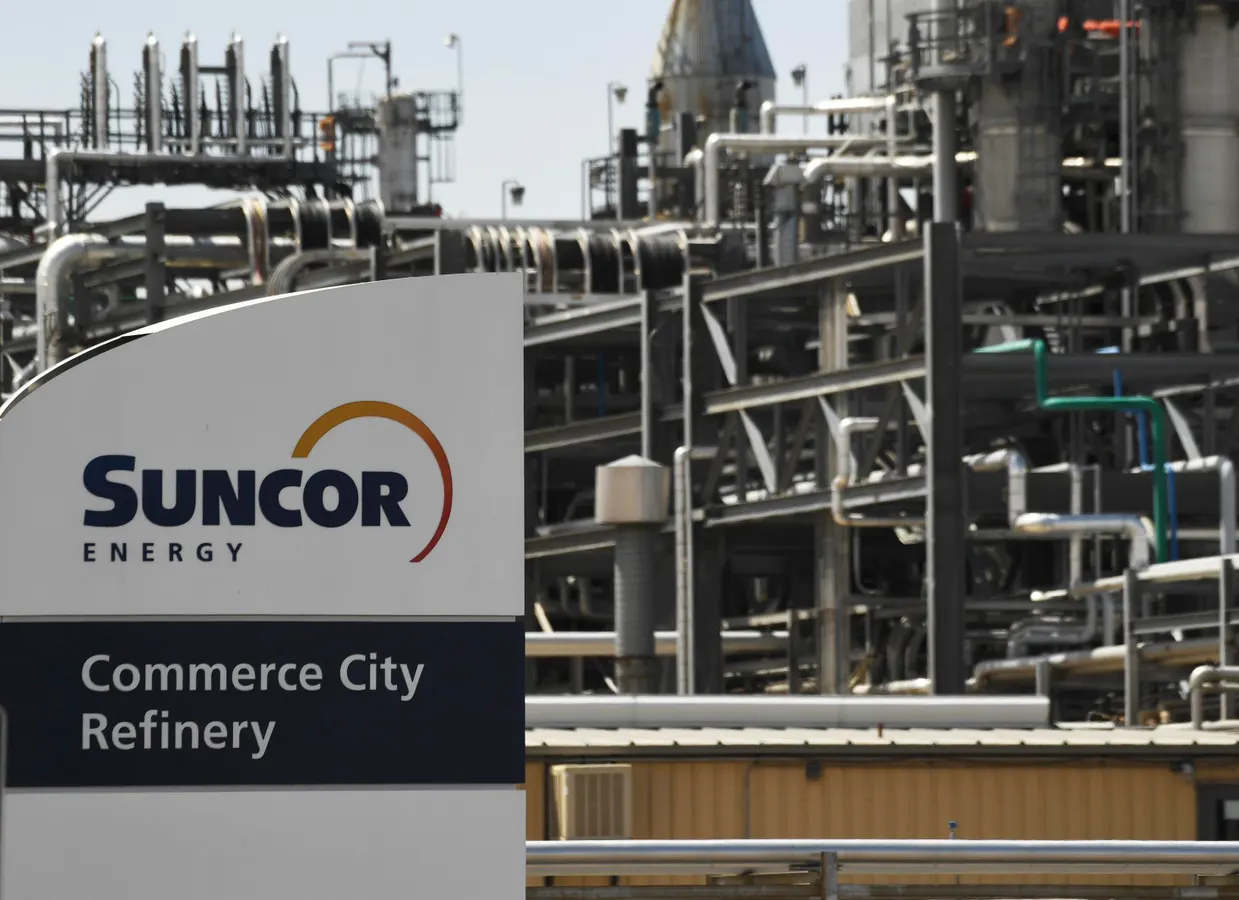

COMMERCE CITY, CO – APRIL 19: Suncor Energy Refinery April 19, 2018 in Commerce City, Colorado. (Photo by RJ Sangosti/The Denver Post via Getty Images)
Denver Post via Getty Images
Should a Colorado courtroom get to set energy policy for the rest of the country? That’s the question at the heart of a climate lawsuit the Supreme Court is scheduled to hear next month on October 5.
In Suncor Energy v. County Commissioners of Boulder County, the justices will consider whether federal law bars state-law claims seeking compensation for injuries attributed to worldwide greenhouse-gas emissions. The Court must also address whether it has jurisdiction to hear the case.
The stakes extend well beyond the companies named in the complaint. Allowing state and local courts, and their associated state laws, to attach liability to global energy production could expose businesses to competing demands from jurisdictions across the country, with consequences for investment, energy affordability and American sovereignty.
University of Virginia law professor Sai Prakash – a former law clerk for Justice Clarence Thomas – explained the issues at the center of the case during a September 10 webinarhosted by George Mason University’s Law & Economics Center. Prakash, who filed an amicus brief with the Supreme Court supporting the energy company defendants, focused on constitutional limits to a state’s territorial authority.
Boulder’s theory, in Professor Prakash’s assessment, would extend that authority worldwide. If Boulder can attach liability to the companies it has sued, Prakash argued, “it can attach liability to thousands of others as well.”
Boulder County and the city of Boulder argue that fossil-fuel producers should help pay for local climate harms tied to their products and alleged deception about their risks. The Colorado Supreme Court allowed the claims to proceed, accepting a distinction between seeking compensation for that conduct and regulating emissions.
Professor Prakash argues that damages themselves can regulate behavior. Attaching substantial liability to production outside Colorado creates pressure to change that production, even without an order telling a company to close a well or refinery. For Professor Prakash, the relevant boundary is the reach of state power.
If downstream emissions justify liability for fossil-fuel producers, he argued, similar reasoning could reach steel and concrete manufacturers, farming and cattle production.
Other countries could invoke the same rationale to assert authority over American activity. As Professor Prakash put it, “France could regulate activities in Paris, Texas.” That hypothetical illustrates the risk of inviting foreign governments to claim power over our economy, Professor Prakash explained.
In its brief to the Supreme Court, Boulder County argues that states generally retain authority to address injuries within their borders even when conduct elsewhere contributes to them. The plaintiffs seek damages based on alleged deception and the production and sale of fossil fuels, while expressly disavowing an injunction against operations or emissions controls.
Cooper & Kirk partner Megan Wold – a former law clerk for Justice Samuel Alito – sees two problems for the claims, and both run through the premise that Boulder is regulating something outside Colorado. Call it production and consumption in other states, and the lawsuit collides with the Constitution and the federal foreign affairs power. Call it greenhouse-gas emissions, and the Clean Air Act preempts it.
“If Boulder is regulating the out-of-state production and consumption of fossil fuels, then it’s blocked by the structure of the Constitution and by the assignment of the foreign affairs power to the federal government. On the other hand, if what Boulder is regulating is actually… the greenhouse gasses that are emitted, then that is clearly preempted by the Clean Air Act,” Wold said.
Wold illustrated her argument with a hypothetical involving production, refining and sales in Texas: “The product itself isn’t touching Colorado.” Yet Boulder’s theory still puts the seller on the hook. A tort that reaches conduct with no physical connection to the state is regulation of interstate commerce, whatever the complaint calls it.
The Colorado Supreme Court reached a different legal conclusion when it allowed the claims to proceed in May 2025. Its majority reasoned that a lawsuit’s potential influence on behavior does not, by itself, make the suit impermissible regulation. It also found that the Clean Air Act preserves significant state authority. The court did not decide whether Boulder would ultimately establish liability.
Phil Goldberg, representing the Manufacturers’ Accountability Project, argued that legislatures provide a process for deciding whether to increase energy costs, who should pay and how resulting revenues should be used. Moving those judgments into damages litigation, in his view, changes who makes those choices.
George Mason law professor Todd Zywicki similarly emphasized energy costs and democratic accountability.
“If people in Boulder want to sit and freeze in the dark because they don’t want to use fossil fuels… it’s protected for them under the Constitution,” Zywicki said. “What Boulder County can’t do is tell the rest of us that we also have to sit in the dark and freeze.”
Boulder’s response is that its claims enforce traditional legal duties. It argues that preventing deceptive marketing does not require reducing emissions and that the Clean Air Act does not regulate that marketing or the upstream production at issue. The disagreement therefore concerns both the alleged wrong and the legal significance of the requested remedy.
Professor Prakash acknowledged that a victory for the companies might not end climate litigation but could re-define the scope of these cases moving forward. The pending case’s significance will depend on how the justices define the relationship between state remedies and federal authority.












Leave a comment