


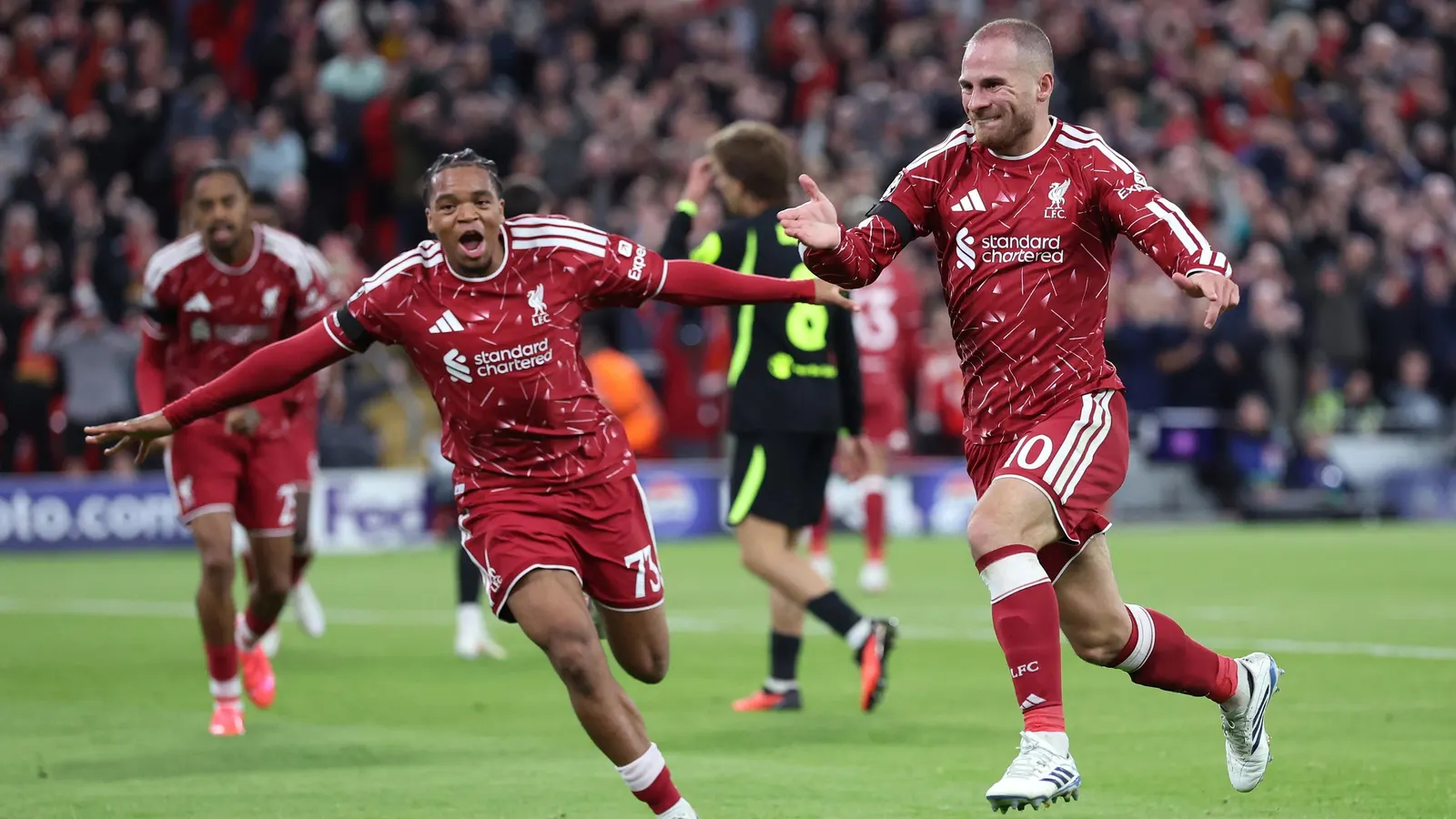

LIVERPOOL, ENGLAND – SEPTEMBER 09: Alexis Mac Allister of Liverpool FC celebrates after scoring their second goal during the UEFA Champions League 2026/27 League Phase MD1 match between Liverpool FC and Atletico de Madrid at Anfield on September 09, 2026 in Liverpool, England. (Photo by Alex Livesey – Danehouse/Getty Images)
Getty Images
Turkish Airlines just signed with English Premier League soccer club Liverpool as its new front-of-shirt sponsor, typically the most visible and most expensive sponsorship asset clubs have.
The carrier will replace Standard Chartered, a British-based multinational bank, in a deal covering a five-year period commencing the 2027- 2028 season, with an estimated value of $400 million+, making it the most lucrative such deal in English football history.
Turkey’s state-owned airline is no stranger to sports sponsorship or endorsements; for instance, it has previously partnered with English club Manchester United and Borussia Dortmund, a club with close links to industrial Germany’s Turkish communities.
Between 2010 and 2025, it also sponsored Euroleague basketball, a sport in which almost 50% of the urban Turkish population is interested, whilst the late Kobe Bryant once served a two-year stint as a Turkish Airlines endorser.
Premier League push intensifies battle for the skies
Given the global ubiquity of English Premier League football, it is perhaps no surprise to see the carrier partnering with Liverpool, a club that may have 200 million fans worldwide, which should help propel both Turkish Airlines and Turkey as a tourism destination up in their respective top 10 global rankings.
But this is not just a simple matter of using soccer to sell airline seats and boost tourist numbers; there is a geopolitical power play at work, given urgency by the current turbulence in the Arabian Gulf.
Turkish Airlines is only one of many state-owned airlines in the region vying for market share and regional power; others include Qatar Airways, Emirates Airline and Etihad Airways, although they will soon be joined by Riyadh Air, a new carrier owned by Saudi Arabia’s sovereign wealth fund – the PIF (Public Investment Fund, former owner of LIV Golf).
It has been commonplace for all of them to use soccer sponsorship; for instance, Abu Dhabi’s Etihad deal with England’s Manchester City is believed to be the world’s most lucrative (worth $90 million per season), while Emirates Airline has accumulated a portfolio of front-of-shirt deals that includes Spain’s Real Madrid and Arsenal of London.
Meanwhile, Riyadh Air has been sponsoring Atletico Madrid’s (Real’s direct local rival) shirt fronts for more than two years and now also has a stadium naming rights deal with the club, even though the carrier operates barely any flights, ahead of an unspecified full launch of its flight network.
Giuliano Simeone centre-forward of Atletico de Madrid and Argentina and Gabriel centre-back of Arsenal and Brazil compete for the ball during the UEFA Champions League 2025/26 Semi Final Second Leg match between Arsenal FC and Atletico de Madrid at Arsenal Stadium on May 5, 2026 in London, England. (Photo by Jose Breton/Pics Action/NurPhoto via Getty Images)
NurPhoto via Getty Images
Soccer becomes a game of replicating rivals
There is a sense of mimetic isomorphism in all of this: that is, organisations copying or imitating the structures, processes, and behaviours of other organisations in their field, particularly when facing uncertainty or turbulence.
Indeed, it is worth noting that Tony Douglas, the Chief Executive Officer of Riyadh Air, was previously the CEO of Etihad Airways.
This extends to the home bases from which these airlines operate; in 2022, Saudi Arabia’s Crown Prince Mohammed bin Salman announced that a considerably expanded King Salman International Airport in Riyadh would be built; in 2024, Dubai followed suit by revealing plans to construct the world’s largest airport.
Previously, Hamad International Airport in Doha, Qatar’s capital city, even had a partnership with the German Bundesliga team Bayern Munich, which perhaps signals what’s ahead for the airports currently being built.
Yet all of this is what makes Turkish Airlines’ tie-up with Liverpool so notable, as most airlines and airports in the region are affected by the war in the Arabian Gulf.
At one stage this year, almost 97% of flights at Bahrain’s International Airport were cancelled, while estimates suggest the region’s airlines could lose $4.3 billion this calendar year, with profit per passenger falling from $31.50 last year to a loss of $21.40 this year.
Turkey taking advantage of turbulence
However, unlike its rivals, Turkish Airlines’ home base at Istanbul Airport hasn’t closed during the conflict; in fact, the airline’s passenger load factors hit a record 84% in Q2 of this year, whilst its total revenues surged roughly 20.5% year-on-year to $7.2 billion in the second quarter, bringing first-half revenues to approximately $13.1 billion.
Amid difficult trading conditions for the likes of Qatar Airways (which sponsors UEFA Champions League winners Paris Saint-Germain), Turkish Airlines no longer appears to be copying its rivals; instead, it seems to be pressing home its strategic advantage to strengthen its position as the region’s primary transit hub.
The name and logo on Liverpool’s shirt will therefore be as much a geopolitical powerplay as it is an instrument of marketing communication.
Which raises questions about how Gulf rivals will respond.
One possibility is that they will copy their rival and double down on their existing commitments, though they will likely have to do so at a higher cost given the magnitude of Turkish Airlines’ Liverpool deal.
Whilst FOMO could be at play, executives across the Middle East will probably be more concerned about losing ground to a major rival.
Whether money is available to them for this purpose remains to be seen; following the pandemic, state-owned airlines across the region were bailed out to the tune of billions of dollars, but this time round times appear tougher (for instance, Qatar’s economy looks likely to shrink by more than 8% this year).
The new name on Liverpool’s shirt next season will therefore be an exercise in much more than brand recall and recognition, as Turkey presses home its strategic advantages.














Leave a comment