


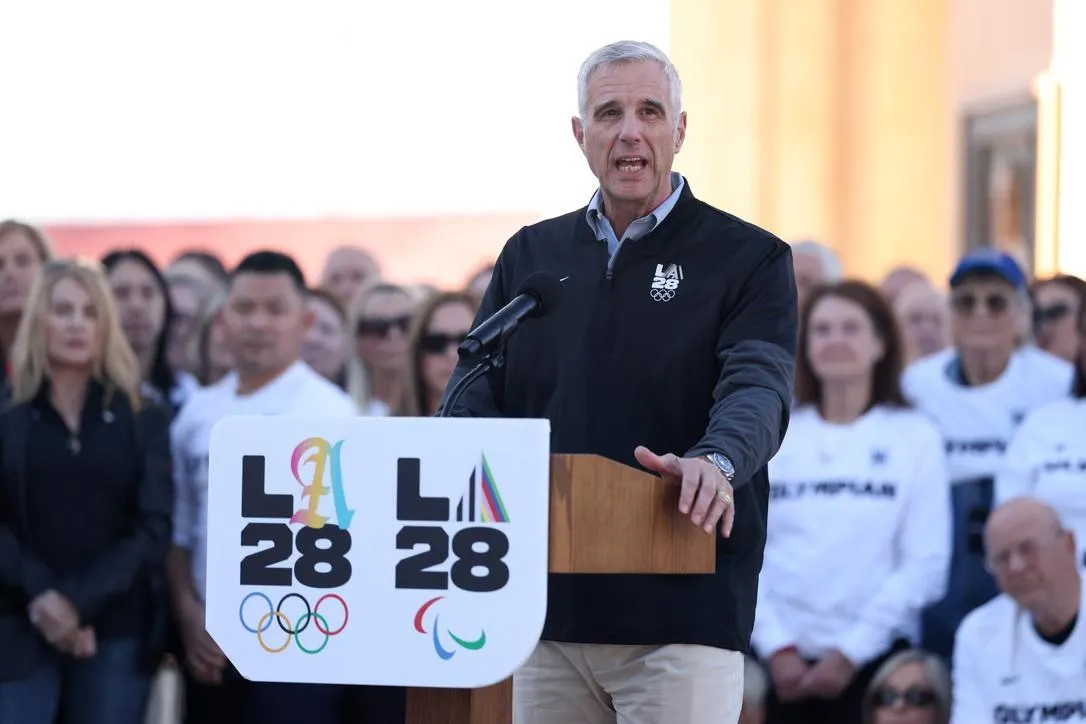

LA28 CEO Reynold Hoover Los Angeles, California.
Photo courtesy of LA28
LA28 CEO Reynold Hoover draws on more than four decades of military and public service to lead preparations for the 2028 Olympic and Paralympic Games in Los Angeles, applying lessons in leadership, teamwork, logistics, and decision-making under pressure.
(This is part one of a two-part story based on a Forbes exclusive interview with LA28 CEO Reynold Hoover on September 24, 2026. All quotes are taken directly from a transcript of the interview.)
Reynold Hoover wasn’t looking for another job when the opportunity to lead the Los Angeles 2028 Olympic and Paralympic Games came along. After more than three decades in the United States Army and years of public service, he was happily retired.
Then came LA28.
For Hoover, the opportunity to lead preparations for one of the world’s largest sporting events was more than just another assignment. It was a chance to apply a lifetime of leadership lessons to what will be the largest sporting event in human history: The Los Angeles 2028 Olympic Games. That’s 15,000 athletes and 60,000 volunteers.
LA28 CEO Reynold Hoover Los Angeles, California.
Photo courtesy of LA28
Appointed CEO of LA28 in June 2024, the retired three-star Army lieutenant general is responsible for helping organize the 2028 Games, a complex operation involving thousands of people, numerous venues, multiple levels of government, and a deadline that cannot be moved. His approach draws heavily on his military experience: establish a clear organizational structure, put capable people in the right positions, develop sound plans, and execute.
In a recent interview Hoover explained how his journey began almost by accident, with a conversation with his older brother during his junior year of high school.
A Family Legacy Of Military Service
Hoover’s introduction to military service began with his family.
His grandfather served in the Navy during World War II and hoped his two grandsons would follow him into the service. But it was Hoover’s older brother who ultimately pointed him toward the Army. While his brother was preparing to leave for his first overseas assignment, Hoover was at home completing applications for four-year ROTC scholarships. His brother asked what he was doing. When Hoover explained his plans, his brother offered a suggestion that changed the course of his life.
“If you’re going into the Army to be an officer, you should go to West Point,” his brother told him. “That’s where they make the officers.”
WEST POINT, NEW YORK – MAY 23: Graduating cadets during the United States Military Academy commencement ceremony in Michie Stadium at the U.S. Military Academy on May 23, 2026 in West Point, New York. U.S. Secretary of War Pete Hegseth was announced as the 2026 commencement speaker just two days before the event. (Photo by Adam Gray/Getty Images)
Getty Images
Hoover had never even heard of West Point.
His parents offered to drive him to the United States Military Academy, approximately two hours from their home. He liked what he saw, applied, and was accepted. On July 2, 1979, Hoover arrived at West Point. Four years later, in 1983, he graduated and began the next phase of a military career that would span more than 35 years. The decision set him on a path that eventually led to senior leadership positions in the Army and federal government before bringing him to the Olympic movement.
The Calculus Classroom That Taught Him Leadership
West Point was not an easy academic experience for Hoover. At the time, cadets did not choose traditional academic majors. Their coursework emphasized mathematics, science, and engineering. Hoover readily admits that these were not his strongest subjects. One experience from his first year, however, would become a defining leadership lesson. During his plebe year, West Point scheduled calculus immediately after mandatory physical education, which included boxing.
Cadets would leave the boxing session, sometimes battered and exhausted, and head directly into a windowless classroom with blackboards covering the walls. The instructor would ask what questions they had about the previous night’s homework. If Hoover admitted he did not understand something, the response was predictable. The instructor would tell him the material should have been intuitive from the previous lesson and direct him to see him after class.
Then came the command: “Take boards!”
All 15 cadets would stand at the blackboards and work through assigned problems in white chalk. They were required to underline their final answers in red chalk and write “ANS.”
During an engineering class at the US Military Academy, cadets solve assigned problems on a chalkboard, West Point, New York, 1950. (Photo by US Army/PhotoQuest/Getty Images)
Getty Images
Afterward, the instructor would select cadets to explain their solutions to the class. Hoover frequently found himself standing at the front of the room, trying to explain a mathematical process he did not fully understand. Other cadets would scrutinize his work, identify mistakes, and challenge his reasoning. It was an uncomfortable experience, but one that eventually revealed a larger purpose.
“What I eventually learned from that experience was that West Point wasn’t really trying to teach me calculus,” Hoover said. “They were teaching me how to think logically, how to approach complex problems, and how to have the confidence to work toward a solution.”
The lesson extended well beyond mathematics.
In the real world, leaders rarely have every piece of information they would like before making a decision. Waiting for perfect conditions can be as damaging as making a poorly considered decision. Hoover learned that a leader must assess the available information, develop a reasonable solution, communicate it clearly, and make adjustments as circumstances change.
“In life, getting the exact textbook answer on the first pass didn’t matter as much as getting a solution that was good enough, based on the information available, with the confidence to execute and adjust as you went,” he explained.
That philosophy now influences how he approaches LA28.
From Military Training To The Olympic Mission
Hoover’s military education reinforced several principles that would become central to his leadership: duty, responsibility, accountability, teamwork, and service. His career subsequently included senior military leadership assignments and civilian government service, where he worked on complex operational and logistical challenges. He eventually retired after more than 35 years in the military. But the opportunity to lead LA28 offered a compelling reason to return to public service.
For Hoover, the connection between military leadership and Olympic planning became especially clear when he attended the Paris 2024 Summer Games. The Olympics are a global celebration of athletic achievement, but delivering them requires an enormous operational effort behind the scenes. Thousands of interconnected decisions must come together. Transportation, venue operations, security, schedules, staffing, equipment, and countless other logistical details must work in coordination.
A U.S. military base sits at Kandahar International Airport in Kandahar, Afghanistan on October 14, 2010. The Afghanistan War began in 2001, when the U.S. invaded to topple the Taliban after the 9/11 attacks. It ended in 2021, with the U.S. withdrawal and the Taliban’s return to power. (Photo by Hossein Fatemi / Middle East Images / AFP via Getty Images)
Middle East Images/AFP via Getty Images
Hoover recognized a familiar framework.
“When you see the Summer Games up close, you realize very quickly that while it’s a massive, incredibly complex global spectacle, at the end of the day, it is fundamentally about three things: operations, plans, and logistics,” he said. “Those three pillars are the bread and butter of any military officer.”
After returning from Paris, Hoover reorganized LA28’s headquarters around those three functions. The objective was to establish a structure that would help the organization coordinate its work, clarify responsibilities, and execute the mission. Just as important was identifying the right people to lead each area.
Reynold Hoover, Carl Lewis and Paul Madwin at the LA28 Olympic Games: 2 Years Out Press Conference held at Griffith Park on July 14, 2026 in Los Angeles, California. (Photo by Michael Buckner/Penske Media via Getty Images)
Penske Media via Getty Images
“My military experience has always taught me that you build the frame around your core operational pillars, you put the right leaders in the right slots, and then you get out of their way,” Hoover said.
That final point is particularly important to his management philosophy. Leadership is not about making every decision personally. It is about building a capable organization, giving talented people the resources and authority to succeed, and holding the team accountable for delivering results.
Leading Through Uncertainty
The Olympic and Paralympic Games present a challenge unlike most corporate assignments. There is no flexibility in the opening date. The Olympic Opening Ceremony is scheduled for July 14, 2028. No matter how complicated preparations become, the deadline remains fixed.
“You cannot buy more time,” Hoover said.
The LA28 Olympic cauldron is lit during a ceremonial lighting at the Memorial Coliseum in Los Angeles on January 13, 2026, ahead of the launch of ticket registration for the 2028 Summer Olympic Games. (Photo by Frederic J. Brown / AFP via Getty Images)
AFP via Getty Images
That reality requires leaders to become comfortable operating amid uncertainty while maintaining a shared sense of purpose. Hoover believes the best organizations do not eliminate every problem before moving forward. Instead, they develop the ability to recognize challenges, respond quickly, and adjust without losing sight of the mission. He also believes leaders must be willing to fail along the way. His experience at West Point taught him that a first attempt does not have to be perfect. What matters is the ability to think critically, learn from mistakes, and improve the solution.
At LA28, that means empowering teams to make decisions while maintaining the discipline needed to deliver a complicated international event.
Hoover pointed to the organization’s workforce and retention as evidence of the culture being built. At the time of the interview, LA28 had grown from approximately 120 employees when he arrived to more than 1,000, with a retention rate approaching 95%. For an organization preparing an event of extraordinary scale, the maintaining of a cohesive and committed team is essential.
A Lifetime Of Service Comes Full Circle
Hoover says he did not come out of retirement because he needed another professional challenge. He came because the Olympic opportunity offered something different. It allowed him to connect his military career, public service, and commitment to teamwork with a global event built around human achievement.
“Coming out of retirement to do this was truly the opportunity of a lifetime,” he said.
He describes the assignment as a way to capstone nearly four decades of public service, beginning with his arrival at West Point in 1979 For Hoover, the leadership lessons learned in a demanding calculus classroom, reinforced through military service, and applied to complex government operations have found a new purpose. His challenge is now to help deliver the largest Olympic and Paralympic Games in history.
MILAN, ITALY – FEBRUARY 03: CEO of LA28 Reynold Hoover speaks during the IOC Session at the Main Media Centre MPC at Allianz MiCo on February 03, 2026 in Milan, Italy. (Photo by Andreas Rentz/Getty Images)
Getty Images
For a leader whose career began with a brother’s suggestion to visit West Point, the journey to LA28 has been anything but predictable.
Yet the mission is remarkably consistent: serve something larger than yourself. Bring capable people together. And give them the opportunity to accomplish something extraordinary.














Leave a comment