


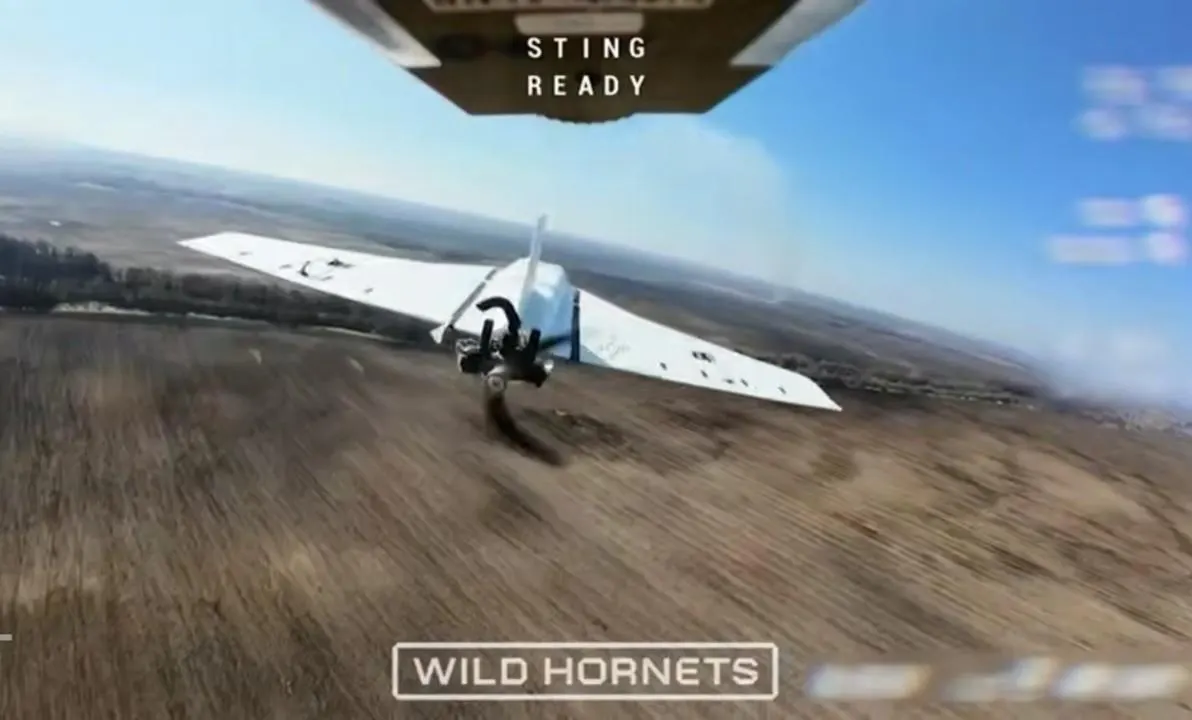

Image captured from a video posted on social media on April 19, 2026 by Wild Hornets. The video shows the feed from a Ukrainian interceptor drone as it targets a Russian Gerbera Drone.
Social Media Capture
The Russian military has a diverse fleet of aerial drones, ranging from reconnaissance systems such as the Orlan-10 to long-range loitering munitions in the Geran series. One of its lesser-known systems is the Gerbera drone, which was developed as an inexpensive decoy to accompany Geran strike packages. Recently, the Gerbera has undergone a series of upgrades that have expanded its role well beyond that of a simple decoy. It is now being employed for reconnaissance, communications relay, and limited strike missions, with its usage being increasingly reported over the past month. This evolution reflects the rapid adaptation of unmanned systems that has become a hallmark of the Russia-Ukraine War.
The Gerbera Drone
Russia first introduced the Gerbera in July 2024 as a low-cost decoy to accompany the more advanced Geran-2 loitering munition. Similar to the Geran-2, the Gerbera is a fixed-wing aircraft that is approximately 2 m long with a 2.5 m wingspan. However, it only has a maximum takeoff weight of 18 kg and a payload capacity of 5 kg. The drone is powered by a small two-stroke piston engine, allowing a maximum speed of approximately 160 km/h. It has a reported range of up to 600 km and is launched from an elastic or pneumatic catapult, eliminating the need for a runway. The Gerbera’s airframe is constructed primarily from plywood, foam plastic, and commercial off-the-shelf components, reducing production costs to an estimated $10,000.
The Gerbera has been used extensively as a decoy drone in Russia’s large strategic strike campaigns. Since its external appearance and signature closely resemble the Geran-2, it is difficult for air-defense systems to differentiate between the two. By launching large numbers of inexpensive Gerberas alongside strike drones, Russia forces Ukrainian air defenses to detect, track, and potentially engage these low-value targets, increasing the likelihood that the higher-value Geran-2 drones will penetrate the air defense network. However, given their less-advanced flight systems, the Gerberas are highly susceptible to electronic warfare, which can cause the drones to veer off course. This has resulted in reports of Gerbera drones entering the airspace of other countries, including Lithuania, Moldova, and Poland.
Images of the Gerbera drone released on Telegram by the Main Directorate of Intelligence of the Ministry of Defence of Ukraine on November 18, 2024.
Social Media Capture
Although originally developed as a decoy, the Gerbera has a modular architecture that is capable of supporting additional aerial missions. Russian sources have described configurations of the Gerbera as a reconnaissance drone, a communications relay, and a lightweight loitering munition. Over the past year, Russia has steadily expanded these capabilities. One of the most significant upgrades is the integration of the 12-element Kometa-M controlled reception pattern antenna, providing substantially greater resistance to GPS jamming and spoofing than earlier navigation systems. Some Gerberas have also been equipped with mesh networking radios, allowing them to relay encrypted communications between unmanned systems and extend control ranges in contested electromagnetic environments.
The Gerbera Drone’s Expanding Operational Role
While Russia has employed the Gerbera extensively as a decoy since its introduction, recent reporting indicates that it is increasingly being used for additional mission sets. The drone made headlines in February 2026 for its use as a “mothership” carrying FPV drones to forward positions. Ukrainian analysts first identified this capability after inspecting a downed Gerbera and observing mounting brackets for FPV drones. Later that month, footage emerged showing a Gerbera launching FPV drones in flight. This concept significantly increased the range of FPV drones, allowing them to strike targets deep behind Ukrainian lines.
In July 2026, Ukrainian reports indicated a further expansion of the Gerbera’s operational roles. On July 1, Serhii “Flash” Beskrestnov, a Ukrainian electronic warfare and drone analyst, reported that Gerberas had been observed carrying external fuel tanks. Unlike conventional Gerberas, these drones briefly entered Ukrainian airspace, maneuvered within the country, and then returned to Russia rather than conducting one-way strikes. Beskrestnov assessed that they may have been performing signals intelligence missions by collecting electronic emissions and identifying active Ukrainian radio networks.
Image captured from a video posted on Telegram by the Russian Ministry of Defense on July 10, 2026 showing a strike in Dobropillia by a Gerbera drone.
Social Media Capture
The Gerbera has also been employed in direct strike missions rather than simply serving as a decoy. This has been enabled by the integration of seeker systems that allow the drone to lock onto targets. Throughout July, Ukrainian sources reported Gerberas striking civilian and industrial infrastructure across Chernihiv Oblast, including gas stations, grain elevators, energy facilities, and residential buildings. The Russian Ministry of Defense has similarly reported the use of Gerberas in direct strike missions since June. According to the Ministry, the drones have been employed against a range of targets, including cargo ships, power facilities, and Ukrainian drone launch sites. The videos of these strikes show that the Gerbera’s limited payload is still sufficient to cause substantial damage.
The Gerbera has appeared more frequently in tactical operations near the front. During Russia’s July 22 mechanized assault in Donetsk Oblast, the 1st Azov Corps of the Ukrainian National Guard reported that Gerberas operated alongside Molniya attack drones, providing reconnaissance and communications support. The Gerberas may have acted as relay drones using a mesh network to maintain control of the Molniya drones. They were launched as part of the initial drone wave to weaken Ukrainian defenses ahead of the ground assault. However, Ukrainian interceptor drones appeared to destroy many of the Gerberas before they reached the defensive lines.
Why Russia Is Expanding Gerbera Usage
Many of the missions performed by the Gerbera over the past several months could also be performed by the Geran-2, Russia’s flagship long-range drone. The Geran-2 has a larger payload, more advanced navigation systems, and is produced in much greater numbers. It has similarly undergone continuous upgrades, improving its effectiveness as a strike platform while adding capabilities such as communications relay and signals collection. Meanwhile, the cost of an upgraded Gerbera is approaching that of a Geran-2. This raises the question of why Russia is increasingly assigning these missions to the Gerbera.
Images captured from a video posted on Telegram showing a Ukrainian AIr Defense unit shooting down a Russian Gerbera drone in Chernihiv Oblast. The video was posted on June 24, 2026.
Social Media Capture
One possible explanation is the increasing demand for Geran drones. Russia has dramatically expanded its long-range strike campaign, with attacks now routinely involving hundreds of Geran drones. At the same time, the Iranian Shahed-136, on which the Geran-2 is based, has been employed extensively in the Middle East. The two drones share a common design and many of the same components, creating the potential for supply chain constraints. Reserving Gerans for long-range strike missions while assigning lower-priority tasks to the less expensive Gerbera would help preserve Russia’s inventory of its more capable drone.
The increased use of the Gerbera could also stem from its simpler architecture. Because it was originally developed as an inexpensive decoy, the airframe relies heavily on commercial off-the-shelf components and a relatively simple internal design. This makes it easier to modify than the more sophisticated Geran-2. The rapid appearance of multiple Gerbera variants over the past year suggests that new capabilities can be integrated with relatively minor changes to the underlying airframe. This allows frontline units to adapt the platform for specific operational requirements without redesigning the aircraft.
Regardless of the reason, the Gerbera’s increased usage reflects a broader trend in the Russia-Ukraine War. Rather than developing a new drone for every mission, both sides are rapidly adapting existing platforms to meet changing battlefield requirements. This approach reduces development time, conserves resources, and quickly delivers new capabilities to the battlefield. The Gerbera demonstrates that in modern warfare, even a simple decoy can rapidly evolve into an operational weapon system.















Leave a comment