


In this week’s edition of InnovationRx, we look at Fortell’s efforts to make a better hearing aid, Abby Care’s business getting payment for caregivers, J&J’s $5.5 billion talc settlement, Scribe Therapeutics’ IPO, and more. To get it in your inbox, subscribe here.
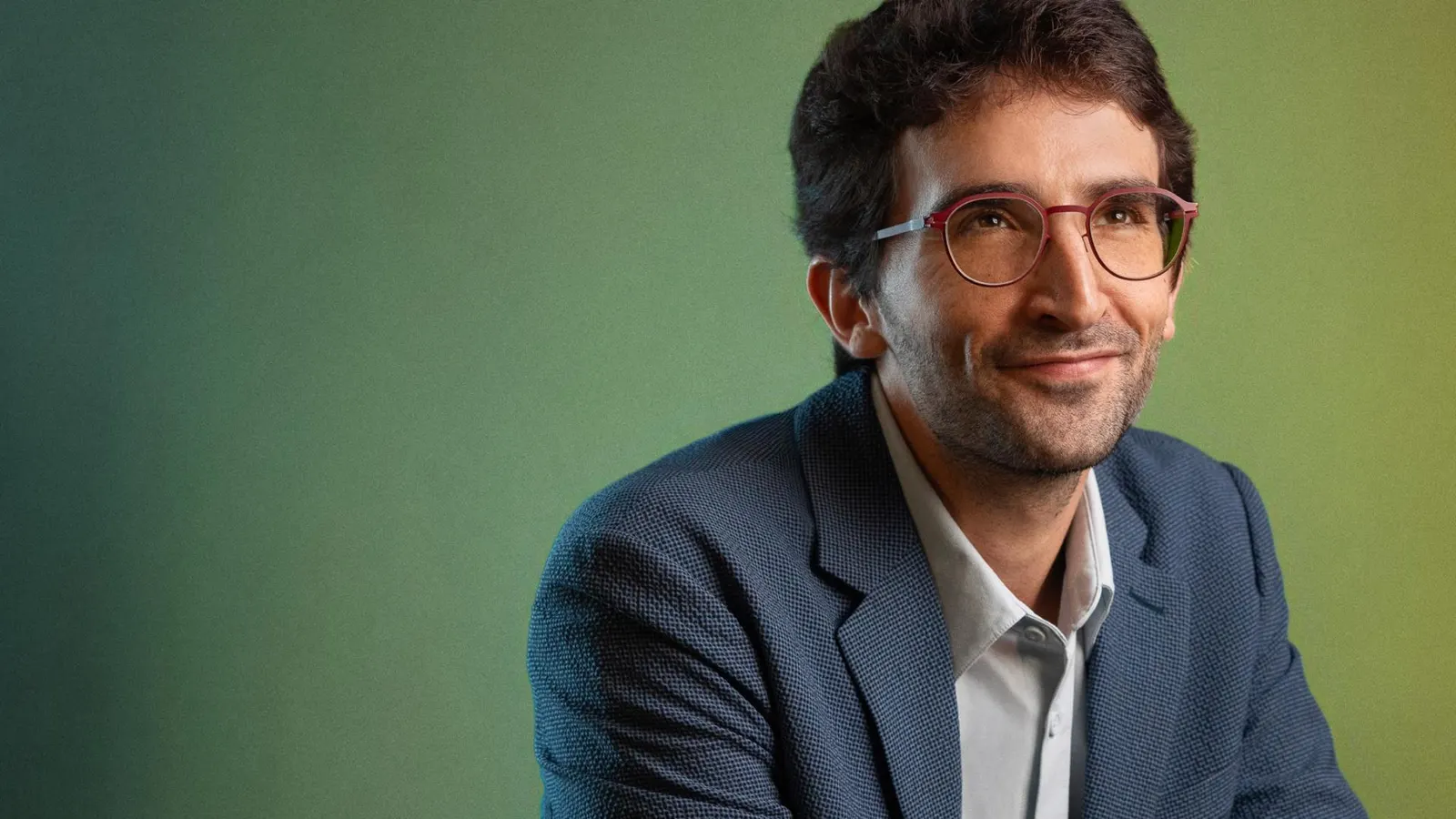
Fortell Research cofounder and CEO Matthew de Jonge
Aaron Kotowski for Forbes
More than a decade ago, Matthew de Jonge, 38, first had the idea to build a better hearing aid after watching his grandparents retreat into social isolation as their hearing loss made it hard for them to follow conversations. But the technology wasn’t quite there. “In 2015, it felt like science fiction,” de Jonge recalls, describing the challenge to build a device that can differentiate sounds and home in on what’s important, especially in environments with lots of ambient noise, like a cocktail party or crowded restaurant.
After a stint at hedge fund Bridgewater Associates, he worked as a product manager at Butterfly Network, which was developing a pocket-sized ultrasound machine. It was only after the pandemic pushed meetings to Zoom, which uses AI to mute background noises, that he realized a much better hearing aid was finally possible. “Zoom is the easiest version of the problem, and the hearing aid is the gnarliest,” he says.
He launched Fortell in early 2021 with former Butterfly colleagues Andrew Casper, 40, and Igor Lovchinsky, 41, as technical cofounders. (Operational cofounder Cole Morris, 38, joined from Oscar Health.) It took a bit longer than expected, but the hearing aids, launched in December, are so popular that they’ve been near-impossible to get. Customers like KKR’s billionaire chair Henry Kravis and comedian Steve Martin have forked over $6,800 for the devices, currently available only at Fortell’s Manhattan audiology clinic or by appointment in Greenwich, Connecticut, and Palm Beach, Florida.
The company (one of 20 companies on this year’s Forbes Next Billion-Dollar Startups list) has now raised $163 million from investors that include Founders Fund, Thrive Capital and Valor Equity Partners at a valuation of $740 million. And it’s got more locations planned, in Boston, San Francisco and Palo Alto, California. The biggest limit on expansion, says de Jonge, is its ability to hire audiologists to staff new clinics. “This should not be a status symbol,” de Jonge says. “We want this to be available to as many people as possible.”
For a longer conversation with de Jonge, see our video interview here.
This Startup Helps Family Caregivers Get Paid
Havi Nguyen
Cody Pickens for Forbes
Five years ago, Havi Nguyen, 26, launched Abby Care with the idea of helping family caregivers get paid for the aid they’re already providing.
The San Francisco-based startup does that by essentially acting as a Medicaid provider that takes advantage of rules that allow family members to become paid caregivers for qualified patients who need long-term care, like people with autism or cerebral palsy, or the elderly. The caretakers become employees of Abby Care, which receives Medicaid funds that it passes on as wages to caregivers. Abby Care provides online lessons that help family caregivers get state certifications and two days of in-person training where they learn techniques such as CPR and the Heimlich maneuver. It operates in eight states, including Colorado, Pennsylvania, New Jersey and Florida. In Colorado, caregivers get paid at least $20 an hour.
For Nguyen, the idea for the company came from personal experience. She grew up in suburban Houston, where her parents, both immigrants from Vietnam, ran a nail salon. Her family’s income was low enough to qualify them for Medicaid–and she learned to navigate the health insurance program’s complexity. “From an early age, I was in charge of applying to Medicaid, renewing benefits, helping my sisters make sure they could go to the right appointments,” she says.
Abby Care (which made the cut for this year’s Forbes Next Billion-Dollar Startups list) booked $15 million in revenue last year. Blue-chip backers include Sequoia Capital, Thrive Capital and Khosla Ventures, who have invested a total of $45 million at a valuation of $225 million.
J&J’s $5.5 Billion Talc Settlement
Johnson & Johnson agreed to pay $5.5 billion to resolve tens of thousands of lawsuits that its talc products–including its popular baby powder–caused ovarian cancer. The settlement would end contentious litigation that has been going on for more than a decade. The settlement, which is conditioned on 95% of remaining claimants participating, covers some 69,000 cases consolidated in federal court in New Jersey and related cases in state court. J&J has long denied that its talc products caused cancer. It replaced its talc-based baby powder in the U.S. with a cornstarch-based one in 2020.
Deal of the Week
Gene editing holds huge promise to cure disease, but it’s been a tough business. That’s why it’s notable that after a two-and-a-half year drought for gene-editing IPOs, Scribe Therapeutics went public last Friday, raising $155 million. The small-cap gene editing company’s shares soared 67% to $25, before falling back to $18 at Tuesday’s close. “Our story is resonating,” says Scribe cofounder and CEO Ben Oakes, noting that its therapies all target cardiovascular disease, which is the leading cause of death globally.
The company (which spun out of University of California Berkeley, where Oakes had been a student in the labs of both Nobel laureate Jennifer Doudna and David Savage) plans to use the IPO proceeds to move its first three potential therapies into clinical trials.
The first one “turns off” the gene PCSK9 (which regulates blood cholesterol) without changing DNA, with a goal of lowering a patient’s LDL “bad cholesterol” to reduce their risk of heart disease. Its next two medicines use Crispr tools to edit genes related to high levels of cholesterol.
These drugs, Oakes says, target “the leading lipid risk for cardiovascular disease, the second leading lipid risk and the third leading lipid risk.”
What We’re Reading
The FDA advisory panel backed six of seven peptides under review for compounding, potentially opening the floodgates for these controversial compounds. (Last week, we looked at the companies preparing to cash in.)
The founder of $7 billion Taylor Farms, whose lettuce was linked to the cyclosporiasis outbreak, speaks out for the first time. On Monday, a top Democratic lawmaker called on the company to release information about its communications with the White House and federal agencies.
Sarepta Therapeutics, which has faced scrutiny over its treatments for Duchenne muscular dystrophy, named Tessera Therapeutics’ Michael Severino as its new CEO.
OpenAI picked Israel’s Sheba Medical Center as its first hospital outside the U.S. where it will deploy its healthcare AI tools. (We previously wrote about OpenAI’s push into healthcare and partnerships with hospitals.)
The FDA approved Otsuka’s ADHD medication Simtriyo, which regulates serotonin as well as the dopamine and norepinephrine controlled by other ADHD drugs.
The American Red Cross says that blood donations have fallen to a four-year low, deepening a shortage that has caused it to limit distributions of Type O blood to hospitals.












Leave a comment