


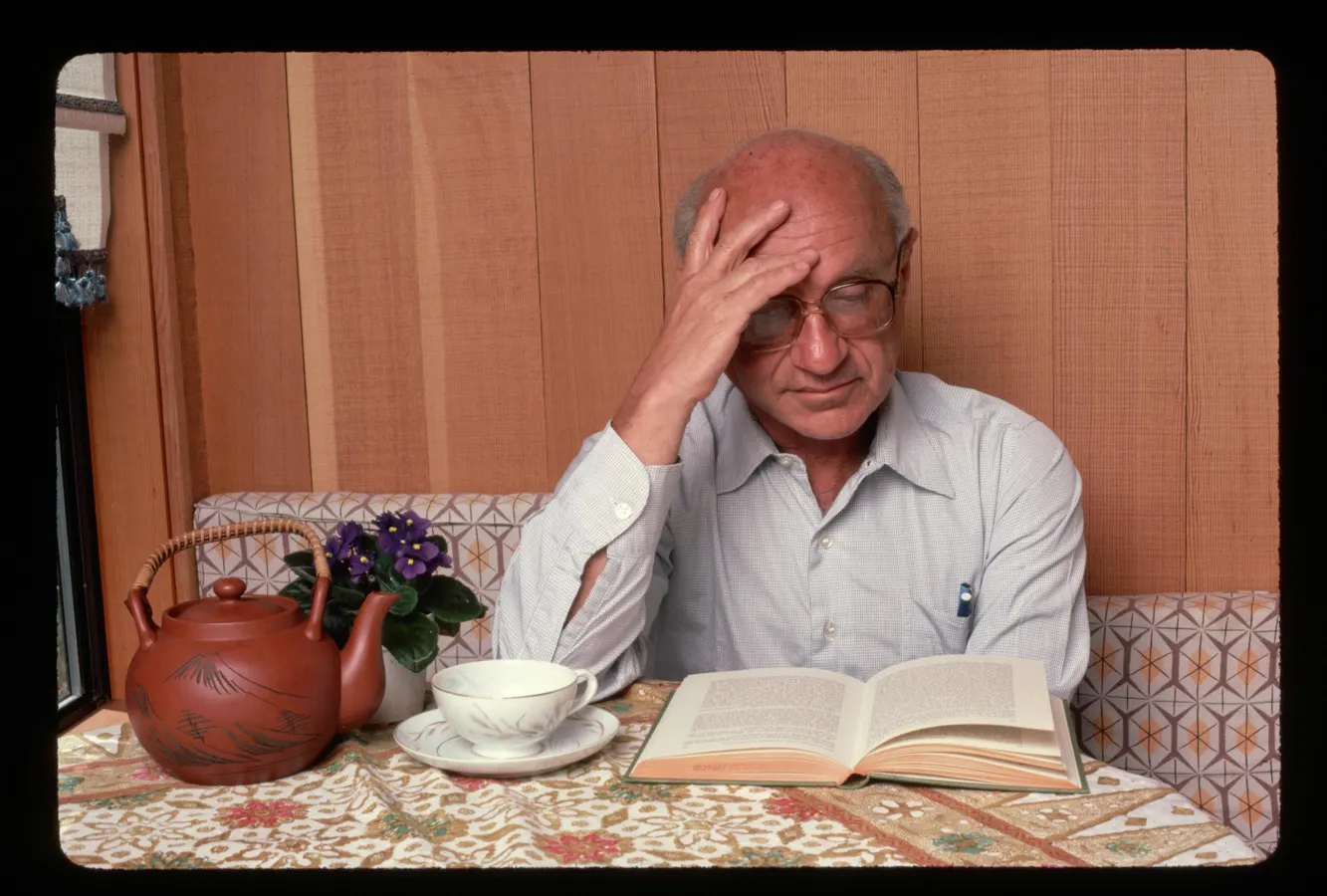

Economist Milton Friedman Reading (Photo by Roger Ressmeyer/Corbis/VCG via Getty Images)
Corbis/VCG via Getty Images
“Soon, I’d see inmates unveil smartphones all around me. The economy inside prisons is an incredible testament to the power of capitalism and how creatively goods will flow to those who want them, so long as the buyer can make it worth it for the seller.” That’s P.G. Sittenfeld in the Wall Street Journal, reflecting on his time in prison. Sittenfeld has since been pardoned by President Trump.
His recollections about prison life are interesting in a lot of ways, but they’ll be utilized here as yet another attempt to put to bed the tired narrative promoted by Milton Friedman (1912-2006) about what caused the Great Depression. It’s an article of faith among conservatives and libertarians that Friedman made a correct case that the downturn was an effect of a “tight Federal Reserve.”
In promoting the Friedmanite fiction about the 1930s, some go so far as to say the Fed didn’t “print” enough, but most stick to the similarly easy-to-discredit notion that the Fed didn’t create enough of what they describe as “money supply,” or “money stock.” Except that money is everywhere that there’s production, and nowhere where there isn’t. See above.
Money doesn’t flow in or out of cells, towns, cities, states, and countries, rather money flows reflect the movements of goods, services and labor for goods, services, and labor. And no central bank could or can alter the previous truth.
Yet conservatives and libertarians continue to try and make “fetch” happen as it were, and while promoting the impossibility that a lack of Fed-produced “money” is what sapped the U.S. economy’s vitality in the 1930s.
Recently the frequently excellent group Unleash Prosperity promoted the Friedman line. It even quoted the Nobel Laureate as saying “The Great Depression was produced by a failure of government, by a failure of monetary policy. It was produced by a failure of the Federal Reserve System to act in accordance with the intentions of those who established it. It was produced by a failure of the Federal Reserve System despite the presence of knowledge on the part of many of the people in the system about the right course of action.” No, the view isn’t serious.
For evidence, just contemplate the global use of dollars at present. The dollar isn’t the primary medium of exchange in Caracas, Pyongyang and Teheran because the Fed placed so-called “money supply” in the cities mentioned, but because production of market goods always and everywhere presumes reasonably credible money circulating: those who accept exchange media for what they bring to market want commensurate goods in return. That’s why the bolivar, won, and rial are legal tender in Venezuela, North Korea and Teheran, but not the currencies of exchange.
In the U.S., it’s precisely the same. The Fed doesn’t place exponentially more dollars in Seattle than in Spokane as much as herculean production in Seattle ensures exchange media in amounts sufficient to move the production. Money doesn’t enable production as Friedman and his disciples imagine, rather it mirrors it.
So, while more than a few of Friedman’s disciples acknowledge the various barriers to production erected by the Hoover and Roosevelt administrations in the 1920s and 1930s, they imagine in Keynesian fashion that the Fed could have overwhelmed economic reality by “gunning” so-called “money supply.” Wrong. Money in circulation is an effect of production, and governments produce nothing.
Furthermore, short of erecting impregnable police states, governments can’t keep exchange media from circulating where exchange takes place. P.G. Sittenfeld’s memories of prison vivify the previous truth, while also laying waste to the silly notion that the 1930s U.S. economy was less porous than the prison Sittenfeld did time in.















Leave a comment