


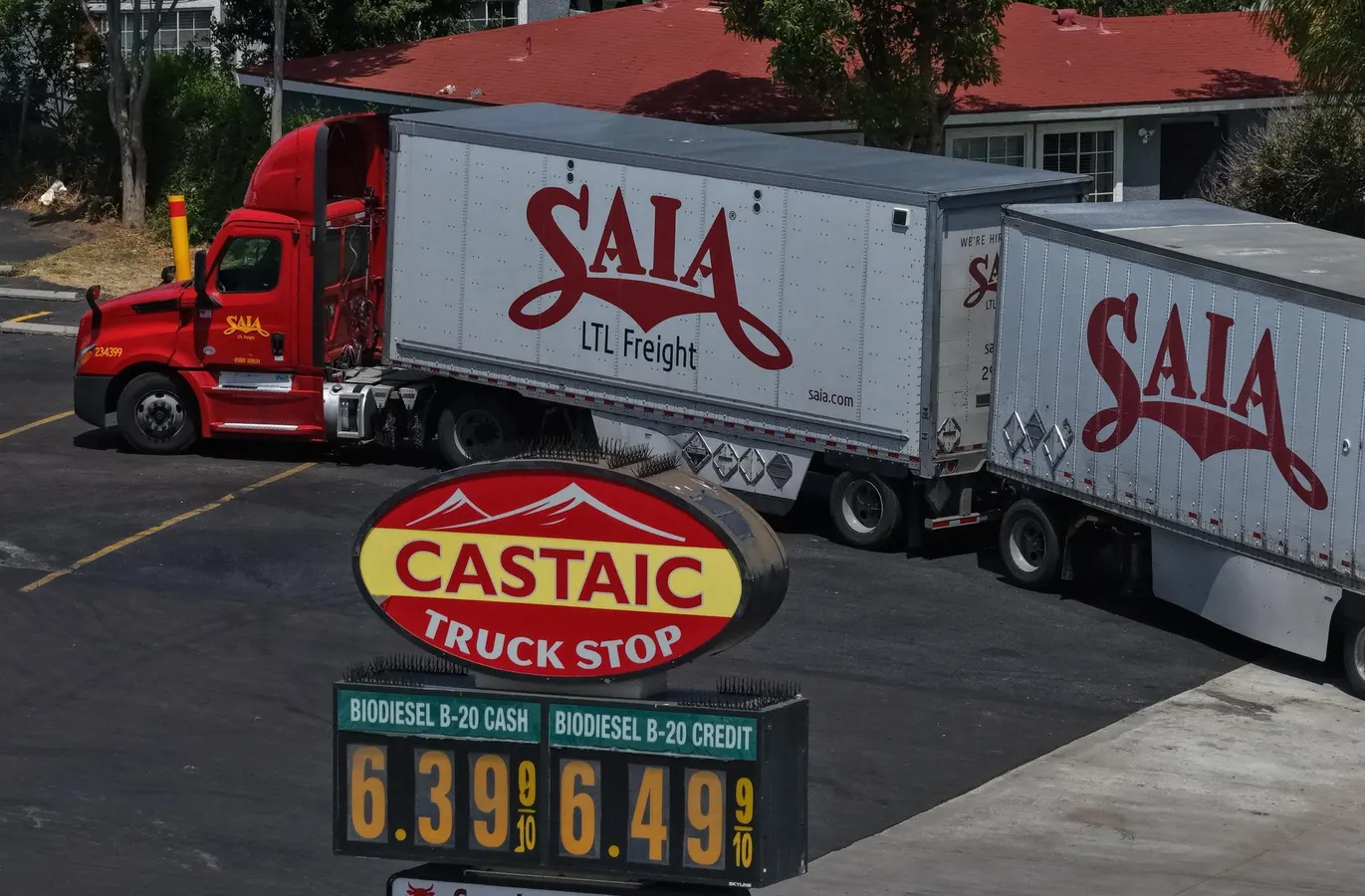

CASTAIC, CALIFORNIA – JUNE 03: In an aerial view, a truck drives by a sign displaying bio-diesel prices over $6 a gallon on June 03, 2026 in Castaic, California. (Photo by Justin Sullivan/Getty Images)
Getty Images
President Trump spoke with Vladimir Putin on Friday and announced that Russia would ship 300,000 tons of diesel to American and global markets, with another 500,000 tons promised for November. The Treasury Department issued General License 135 the same day, allowing Russian diesel into the United States through April 2027. It is the first opening for Russian fuel since Washington banned it in 2022.
Ukrainian President Volodymyr Zelensky answered sharply. “Gifts to Putin will not bring peace,” he wrote, arguing that letting Moscow sell petroleum products finances a war that should be ending.
On Saturday, Trump fired back. He blamed Zelensky’s drone strikes on Russian refineries for record diesel prices that are squeezing farmers and ranchers. Then he went further, arguing that Ukraine should get a new leader who can make a deal. Ukraine’s foreign minister, Andrii Sybiha, replied that Zelensky has his people’s support and that choosing their president is their right. The Kremlin’s envoy, Kirill Dmitriev, applauded Trump.
The numbers tell a different story. Diesel prices are at records because of the Iran war, which closed the Strait of Hormuz and took more fuel off the world market than Ukraine’s drones ever could. Ukraine’s strikes are a secondary factor. And America’s much-touted energy independence has not shielded consumers, because U.S. refiners sell into a global market and Americans pay the global price.
Analysts without a stake in the political fight say the same. A halt to Ukraine’s refinery attacks would help the diesel balance, Arne Lohmann Rasmussen, chief analyst at Global Risk Management, wrote in a client note last month. But the shortage of refined products from the Middle East “matters far more.” Diesel prices and refining margins, he added, only truly surged after the war with Iran began.
Follow The Barrels
Drivers queue at a petrol station to refuel in Tehran, on August 25, 2026. US Treasury Secretary Scott Bessent laid out plans for the “economic asphyxiation” of Iran, expanding Washington’s secondary sanctions threats and warning of dire consequences for countries that do not join the campaign. The announcement comes almost six months into a war on Iran that has ground to a stalemate, with stalled peace talks and Tehran blocking most traffic through the crucial Strait of Hormuz. (Photo by AFP via Getty Images) / Israel OUT / NO Access Israel Media/Persian Language TV Stations Outside Iran / Strictly No Access BBC Persian / VOA Persian/Manoto TV / Iran International/ Radio Farda
AFP via Getty Images
Start with the timeline. Diesel cost less than $4 a gallon when the U.S. and Israel attacked Iran on Feb. 28, 2026. Within two months, it had jumped by nearly half, well before Russia banned diesel exports in July. It hit a record $6.53 in late September and still costs roughly 70% more than a year ago.
Then look at the volumes. The war choked off most traffic through Hormuz, the channel that normally carries about a fifth of the world’s oil, and the IEA says it has cost the market billions of barrels of exports.
Gulf crude has since found its way around the strait by pipeline and ship-to-ship transfer. Refined fuel has not. Fuel shipments through Hormuz are a fraction of pre-war levels, and the Gulf’s diesel exports have shrunk to about a quarter of normal.
Russia’s losses are real but smaller. Its diesel exports have sunk to a two-year low. Before the war, the Gulf and Russia together supplied almost 45% of the diesel traded by sea. The Gulf accounts for the bulk of what has gone missing.
The U.S. buys no Russian fuel and has exported more oil than it imports since 2021. Most of its imports come from Canada. The Northeast, with little refining of its own, leans on imported diesel and Gulf Coast fuel.
None of that protects the price at the pump. Diesel trades on a world market. When Europe and Asia bid up cargoes, U.S. refiners ship them abroad, and they have exported diesel at record levels this year. That is why the White House has floated a diesel export ban, and why its own energy and interior secretaries have resisted it. S&P Global warns a ban would force refiners to cut output and push gasoline prices up.
Friday’s Russian deal won’t move the needle much, either. The first shipment equals about half a day of American diesel demand.















Leave a comment