


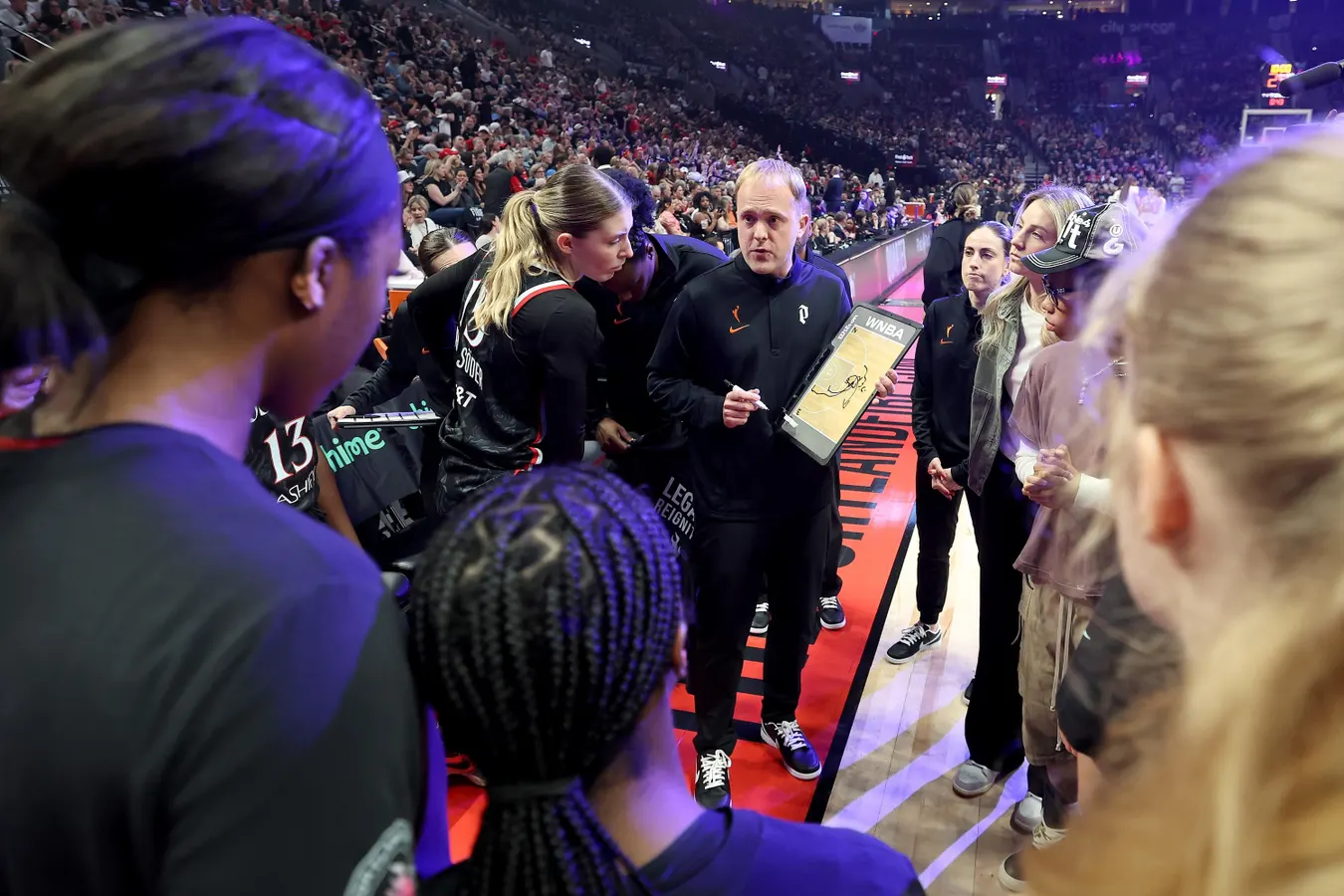

PORTLAND, OREGON – MAY 09: Head coach Alex Sarama of the Portland Fire gathers his team against the Chicago Sky at Moda Center on May 09, 2026 in Portland, Oregon. (Photo by Steph Chambers/Getty Images)
Getty Images
Ask most coaches what went right after a win and you get the usual spiel around effort, gratitude, character and heart. Ask Alex Sarama, the head coach of inaugural Portland Fire WNBA team, and you get language like pick-and-pops, twists and re-screens, spacing around the pick-and-roll. There’s also high praise around playing heavy in the gaps, building walls on defense and players making two-on-one reads.
It’s not new coach-speak. It’s the dialogue he uses that helps explain the Constraints-Led Approach (CLA), the training philosophy Sarama has built his career on and refined since he was a teenager.
“Most analytical models had us for nine wins for the year,” Sarama said. “I’m really happy with how the group’s responding to things, the style of play. I really feel like we’re getting the best out of our players and maximizing them.”
How The Portland Fire Players Have Responded To CLA
This year Portland are 13-19 and fifth in the West. They surpassed any pre-season predictions of less than 10 wins for an expansion team. Further, their top players are all having career seasons. Carla Leite, who averaged 7.2 points per game in 2025, is now scoring 15.9 points per game; Bridget Carleton has more than doubled her scoring output of 6.5 points per game in 2025, to 14.3 points this year. Megan DiLeo is averaging 12.9 points and Sug Sutton was shooting career numbers (11.3 points per game) before being traded to Dallas. If the Fire do happen to qualify for playoffs it would replicate what Golden State Valkyries did last season and become the second team to reach playoffs in its inaugural season.
But none of that explains what’s actually made their journey under coach Sarama different from any other WNBA club. When he took the coaching job, part of the appeal was building a system through CLA from the ground up.
“You’ve got to kind of be all in or not at all. I feel like we’re taking it really far in terms of practices, player development,” he said. “I wanted to take it further. But I don’t see CLA as like a magical bullet.”
CLA draws on the research of sport scientists Keith Davids and Dr. Rob Gray, who studied motor learning and how athletes actually acquire skill under pressure. Rather than isolated repetition and running a move until it looks clean with no defender in the way, CLA asks coaches to build constraints into the drill itself: a three-on-three set with no dribbling, or a defense that has to find its answer live, switching or hedging on the fly instead of drilling one coverage in isolation. (Soccer coaches use a version of this on TikTok, shrinking the goal to force better shot selection.)
Brittni Donaldson spent eight years in the NBA with stops at the Raptors when they won the title in 2019, the Pistons and the Hawks. She was hired in a hybrid front-office-and-coaching role with Portland and viewed as a “groundbreaking hire”. The 33-year-old is Sarama’s lead assistant during the season and a close collaborator with general manager Vanja Černivec.
Donaldson believes that Portland’s answer as an inaugural team looking to play with edge is to make practice deliberately less tidy and move away from the old style of thinking that perfect practice makes perfect. Giving more priority to sessions that produce adaptable players with game-like chaos over sessions that look clean.
The framework Donaldson uses to explain the payoff is competence before confidence. That is, give a player enough opportunities to solve live problems, and the competence follows – built by adapting rather than memorizing a scripted answer. Donaldson says this is not only applied tactically, it’s filtered into everything they do: from managing player health, rotation patterns, how players warm up in practice, and giving players the green light to lead discussions.
“We’re putting them in situations where we’re not always giving them the answer up front. So they’re having to adapt and think and collaborate on the fly. It’s just more representative of what they’ll see in a game,” she said. “We kind of talked about it like an airplane metaphor. We’re gonna go through some turbulence every now and then, but we have to just keep the plane flying.”
Alex Sarama’s Method Took 15 Years To Build
To understand why Sarama thinks this method has more of an edge than say traditional systems you have to go back 15 years to when he was a 16-year-old. In a school gym, he built the Goldhawks basketball club. He recalled there were no other clubs like it where kids could develop into a serious hooper in the U.K. So he created a program, built the culture and focused on development over transactional coaching which helped shape his own basketball journey. Within two years he had eight junior teams, and by his third year, the senior team won a national title.
Then came stints at NBA Europe, in Belgium, Italy, Paris, where he was able to shape his method with youth basketball teams by seeing what worked and what needed scrapping. By the time he landed a role with Rip City Remix – the Trailblazers’ G-League team – the Cleveland Cavaliers hired him where he moved into an assistant coach position drawing up out-of-timeout plays and building practice plans under head coach, Kenny Atkinson. It was there, he says, that theory started to become style.
“The reason why he kept giving me more and more was because I was always the one to challenge and to speak out,” Sarama said. “I was always the one in the coach meeting to say, I disagree, I think that’s a bad idea, this is why.”
Basketball trainer and consultant Noah LaRoche, who previously worked with the Memphis Grizzlies, Victor Wembanyama, Paul George and other NBA stars, was hired by the Miami Heat to reconstruct their offense through CLA concepts. He told the media, “You don’t teach it. They (the players) learn it through the environment you design.” When Sarama started at Cleveland, he was one of the only coaches in the NBA experimenting with CLA; he estimates roughly six teams have taken it up since. But he doesn’t expect Portland’s approach to sweep the league anytime soon. He says that CLA won’t work if you don’t have structured offensive and defensive principles. Donaldson is similarly measured about the timeline in the WNBA.
“I don’t think we’re within the three-to-five-year range of this becoming incredibly mainstream, but I do think more and more coaches, trainers are becoming more curious about kind of what this is,” she said. “Change doesn’t happen overnight. The higher up you are the harder it is to experiment and try something new because ultimately you have to win games, and it might seem risky to try something new when you have to win.”
Looking back on the season so far, coach Sarama said the team’s first ever WNBA victory was special. In early May, Portland’s Sarah Ashley Barker made a putback bucket on the buzzer to beat New York; Bridget Carleton was dominant with a career-high 26 points, with five triples. Later that month, on home court, the Fire beat Indiana by 16 points in a game that Sarama said showed proof of concept and how they can compete with anyone in the league.
While the season might not end with Portland winning the title or making the playoffs, Sarama’s dedication to his program is fueled by the development of his players and team growth, which he hopes will lead to further success and elevate their basketball game in the years to come.
“I think if we’ve established a really good baseline with a core group of players, and we’re adding to that, that’s that’s really gonna help,” he said. “For me, the most important thing is the development of the players individually. So seeing that and then just continuing to see the growth, because I think that’s gonna give us a great foundation to build on.”














Leave a comment