


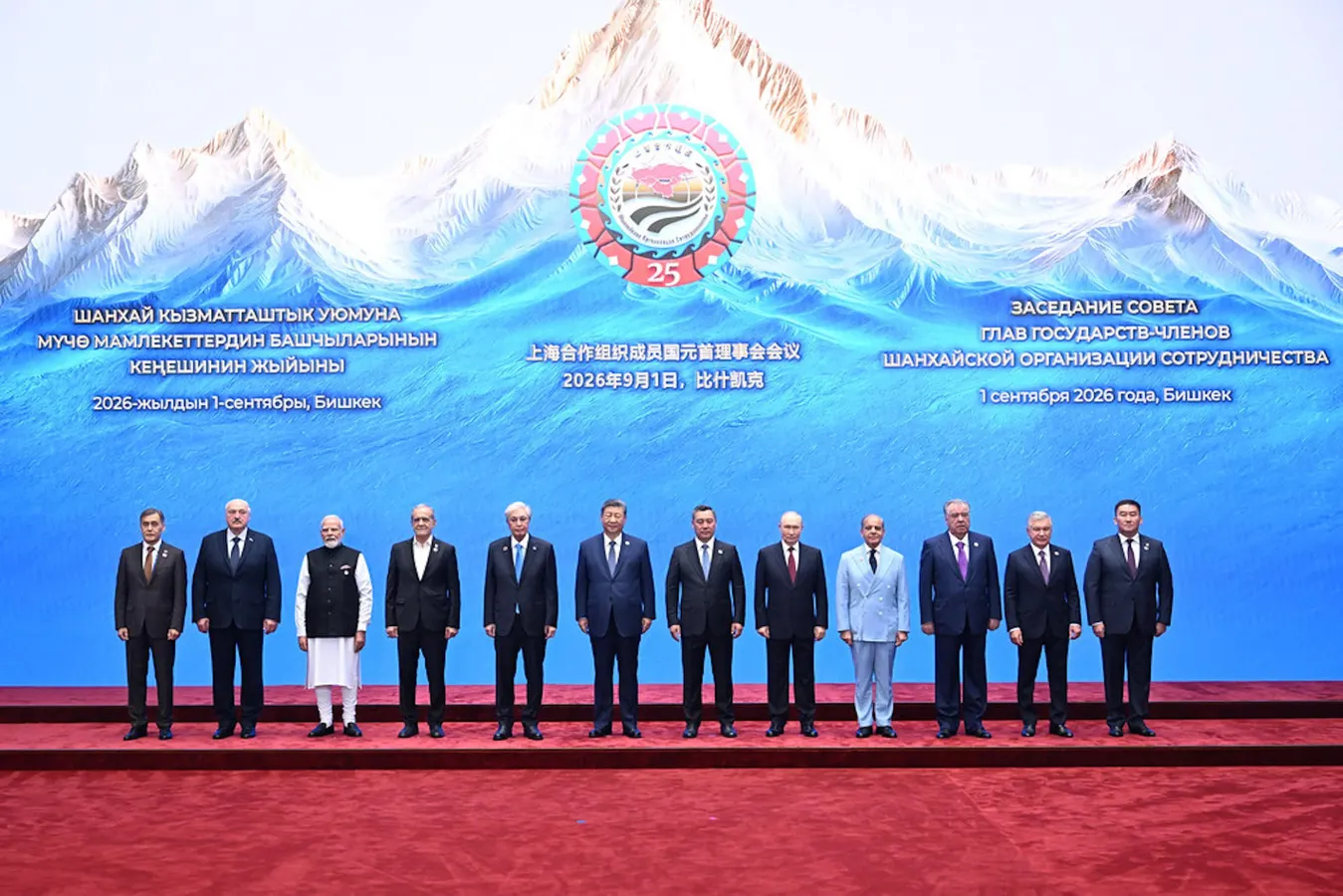

BISHKEK, KYRGYZSTAN – SEPTEMBER 1: Heads of state, government leaders of the Shanghai Cooperation Organisation (SCO) member states, and guest leaders pose for a family photo alongside President of Kyrgyzstan Sadyr Japarov during the extended SCO Plus format meeting held at the Yrys Ordo Congress Center in Bishkek, Kyrgyzstan, on September 1, 2026.
Anadolu via Getty Images
The Shanghai Cooperation Organization is an organization encompassing over half of humanity, uniting Russia, China, and India under one institutional roof alongside a host of other states throughout Eurasia. The SCO summit in Bishkek, Kyrgyzstan on August 31 and September 1 brought this collection of states together with many objectives, but its primary aims were development rather than geopolitical.
The SCO includes several geopolitical rivals with little incentive to subordinate their national interests to a common bloc. China and India compete for influence across Asia, while India and Pakistan are mortal adversaries. Russia and China cooperate strategically in some arenas while competing for economic influence in Central Asia, although Beijing clearly holds all the cards. Coordination is limited, and bilateral relationships often drive outcomes more than the organization itself.
It would be a mistake to dismiss SCO just because of these differences. The SCO’s security architecture is different from NATO. The organization is better understood as a capacity-building project, one that creates habits of cooperation, institutional relationships, and commercial channels among member states that all have their own agendas and priorities. Economic priorities are driving cooperation amongst SCO members.
An Underappreciated Investment Engine
SCO has spent years, now a quarter of a century, attempting to expand trade, investment, infrastructure, energy, and financial cooperation. The organization is slowly accumulating the machinery through which investment can move and be channeled across Eurasia even as its institutions continue to develop.
China has been the most consequential actor in this process. Beijing has repeatedly used the SCO as a platform for advancing the broader economic architecture associated with the Belt and Road Initiative. It is not alone. Russia and India have pursued economic initiatives through the organization to varying degrees, while Central Asian governments have sought to use its gatherings to attract capital and secure infrastructure commitments.
Energy provides an early example. At the 2007 Bishkek summit, SCO members backed greater energy cooperation and the creation of an energy club, while Russia and Kazakhstan advocated deeper integration of regional energy networks. The initiative did not produce the unified energy market some envisioned, but it showed SCO can create a political setting in which commercial interests are assembled, discussed, and occasionally converted into projects. The most notable gain was the consolidation of the China-Turkmenistan gas pipeline, which became one of China’s most important energy arteries.
SCO may remain too loose to function as a coherent economic bloc, but China can use the promise of investment to give the organization greater practical weight. Economic interdependence can accomplish something diplomatic declarations cannot. It gives an organization a reason to persist.
Diplomatic Summit, Investment Expo
Kyrgyzstan appears intent on testing precisely this proposition. As the outgoing president of SCO, Bishkek has an opportunity to use the summit as more than a diplomatic gathering. Previous chairs have done the same. Kazakhstan’s 2017 presidency coincided with its effort to showcase Astana as an international business and investment center around EXPO 2017.
Kyrgyzstan has two particularly consequential projects to trumpet. The first is the China-Kyrgyzstan-Uzbekistan railway, a roughly 530-kilometer project connecting Kashgar in China’s Xinjiang region through Kyrgyzstan to Andijan in Uzbekistan. The railway is designed to create a shorter overland route between China and Central Asia, with the potential to move as much as 15 million tons of freight annually. Strategically, it also endeavors to re-direct north-south trade between Central Asia and the Indian subcontinent through the China Pakistan Economic Corridor.
The second is more unusual: the Tamchy Special Financial Investment Territory. Established in 2025 and formally opened in July 2026, the Tamchy SFIT is a special economic zone attempting to create an international financial jurisdiction utilizing an imported English common law legal regime with independent financial regulations and arbitration mechanism. This is noteworthy because its economic logic extends beyond the SCO. Kyrgyzstan is inviting SCO capital, but unlike past expos piggybacking off of SCO summits, this is not at the expense of Western investors. Kyrgyzstan is seemingly eager for investment from everyone.
Kyrgyzstan has, since the 2005 Tulip revolution, been the political darling of Washington in Eurasia for its democratic credentials. Investment hasn’t mirrored political favor yet. By establishing a jurisdiction modeled around international financial standards, Bishkek is signaling that Western capital is welcome and will be nurtured. The Tamchy SFIT is thus not merely another investment incentive. It is an attempt to create a platform where different pools of capital can enter Kyrgyzstan and reassure investors that their interests will not be subordinated to geopolitical forces.
SCO Investments Going Forward
SCO should not be mistaken for an emerging economic fortress or monolithic protectionist bloc. Its members have their own and at times competing interests, and smaller states have too much incentive to preserve access to capital beyond the organization. The dominant strategy is not to choose between China and the rest of the world, but to use China’s connectivity projects, the SCO’s political power, its own geopolitical neutrality, and international investment to expand their freedom of action.
The Bishkek summit matters beyond geopolitics. Bringing representatives of the largest non-Western intergovernmental organization is politically important, but also a great sales opportunity. Whatever Xi and company discuss and whatever proclamation is published, the greatest legacy of the summit will probably not be political, but economic. These outcomes will help determine whether the SCO remains primarily a forum for political coordination or becomes something more consequential: an increasingly important mechanism for directing the flows of capital, infrastructure, and commerce across the globe.
















Leave a comment