


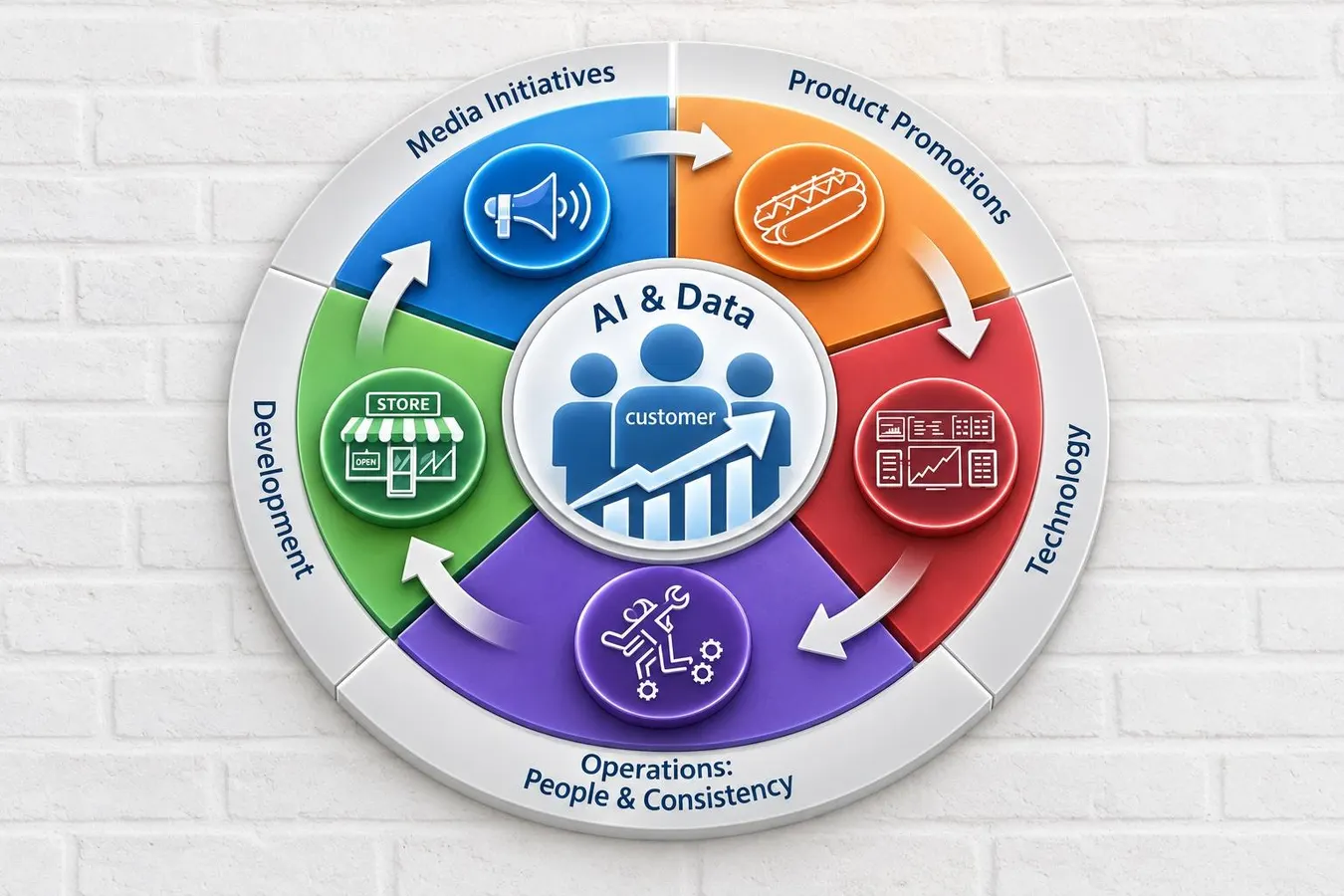

The process for evolving from a brand that shows up into a brand that wins.
Clifford Hudson & Craig Miller
Brand building is fundamental to the value-creation and growth strategy of any commercial enterprise of scale. It involves establishing and continuously evolving the characteristics necessary to remain relevant and trusted by consumers as preferences and the competitive landscapes change. It is essential to influencing perceptions, emotions, and choices that will ultimately help stimulate customer loyalty, market share, and profit margins.
But evolving a consumer brand from the brick-and-mortar experience of the 20th century into the digitally-driven world of the 21st is often more art than science – as we unpack in Bricks and Clicks. Too many brands get this wrong; they roll out new technology with their logos and call it “digital transformation.” That’s not evolution. That’s decoration.
The adoption of new technologies or entry into new digitally powered forums may create the appearance of modernization but fall short of creating meaningful strategic or economic value.
The greater opportunity is to develop the brand with newer, more relevant methods of consumer engagement, while amplifying what has always made it distinctive. That means understanding how customer expectations are changing, where new forms of engagement are emerging, and how new technologies can strengthen the customer experience without diluting (or compromising) the essence of the brand.
The changes facing companies in today’s digital age seem to be more radical and are happening faster than ever. Leading a company in such an environment can feel volatile, chaotic, and uncomfortable. Yet some companies seem to have the resilience and endurance to survive—and even thrive—in these turbulent conditions.
In fact, we’ve experienced a technological revolution for decades, now rapidly accelerating across every segment of the economy, transforming industries and redefining competitive landscapes. The transition of technology and its impact across business will continue at an exponential pace—from automation to connecting and engaging with customers in new ways, and now to leveraging predictive content and augmented intelligence created by AI.
So how do companies prepare and build winning strategies in a world of perpetual uncertainty and constant change? How do some companies thrive, while others don’t survive?
In our view, the common characteristic of preparedness and winning strategies among resilient and enduring companies is a set of guiding principles held in a flexible mindset, manifested through behaviors rooted in their DNA. Two of the primary characteristics are: 1) a constant focus on the customer experience, and 2) a clear sense of your brand’s differentiation as a competitive advantage.
Real brand evolution isn’t about appearing everywhere. It’s about belonging where your customer already lives, and doing it in a way that feels inevitable, not invasive. Here’s a suggested process that separates brands that merely show up from brands that win.
1. Never Start with the Technology
One of the most common mistakes in evolving a modern brand strategy is beginning with the technology instead of the customer.
Technology can be an extraordinarily powerful enabler, but it’s not the strategy. Chasing the newest channel because a competitor got there first is how brands lose their way with the customer.
A better starting point is to ask what customers value most about the brand, why they choose it over alternatives, and where friction or unmet opportunity exists in the experience. Once those fundamentals are understood, technology can be applied with strategic purpose, rather than tactical, copycat excitement.
2. Clarify What Makes the Brand Different
Before deciding how a brand should evolve, leadership must first understand what brand attributes should be protected.
Every durable consumer brand possesses a collection of characteristics that customers associate with it. Those characteristics may include convenience, hospitality, speed, personalization, value, culture, trust, or some combination of attributes that have been built over many years.
True differentiation is deeper than logos, colors, and slogans. It is reflected in the emotional and functional reasons customers return, recommend, and remain loyal.
3. Identify the Evolving Trends of Consumer Behavior
Consumer behavior is constantly evolving. At present, customers are becoming more mobile, more informed, more impatient, more socially connected, and more accustomed to highly personalized experiences. They move fluidly between physical and digital environments and increasingly expect brands to recognize that continuity.
The strategic question is not simply which behaviors are changing. The more important question is how to leverage or adapt the brand’s existing core attributes to meet the needs of the customer’s evolving behaviors.
4. Chart All Touchpoints of Your Brand Experience
Map the full journey—every touchpoint where a customer meets your brand today, physical or digital, intentional or incidental. Most companies have this map in fragments across different departments, not laid out end-to-end.
Customers, of course, do not experience a company through its organizational structure. They experience the brand through customer-interfacing interactions, whether positive or negative.
The strategic opportunity is therefore not simply to digitize individual touchpoints. It is to turn those touchpoints into a coherent experience in which the customer can move naturally between physical and digital interactions without encountering the seams inside the organization.
5. Identify What Technologies Can Enhance the Experience
Identify emerging technology trends that can enhance, extend, or remove friction at key consumer touchpoints across your brand experience.
With your brand DNA clarified and your engagement map in hand, you can evaluate new platforms, mediums, and formats. Not every platform deserves your presence. The ones that do are the ones sitting at the intersection of real consumer behavior and real brand relevance.
So, the chosen technology should not necessarily be the newest or most heavily promoted. It should be the technology that strengthens the customer experience and improves the economics of the business.
6. Weave the Physical (Bricks) and Digital (Clicks) Together
The synthesis of brand characteristics, consumer behavior, engagement mapping, and technological relevance isn’t a spreadsheet output—it’s a creative act. It requires the courage to express it somewhere it’s never lived before. Done well, this is where you meet the customer at the exact place they were already heading, speaking in a voice they already trust.
Digital capabilities should improve the physical experience, while interactions in the physical experience should generate insights that improve digital engagement. Customers should experience continuity across channels, regardless of where the interaction begins.
This is the fundamental principle behind an effective bricks-and-clicks strategy: the digital experience should not replace the physical brand experience. It should extend it, strengthen it, and make it more valuable.
7. Turn Customer Data into Economic Value
The opportunity to collect meaningful customer data is extraordinary. Using that data and the actionable insights derived from analyzing customer behavior and interactions with the brand can fundamentally reshape marketing and the broader operating model to reduce friction, improve decisions, personalize engagement, and create substantial value for both the customer and the business
Here’s the payoff most brands leave on the table. Every one of these new touchpoints generates “first-party” data—behavioral, transactional, attitudinal—at a resolution the brick-and-mortar era could never offer.
The algorithms born from analyzing customer behavior should be actively reshaping how you market, personalize, and spend, directly improving sustained growth and profitability
Beyond the Four Walls: Extending the Value Proposition
Success, for Sonic, meant rethinking the traditional brick-and-mortar business model, not segregating but synthesizing the digital and physical paradigms, and not replacing but retrofitting to harness the commercial power of the internet and the World Wide Web.
For the leadership team, it meant realizing that the traditional business model was no longer constrained by its physical brick-and-mortar limitations. It was about using our brand-building framework to determine how we could leverage digital and data to reduce friction in the operations and the customer experience. It was about reimagining how to enhance and extend the business model beyond the four walls and transform into a bricks-and-clicks entity.
The Winning Formula
The companies that succeed in periods of technological change are rarely those that chase technology the fastest. More often, they are the companies that understand their brand deeply, stay close to their customers’ evolving behavior, and identify where new technology can strengthen both.
When that sequence is reversed, technology often becomes a collection of costly, disconnected initiatives that add little to no value. When the sequence is right, technology becomes an integrated business capability that strengthens differentiation, improves the customer experience, and creates measurable economic value.
The pace of technological change will continue to accelerate, particularly as artificial intelligence becomes embedded across nearly every aspect of business. Yet the fundamental leadership challenge remains remarkably consistent: understand who you are, understand why customers choose you, anticipate where their expectations are moving, and then use technology to meet them there without losing what made the brand distinctive in the first place.
Fortune will favor the prepared in this new era of AI. The brands that win the next decade will be those that protect and amplify their core value proposition, while adapting to rapidly evolving customer needs and market conditions.
















Leave a comment