


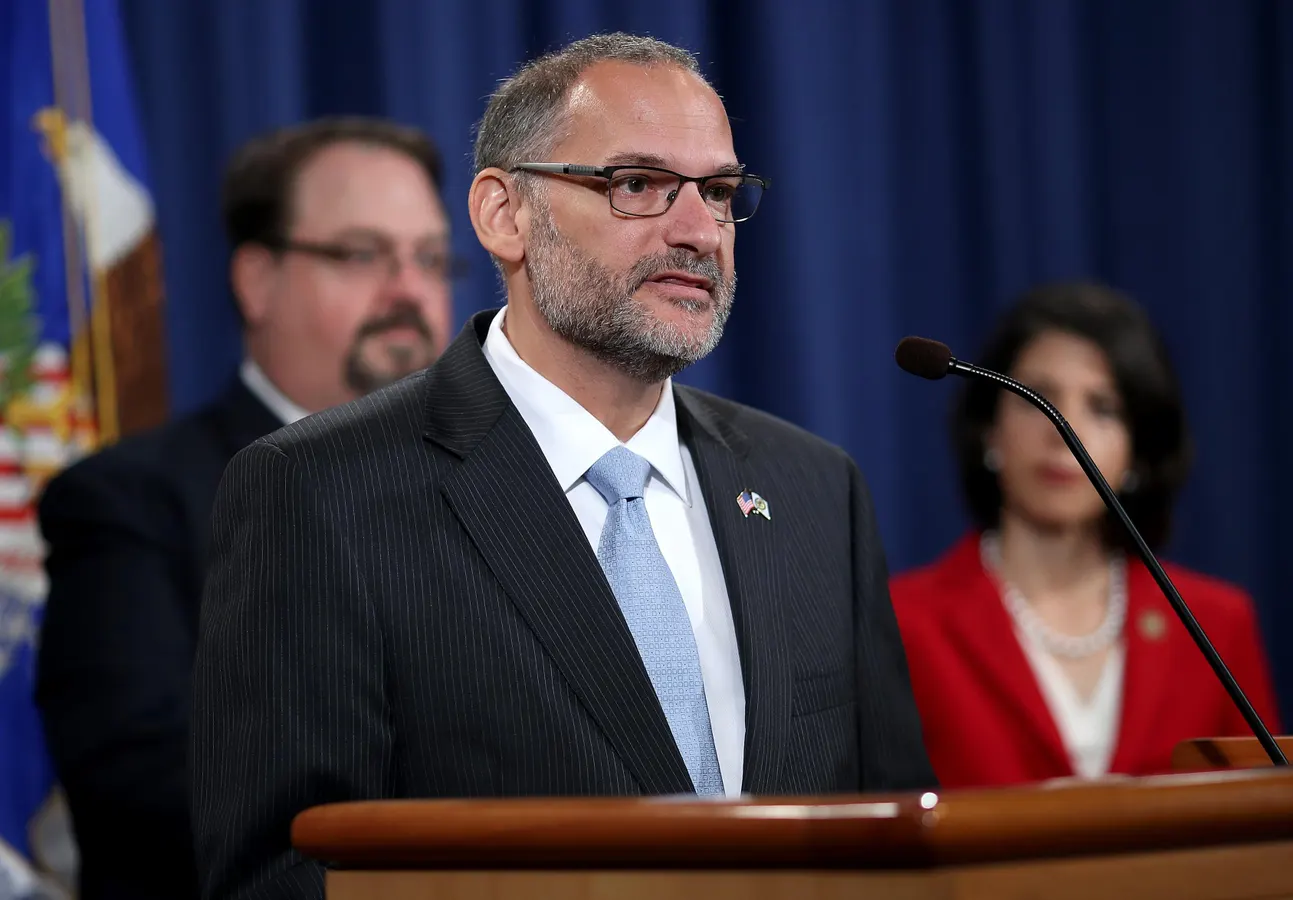

Hugh Hurwitz, then Acting Director of the Bureau of Prisons, held a press conference in 2019 talking about the new First Step Act. A few Directors later and now the Act is getting the attention it deserves.
Getty Images
The First Step Act has been the law for nearly eight years but implementing it across the Federal Bureau of Prisons has proved far more difficult than passing it.
On September 24, 2026, the Bureau of Prisons (BOP) announced the creation of a dedicated First Step Act Office that will report directly to BOP Director William K. Marshall III. The office will be responsible for coordinating implementation of the law across the federal prison system, including the calculation of First Step Act Time Credits, programming, staffing, training, budgeting and compliance.
It is a significant organizational change because the First Step Act affects nearly every part of an eligible federal prisoner’s sentence, from programming inside an institution to the calculation of credits that can eventually move that person to prerelease custody or supervised release.
The announcement also represents another step by the Trump administration and Marshall to address problems that have plagued implementation of one of President Donald Trump’s signature criminal justice accomplishments.
Trump And The First Step Act
President Trump signed the First Step Act into law on December 21, 2018, after it passed Congress with bipartisan support. The legislation represented one of the most consequential changes to federal corrections in decades.
The First Step Act required the development of a risk-and-needs assessment system and expanded evidence-based recidivism reduction programs and productive activities. Eligible prisoners who participate can earn First Step Act Time Credits that may ultimately be applied toward prerelease custody, including halfway houses and home confinement, or toward an earlier start of supervised release.
The law also made other important changes. It increased available good-conduct time, expanded the federal safety valve for certain drug defendants, made portions of the Fair Sentencing Act retroactive and directed the BOP, to the extent practicable, to place prisoners closer to their families.
Trump deserves historical credit for signing the legislation and making federal prison reform a priority of his first administration. But signing a law and implementing it throughout a sprawling federal prison system are two very different things.
Years Of Problems Implementing The First Step Act
The First Step Act required the BOP to change how it evaluated prisoners, delivered programming, calculated sentences and prepared people for release. The Bureau struggled with portions of that mandate almost from the beginning.
In May 2026, the DOJ Inspector General issued a report examining the BOP’s use of $1.23 billion in First Step Act funding during fiscal years 2022 through 2024. Its findings were troubling.
The OIG found that the Bureau had not provided institutions with sufficiently clear guidance about how First Step Act money should be spent and had difficulty spending those funds within required timelines. It also found that programs advertised as available were not necessarily accessible to prisoners because of staffing shortages, space limitations and institutional lockdowns. At some prisons, according to the OIG, hundreds of prisoners waited years to complete programs.
There were also questions about how the money itself was being used. The OIG reported that more than $250 million in First Step Act funding had been used to provide free telephone calls to all prisoners rather than using that benefit as an incentive connected to First Step Act participation. Another nearly $120 million was transferred to the Department of Labor for vocational training, but the OIG found that BOP oversight was insufficient to ensure that those funds advanced First Step Act purposes.
The Inspector General found that unreliable data impaired the Bureau’s ability to determine whether the First Step Act was accomplishing its objectives or even to accurately communicate its implementation progress to Congress and other stakeholders.
These are not minor administrative issues. For someone serving a federal prison sentence, an incorrect calculation or unavailable program can affect when that person returns home.
Marshall’s First Step Act Task Force
When William Marshall became BOP Director, First Step Act implementation became one of the issues his administration publicly emphasized.
In June 2025, Marshall issued a directive calling for more robust implementation of both the First Step Act and Second Chance Act. Among other changes, the Bureau directed that FSA credits and Second Chance Act eligibility could be treated cumulatively when determining community placement and emphasized the use of conditional placement dates rather than waiting until the last minute to begin the prerelease process.
In July 2025, Marshall created a First Step Act Task Force at the BOP’s Designation and Sentence Computation Center in Grand Prairie, Texas. The Task Force grew out of a problem Marshall said he encountered while visiting institutions which was that prisoners complained that their home-confinement paperwork was not being processed, while staff complained that the systems they relied upon were not always displaying accurate dates.
The Task Force was charged with manually identifying and correcting community-placement dates. Among its assignments were identifying people already in Residential Reentry Centers who qualified for home confinement, manually calculating placement dates that combined First Step Act and Second Chance Act authorities, communicating those dates to Residential Reentry Management offices and reviewing prisoners still inside institutions for additional community-placement opportunities.
Rick Stover, a longtime BOP official who had worked on First Step Act Time Credit policy, became an important figure in that effort. Marshall had earlier tapped Stover to help advance First Step Act implementation, citing his operational experience and involvement in developing the Bureau’s time-credit policy.
The Task Force was an intervention designed to solve immediate problems. The new First Step Act Office appears intended to make that intervention permanent.
A Permanent First Step Act Office
The office announced today will report directly to Marshall and operate from both BOP headquarters in Washington and the Designation and Sentence Computation Center in Grand Prairie. That second location is particularly important because DSCC sits at the center of sentence computation and many of the administrative decisions that ultimately determine how First Step Act credits affect an individual’s incarceration.
According to the BOP, the office will oversee the administration and calculation of First Step Act Time Credits; coordinate evidence-based recidivism-reduction programs; ensure the availability and quality of productive activities; develop policy and training; monitor statutory compliance; manage FSA resources and budgets; evaluate program outcomes; and provide technical assistance to institutions and regional offices.
More importantly, it puts responsibility in one place, just as the designation process is done for all BOP inmates by the DSCC. For years, First Step Act implementation has crossed numerous parts of the BOP bureaucracy: institution case-management staff, education departments, psychology services, regional offices, Residential Reentry Management offices, sentence computation staff and Central Office.
“The establishment of this dedicated office demonstrates the Bureau’s commitment to the successful implementation of the First Step Act,” Marshall said, adding that the office would provide focused leadership to expand programming and opportunities to earn credits toward earlier release.
Stover described another potential benefit: consistency. He said centralizing oversight should allow the Bureau to provide more timely and consistent guidance to staff while also responding more effectively to questions from prisoners, families and advocacy organizations.
The Real Test Will Be Implementation
Creating an office does not solve the First Step Act’s problems by itself. A recent contract award by the BOP to improve the calculation and presentation of information to staff and inmates was awarded a $2.5 million contract to Recidiviz, showing the Agency’s commitment to improvement.
The OIG’s findings demonstrate that some of the biggest obstacles are operational: staffing shortages, inadequate program capacity, poor data, inconsistent guidance and difficulties translating policy written in Washington into something that works at more than 100 federal institutions. Now, there will be an identifiable organization inside the BOP whose principal job is making the law work. That creates something the First Step Act has often lacked, clear accountability.
When credits are calculated incorrectly, when institutions interpret guidance differently, when programs have years-long waiting lists or when money appropriated for rehabilitation does not translate into meaningful programming, there will now be an office responsible for addressing those problems.
The creation of a dedicated First Step Act Office suggests that the BOP now recognizes that implementation cannot simply be one responsibility among many. It requires people whose primary responsibility is ensuring that the law works.















Leave a comment