


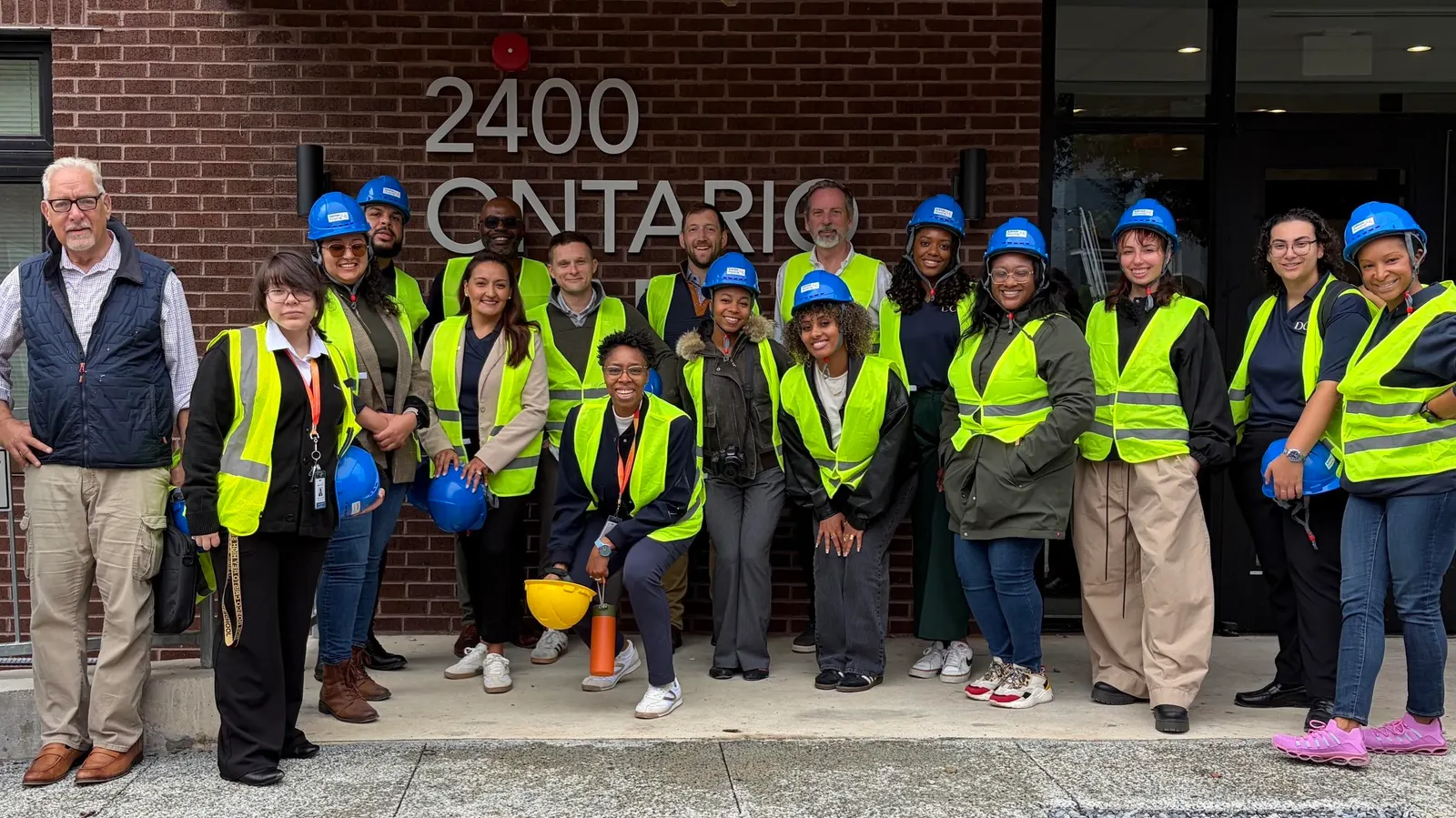

DC Green Bank team visit one of their projects with Jubilee Housing
DC Green Bank
On Sept. 18, a federal judge in Rhode Island ruled that the EPA acted illegally when it canceled Solar for All, the $7 billion program meant to bring cheaper solar power to lower-income households. The money was pulled in August 2025, and the agency now says it is reviewing the decision and weighing an appeal.
Washington, D.C., was set to receive $62.45 million of that funding, through an application put together by the District’s Department of Energy and Environment and the DC Green Bank, one of more than 20 green banks in the U.S. Losing that money did not stop investments. In January 2026, an underused office building near the Dupont Circle Metro closed on $465 million in financing to become 532 apartments, 61 of them affordable. It was the largest PACE deal in the country so far. “We like to think of ourselves as the financial dream partner for folks who want to build in the city,” says Brandi Colander, the bank’s CEO.
A Bank Without Checking Accounts
The name “green bank” throws people off. This is the kind of a bank that does not take deposits, and you cannot open a checking account. DC Green Bank is an instrumentality of the District, and its voting board members are appointed by the mayor and confirmed by the D.C. Council. Since it is not a city agency, the bank does not run only on public money. The idea is to use a small amount of public funding to pull in private capital and eventually cover its own costs. Beyond what the District contributes, the bank draws on its own lending portfolio, federal programs, and grants. “We’ve proven the concept,” Colander says. “Green banks are pioneering hyper-local entities. We know where the community investment actually needs to happen.”
Investments Range From Solar To Stormwater
Regular banks don’t like lending on technology they have not seen work, so green banks take that early risk until everyone else gets comfortable. Solar is the classic case, and not long ago it was hard to get a conventional lender to finance it. Green banks made their name by going first. “Conventional banks now see the promise of technologies like solar that are no longer nascent but scalable and important tools to drive affordability and local energy generation,” Colander says.
DC’s Green Bank has taken on new challenges, such as getting the city ready for floods and heat waves. The bank set up a loan fund for stormwater and green infrastructure projects in Wards 5, 7 and 8 to help with flooding. The goal, Colander says, is “the infrastructure for tomorrow and not the infrastructure for yesterday.”
Now consider a recent uptick in extreme weather events. After damage, most buildings get rebuilt to code. Insurance only pays for that, and owners often avoid the extra friction of trying something new. The green bank tries to change that at the design stage, before anything breaks. “You’ve been thinking and planning ahead for so long that your infrastructure is just inherently more resilient,” Colander says of the District’s approach.
New Life For Old Buildings
Since the pandemic changed how people work and commute, the city has had plenty of office space it would rather see turned into homes and hotels. The green bank runs the DC PACE program, which lets building owners pay for energy upgrades through a charge on their property tax bill.
The $465 million Geneva conversion is the biggest example. Post Brothers is redeveloping the building, with the PACE financing coming from Nuveen Green Capital through the District’s program. Sixty DC, which opened last fall in Dupont Circle, used PACE financing through the green bank to turn an empty office building into a boutique hotel with a restaurant and a rooftop bar. In Georgetown, the bank and Nuveen closed $42 million to turn an old warehouse into a 230-room citizenM hotel, with upgrades expected to save about $46,000 a year in utility costs.
Affordable Housing That is Built To A Higher Standard
Affordable housing is one of the District’s hardest problems, and it is where a lot of the bank’s smaller deals land. The Faircliff, in Columbia Heights, got a $1.85 million predevelopment loan that let the developer build to Passive House standards, one of the strictest energy-efficiency benchmarks in the world. The building is close to airtight, which keeps out street pollution and noise, and it has 12 EV chargers for residents. For Colander, it is proof that good design changes daily life for the people who live there. “Everybody deserves to live in these spaces,” she says.
Cycle House got $2 million in construction financing. It features 18 affordable homes in a net-zero building that makes as much energy from solar as it uses in a year, and it earned LEED Gold. As the name suggests, it was designed for people who bike. Finally, a few blocks from Howard University, a $4.2 million deal turned a co-living Euclid building fully electric. The gas water heaters and stoves are coming out, and new solar should cover about half the building’s energy use.
DC’s green bank has become the place developers go when they want to build something the city will still be glad to have in 30 years: apartments in old offices, hotels in old warehouses, and homes that hold up when the weather turns. For a modest amount of public money, that goes a long way.













Leave a comment