


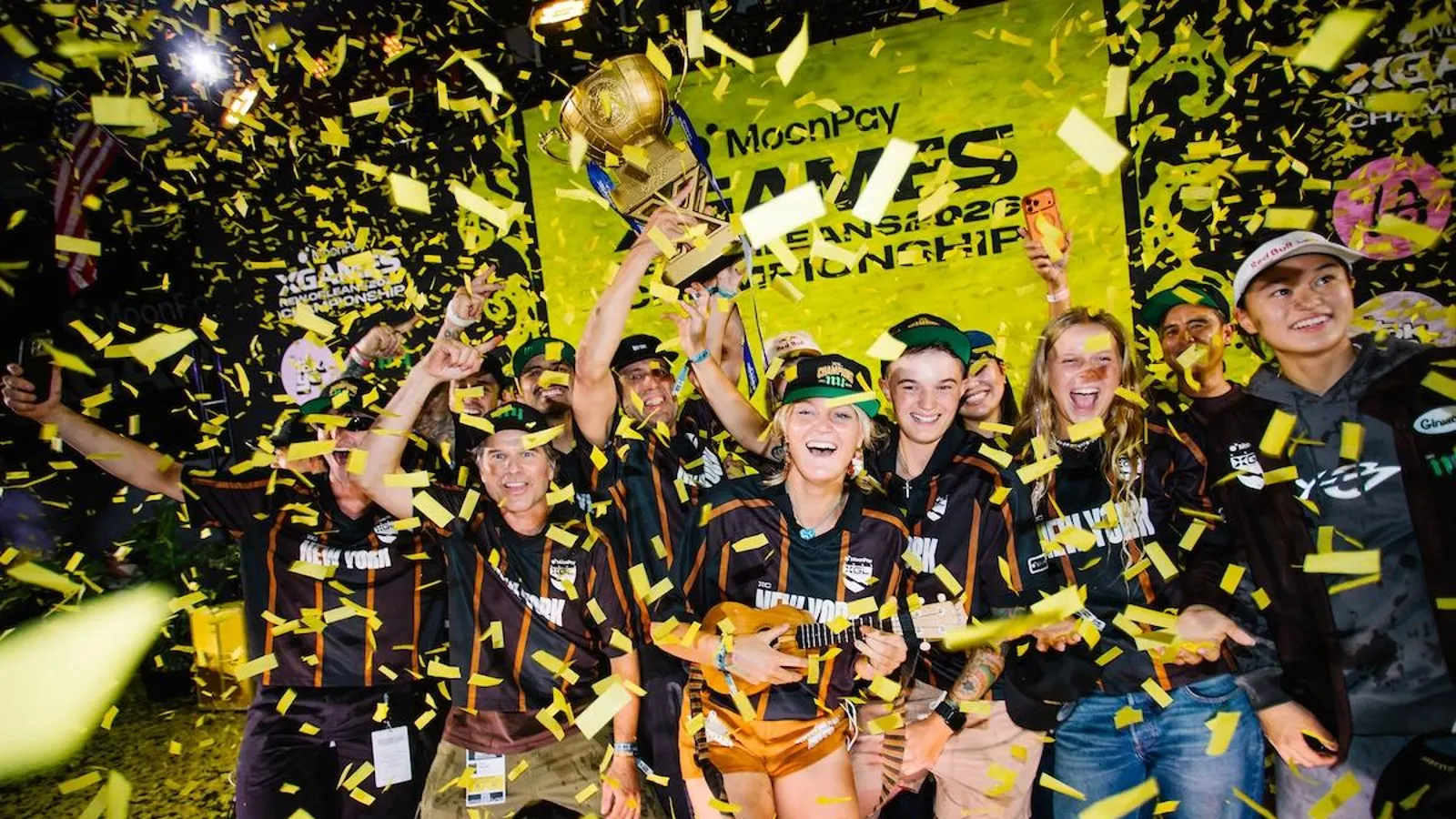

XC New York celebrates winning the first ever X Games League championship.
X Games / Jhank Gonzalez Ortiz
For nearly three decades, athletes have competed at X Games seeking individual glory. Action sports, by their nature, are a solitary, not a team, pursuit—though there have been notable exceptions over the years, such as Tony Hawk and Andy Macdonald’s vert doubles dominance of the ’90s and early aughts.
However, in 2026, the launch of X Games League reimagined what action sports competition could look like. Under this new structure, 40 skateboarding and BMX athletes were drafted onto four teams of 10. The clubs—XC New York, XC São Paulo, XC Tokyo and XC Los Angeles for the summer season, with winter clubs to be announced—have ownership structures, jerseys and salaries, components found in any sports league.
The first season of league competition featured three stops: Sacramento, Chiba and the championship in New Orleans, all happening in the span of 30 days from late June to late July.
Each stop resembled the standalone X Games events of the past, in which athletes competed for individual medals. Undrafted athletes as well as athletes in non-league disciplines (namely, Moto X) were still in the mix for podium spots—and many of them did land there, sending a message to the club general managers who did not draft them.
But during XGL’s inaugural summer season, athletes also racked up points for their teams. These points would eventually see one team crowned league champion at the final event in New Orleans July 24–26.
As the season came to a close, many athletes found that the biggest surprise wasn’t the format itself—it was how quickly they embraced competing for something bigger than themselves. Nowhere was that more evident than with the inaugural champions, XC New York.
Over the three events, New York emerged as a powerhouse, matching XC Tokyo stride for stride in the standings while producing standout performances across multiple disciplines. The roster featured established veterans alongside rising stars.
For athletes accustomed to spending events focused solely on their own contests, the experience of cheering on their teammates became an entirely new part of the job. Daniel Sandoval experienced that shift firsthand when XC New York’s season fell on his shoulders in the final event of the championship, Men’s BMX Park.
“It was a collective of things with the team. Everyone did their part, every point mattered and everything came down to the wire,” Sandoval said.
Sandoval’s bronze medal in BMX Park Best Trick in Sacramento was only one contribution to XC New York’s season.
Olympic silver medalist and BMX athlete Hannah Roberts entered the season as one of the faces of the new league, having been drafted 12th overall by XC New York general manager Steve Rodriguez. While her own performances remained among the sport’s elite—including silver medals in Sacramento and Chiba despite competing through a shoulder injury—the team environment added another dimension to her competition.
Roberts’ experience reflected one of the season’s recurring themes. Athletes who had spent years battling each other for podium positions suddenly found themselves celebrating each other’s success. Riders who normally competed in different disciplines became invested in events they had never before followed closely because every medal mattered to their club.
The effect was especially visible throughout the season as athletes gathered in team areas, celebrated podium finishes together and tracked the overall standings from contest to contest.
For XC New York, those contributions came from every corner of the roster.
No. 1 draft pick Chloe Covell captured gold in Women’s Skateboard Street in Chiba and consistently delivered crucial points. Ginwoo Onodera emerged as one of the breakout stars of the inaugural season with consecutive street victories in Sacramento and Chiba. Logan Martin piled up podium finishes across multiple BMX disciplines while leading XC New York in season points. Veterans like Nyjah Huston and rising stars Paige Heyn and Momiji Nishiya added key finishes that kept New York in the championship race from opening weekend through the finale.
The season demonstrated that while action sports remain deeply individual once the competition begins, the moments before and after each run can be transformed by having teammates to celebrate with. That sense of shared investment extended beyond medals. Athletes found themselves following disciplines outside their own, cheering from the sidelines, discussing strategy between events and experiencing victories—and disappointments—as a group.
Martin was in the running for the XGL MVP award after he earned five medals in six starts across Sacramento and Chiba. However, he took a heavy fall at BMX Park practice in New Orleans, dislocating bones in his hand and receiving six stitches for a slam on his chin that also broke multiple teeth. Disappointed to have to bow out in the championship, Martin said, “I’ve seen the inside of too many hospitals this year.”
But just because Martin was out of commission didn’t mean his team was.
Before XGL, a competition-ending injury like that might have meant heading home early. But Martin’s teammates Roberts and Sandoval still had chances to earn XC New York crucial points on the final day of competition.
Both were also seriously injured. Roberts fractured her fibula and torn ligaments in her right ankle after falling awkwardly in practice, while Sandoval was dealing with a fractured kneecap and ribs as well as a wrist injury.
Martin became a sideline coach and cheerleader, helping Roberts and Sandoval strategize runs that would allow them to get just enough points to keep XC New York in the championship race against XC Tokyo while respecting their injured bodies’ limitations.
The strategy changes when you’re competing as part of a team. As an individual, Roberts admits, she typically has the mindset of if it’s not first place, it may as well be last. But when you’re contributing points toward a team total, even a non-podium finish can be critical for standings.
“I was riding against medical advice, partly because there’s nine other people depending on me, and they’re all living up to their expectations, and, you know, it’s my turn to do my part,” Roberts said. “I wanted to do that by any means necessary, even if it was only getting 20 points.”
Hannah Roberts digs deep to earn Women’s BMX Park bronze for XC New York while competing with a fractured fibula and torn ligaments
X Games / Beatrice Trang
XC New York entered the final day of competition with a 20-point lead over XC Tokyo. Roberts and her team had determined that she only needed to finish in sixth place to give XC New York enough points to maintain the edge in the standings.
“Logan, Chloe [Covell], Nyjah, Tate [Carew], everybody was there,” Roberts said about dropping in for the Women’s BMX Park final. “Having them and having the GMs and the owners and everybody there—I told them I wasn’t taking a second run, I was just gonna do first and third, and they backed that decision 100%—helped me get what I needed in the moment.
“And that was the craziest feeling for X Games. I mean, I’m a very competitive person, but with how the leg was feeling and the ankle was feeling, I probably would have pulled out on Saturday. And then you just look at how good everybody was riding, how close the points were. And I was just like, ‘No, I could do this.’”
Roberts overdelivered, finishing in bronze-medal position and earning 75 points.
Women’s BMX rider Hannah Roberts celebrates winning bronze in Women’s BMX Park with her XC New York teammates
X Games/ Beatrice Trang
Meanwhile, after a fall in BMX Dirt practice Sunday afternoon left him with a fractured kneecap and wrist injuries—on top of the fractured ribs he suffered at the first stop of the season in Sacramento—Sandoval wasn’t looking likely to compete in Men’s BMX Park, the final event of the championship.
Sandoval was supporting teammates Chloe Covell and Momiji Nishiya at their Women’s Skateboard Street Best Trick event, hoping they would be able to earn enough points to make up for the fact that he wasn’t able to compete. Nishiya eked out a win.
However, Covell wasn’t able to put down a clean run, while two XC Tokyo athletes, Coco Yoshizawa and Yumeka Oda, earned podium positions and, between them, 160 points, 60 more than Nishiya earned with her first-place finish.
It kept XC New York statistically alive, but hardly.
Sandoval got the note that Men’s BMX Park practice was set to begin in 10 minutes and began to make his way across Caesars Superdome to drop in and see how he felt. The president of XC New York owner UNA Sports Group, Daniel Rader, walked with him. Rader was thinking out loud: the Men’s BMX Park podium would most likely involve some combination of Marcus Christopher, Justin Dowell and Kieran Reilly, none of whom competed for XC Tokyo.
If Sandoval could somehow finish fourth, and Kevin Peraza (XC Tokyo) and Bryce Tryon (free agent) came in fifth and sixth…
Sandoval understood the implication immediately. XC New York was still in the running for the championship, and he could secure it without even having to finish on the podium.
“He could barely walk to the course,” X Games CEO Jeremy Bloom said. “We got the note from medical that Daniel was out. And then Steve Rodriguez, his GM, came up to me in the athlete lounge and said, ‘Hey, if I send Daniel, and he just drops in to get us the 20 points’—because that’s what he would have gotten at sixth—’is that allowed?’ I said, ‘Yeah, I mean, absolutely, he can drop in and not do anything.’”
“I’m watching him practice, and I watch him go faster and faster every practice run, and then on the third he goes up to his team box and says, ‘Throw me my pads,’” Bloom recalled. “And that’s when I knew, this guy is gonna compete, not just drop in.”
Daniel Sandoval fought through fractured ribs and kneecap and a wrist injury to compete in Men’s BMX Park and earn XC New York enough points to earn the inaugural XGL championship
X Games / Beatrice Trang
“Logan Martin was with me in my corner when I got injured,” Sandoval said. “He said, ‘Bro, 45 seconds is all you need.’ And Hannah had already performed and did her thing. I was like, ‘All right, let’s just do this. I’ll hurt later, but at least it gives us hope.’”
Sandoval knew he was in no state to finish on the podium. He knew he didn’t need to.
“I knew I could get fourth and at least apply the pressure [to XC Tokyo],” Sandoval said. “It’s a roll of the dice.”
Sandoval and Martin went back and forth on how best to structure his run. He needed an approach that would score high enough to secure fourth place but that wouldn’t risk another fall and additional injury.
Once he dropped in, “every trick or hit I’m hoping my body doesn’t shoot any sharp pain,” Sandoval said. “Adrenaline is one hell of a drug because I was feeling good. I just pushed through all of it and I just dug real deep. It was a crazy moment because maybe two or three people knew I was gonna go for it; everyone else thought I was just there supporting my team.”
“I remember he and Logan discussed a run that they knew would put him in fourth, and once he pulled it off, we were all waiting to see if Tokyo could top it,” Roberts said.
Peraza and Tryon made critical errors in their runs and were unable to top Sandoval’s. As soon as Tryon went down, XC New York’s celebrations began.
“It seems like Bryce fell and had this whole group of people celebrating his downfall, but it’s not like that,” Sandoval said. “It’s a different aspect of competitiveness. At the end of the day, we’re all homies and we all get along and there’s no bad blood. But in the moment of competition, all that’s out the window.”
Embracing Roberts, Sandoval broke down in tears, which in turn caused Roberts to cry as well. Meanwhile, the confetti fell around them for XC New York’s win and eternal claim to the title of first-ever XGL champions—and the $500,000 prize purse that came along with the custom trophy designed by lifestyle jewelry brand GLD.
Joining them in the celebration was GM Rodriguez and teammates Huston, Martin, Covell, Bryce Wettstein, Carew, Nishiya, Ginwoo Onodera and Heili Sirviö. Skateboarders Julian Agliardi, Paige Heyn and Jagger Eaton also served as injury replacements during the season.
XC New York GM Steve Rodriguez and teammates Nyjah Huston, Logan Martin, Chloe Covell, Bryce Wettstein, Tate Carew, Momiji Nishiya, Ginwoo Onodera and Heili Sirviö celebrate winning the inaugural XGL championship and the $500,000 prize purse
X Games / Beatrice Trang
“When you sit down and you program the 30 events from Friday to Sunday, you try to do your best to be deliberate with that last one,” Bloom said. “And I had such a strong intuition that the event would come down to that last event, Men’s BMX Park. But none of us could have scripted it that well.”
Many viewers expressed concern, if not criticism, that Roberts and Sandoval competed when they were so obviously injured. Both were evaluated by medical staff and told exactly what they were risking if they chose to compete. Both decided the consequences were ones they could live with. The medical staff serve as the referees of these sports, but short of failing concussion monitoring, the final decision is typically left to the athletes.
Roberts and Sandoval both said they likely wouldn’t have competed that Sunday if they were doing so as individuals. Both felt an obligation to be there for the nine other members of their team who were counting on them, but in the end, it was positive motivation driving their performances, not peer pressure.
“My teammates knew how bad I was hurting and they saw it all,” Sandoval said. “If I were to have been like, ‘Hey guys, it’s not happening,’ not one of them would have been like, ‘Come on, dude, you got this.’ They’d be like, ‘We get it, that was rough.”
Roberts agreed, and found that the support of her team was essential to pushing through the pain. “I always wear headphones, but I literally couldn’t hear my music once the competition started because Team New York was cheering so loud,” she said.
These are athletes who have been present at all the same X Games events for many years but, until XGL launched, had rarely crossed paths. What cause would men’s park skater Tate Carew have to be at a women’s BMX park event? When would Sandoval have ever found himself at a women’s skateboard street event?
After three events as members of XC New York, however, the athletes had completely bought in.
“Just being part of Team New York has inspired me and has been such an unbelievable huge influence on me and is a blessing in my life,” skateboarder Bryce Wettstein wrote on Instagram. “It feels like family.”
For a generation of athletes raised in an individual sport, the embrace of team culture came faster than many expected.
“Building camaraderie in a league like XGL isn’t like anything else in action sports. These are riders who’ve spent their whole careers doing their own thing, dropping in solo, so it was really special watching them actually buy into a team vibe and show up for each other,” said Rodriguez.
“When Hannah threw down the way she did, and then Daniel put it all on the line at the end, you could tell it wasn’t about personal glory anymore. They were riding for each other, for the team,” Rodriguez continued. “The look on Daniel’s and Hannah’s faces when they clinched it, that raw emotion, that’s something you can’t script. You could see everything they poured into this season just hit them all at once. That’s when you know the team model works. You can’t fake that kind of selflessness and team chemistry, and you definitely can’t force it. It has to happen organically, and for this group, it just clicked.”
Longtime action sports fans were skeptical that a team concept could succeed at X Games. Many changed their minds after seeing what XC New York pulled off.
“I had so many people message me, ‘I wasn’t onboard with this whole team thing but now I’m all in,’” Sandoval said. “I didn’t think it was going to have that much of an impact, but it really changed a lot of people’s perspectives. There were so many DMs that I got emotional about it. It was pretty powerful.”
In the end, XC New York captured the championship by finishing only 10 points ahead of XC Tokyo.
As the inaugural X Games League season concluded, XC New York emerged as the champion, but the league’s most meaningful achievement was something less tangible. It proved that action sports athletes could maintain their individual identities while embracing the camaraderie, accountability and shared purpose that define traditional team sports.













Leave a comment