


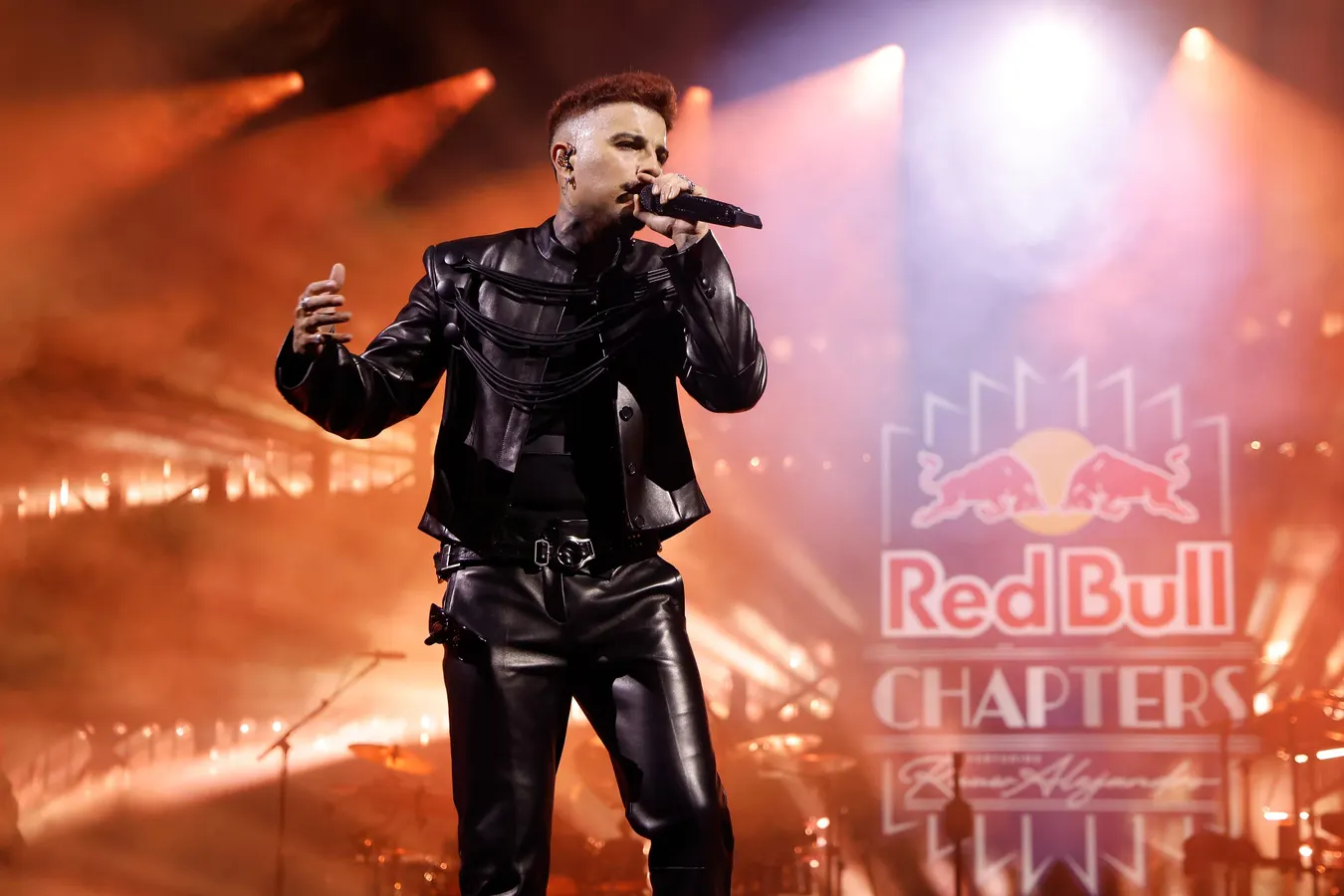

NEW YORK, NEW YORK – SEPTEMBER 05: Rauw Alejandro performs during the inaugural Red Bull Chapters at Forest Hills Stadium on September 05, 2026 in New York City. (Photo by Taylor Hill/Getty Images)
Getty Images
Rauw Alejandro has spent the last six years building a case for himself as one of the defining artists of the modern reggaeton era, moving fluidly between trap, pop, rock urbano and electronic influences while never losing his grip on the sound that raised him. This past weekend, Red Bull gave him a format built to match that range. Red Bull Chapters, a new three-part theatrical concert concept, made its debut at Forest Hills Stadium in Queens, and it did something a standard arena show rarely attempts: it asked an artist to narrate his own evolution in real time, on stage, for a paying audience of his biggest fans.
But the show itself was only the final beat of a rollout that had been building for weeks, and the campaign around it is worth examining as closely as the performance.
The Rollout Set The Stage
In the lead-up to Red Bull Chapters, the Cosa Nuestra tour’s Instagram, which had gone quiet between legs, came back to life with a steady stream of behind-the-scenes video and photo content from rehearsals. That kind of activation is a deliberate signal to an existing fan base that something is being built specifically for them, rather than a recycled festival appearance. Rehearsal content works as a slower burn than a single announcement post. It lets fans watch a show come together in pieces, which builds anticipation while also reinforcing the idea that this particular performance required real preparation, not just a tour stop plugged into a brand’s calendar.
The week before the show, Red Bull and Alejandro’s team also hosted a press dinner called La Mesa Nuyorican, an event built around celebrating Puerto Rican culture in New York and honoring Alejandro directly ahead of his Queens debut. Press dinners tied to a specific cultural theme, rather than a generic media meet and greet, do more work than they get credit for. They give outlets a reason to write about an artist before the actual event, they put the cultural framing of the show in front of press before a single song is performed, and they signal to the community being honored that the campaign understands the difference between playing in a neighborhood and actually engaging with it. La Mesa Nuyorican effectively set the thesis of Red Bull Chapters in advance, this was a concert about the New York that shaped, and continues the build, him.
That framing carried directly into the venue choice. Forest Hills Stadium sits a few miles from the Brooklyn neighborhoods where Alejandro spent stretches of his childhood living with his paternal family, absorbing Nuyorican culture, American R&B and dancehall alongside the reggaeton and Latin sounds of his native Puerto Rico. By the time fans walked onto the grounds, the campaign had already done the work of connecting the dots between the dinner, the borough and the artist’s own history. The pre-show retrospective waiting for them inside, display cases holding the Pirates jersey from his 2020 “Perreo Pesau’” video, the all-white look from “Cúrame” during his Vice Versa era, the silver suit from the Saturno World Tour and the red satin three-piece from the Cosa Nuestra World Tour, simply extended that same narrative one step further before the lights even went down.
And the demand curve backed all of it up. Red Bull Chapters was originally planned as a single night. It sold out fast enough that a second show was added, turning what could have been a one-off brand activation into a two-night sold-out run of roughly 13,000 fans a night. When a brand has to expand capacity mid-cycle because ticket demand outpaces the original plan, that is not luck. That is the product of a rollout that correctly built anticipation over weeks rather than days.
NEW YORK, NEW YORK – SEPTEMBER 05: Rauw Alejandro performs during the inaugural Red Bull Chapters at Forest Hills Stadium on September 05, 2026 in New York City. (Photo by Taylor Hill/Getty Images)
Getty Images
Chapter One: Inspiration
The show opened with an LED screen sequence and voiceover narration tracing Alejandro’s Taíno, African and Spanish roots, framing his career less as a series of hits and more as an inheritance. That framing is smart positioning for an artist whose catalog spans reggaeton, bachata, rock and electronic experimentation. It gives listeners a throughline to hold onto even as the sound shifts from song to song.
Once Alejandro appeared on stage, the chapter moved through his 2024 single “Santa” and into “Déjame Entrar” from Cosa Nuestra, before settling into earlier catalog staples like “Toda,” “Dream Girl” and his Romeo Santos collaboration “Khé?” The set also reached back further, closing with a cover of “Tú Con Él” and the bomba-infused “Carita Linda,” two selections that function as a tribute to the Latin music lineage he draws from rather than a promotional showcase for his own material. That is a meaningful choice for an artist at his commercial altitude. It signals confidence rather than a need to fill every minute with his own hits.
Chapter Two: Momentum
The second act reset the tone entirely. Alejandro shifted into an all-black look with heavier jewelry, and the production leaned into live rock instrumentation for a run of fan favorites including “Baby Hello,” “Dime Quién????,” “Todo De Ti,” “Tiroteo (Remix),” “Desenfocao’” and “2:12 AM.” This is the chapter built for the audience that has followed him across eras, the ones who know the deep cuts as well as the singles.
The chapter closed with a motorcycle stunt finale, doubling down on that same instinct to let Red Bull’s action sports world physically share the stage with the music.
NEW YORK, NEW YORK – SEPTEMBER 05: Rauw Alejandro and Chencho Corleone perform during the inaugural Red Bull Chapters at Forest Hills Stadium on September 05, 2026 in New York City. (Photo by Taylor Hill/Getty Images)
Getty Images
Chapter Three: Legacy
The final chapter is where the night’s biggest statement landed, and it opened with a DJ set from Tainy. It is difficult to overstate how significant Tainy’s presence on that stage actually is. He is the producer behind a meaningful share of the reggaeton and Latin trap records that defined the genre’s global rise over the past decade, with production credits spanning Bad Bunny, J Balvin and Alejandro himself. Tainy’s work on Alejandro’s own catalog, including album cuts that helped define his sound, makes him less of a guest and more of an architect of the artist’s musical identity. Beyond the credits, Tainy represents the infrastructure layer of Latin music’s crossover into the American mainstream, the kind of behind-the-boards figure whose influence shapes an entire generation of artists even when his name is not the one on the marquee. Having him open Legacy rather than simply appear as a cameo was a way of crediting the machinery behind the artist, not just the artist himself.
From there, the chapter moved into pure hit-parade territory: “Party” with Bad Bunny, “Panties y Brasieres,” “Diluvio,” “Qué Pasaría,” “Lokera” and “Punto 40.” Reggaeton veteran Chencho Corleone then joined for “El Efecto” and “Desesperados,” two multi-platinum records that gave the finale its biggest crowd reaction of the night. Fireworks closed the show over the Queens skyline, and the audience stayed on their feet for all of it.
Where Live Music Marketing Is Headed
Taken together, the weeks before Red Bull Chapters did as much narrative work as the show itself. The rehearsal content on the Cosa Nuestra Instagram built anticipation with the existing fan base. La Mesa Nuyorican built cultural credibility and press interest with the community the show was meant to honor. The venue and the pre-show retrospective connected the artist’s biography to the physical space fans were standing in. And the skateboarding and motorcycle moments inside the show itself reminded the audience that this was still fundamentally a Red Bull property, not just a concert the brand happened to sponsor. Every piece of that sequence pointed at the same idea before Alejandro ever stepped on stage.
A branded concert experience with a real narrative arc, one that starts weeks before doors open and threads through a dinner, a social rollout and a pre-show retrospective, gives fans and press a reason to engage with a show as a story rather than a single-night event. It also gives other brands and artist teams a clearer template for how far a sponsorship can go when it is built around an artist’s actual history instead of a generic activation. Red Bull Chapters worked because the buildup and the show were treated as one continuous piece of storytelling, and because the artist at its center had a catalog and a biography substantial enough to support that ambition. The sold-out expansion suggests the audience noticed the difference before a single review was even published.










Leave a comment