


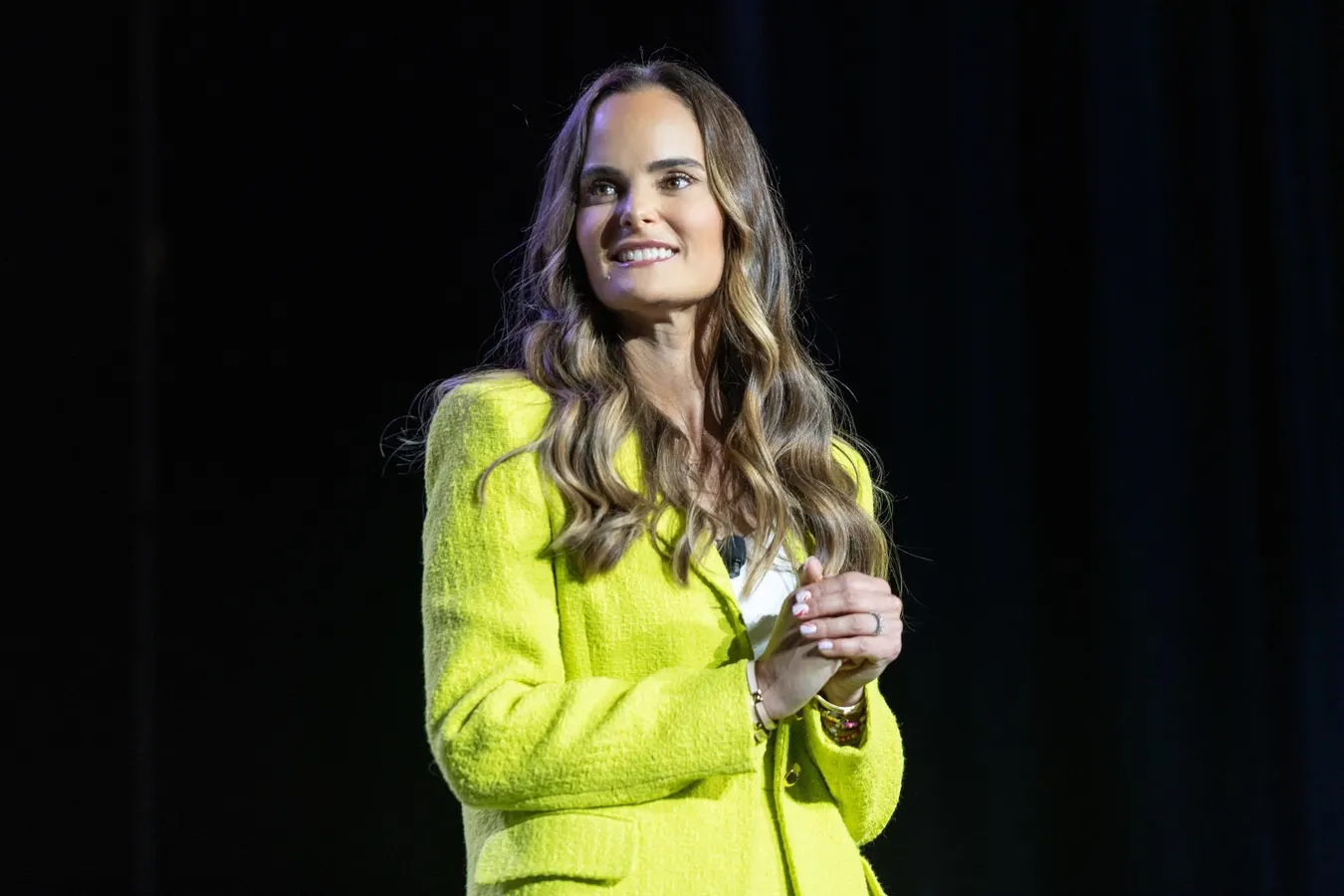

Melissa Medina, co-founder and CEO of eMerge Americas, and her father, Manny Medina, have been instrumental in making Miami and South Florida attractive to investors like Ken Griffin.
Clutch Content Partners for eMerge Americas
“We don’t get the same questions we got in the beginning,” Melissa Medina, co-founder and CEO of eMerge Americas, told me over Zoom as we discussed Miami tech and its growing recognition. “Why Miami? Why would you do that there? Are we really going to meet entrepreneurs that we can invest in?” Now, she said, the question has reversed itself: “How can we be involved? We have funds that are asking us, can we get first access to your accelerator founders.”
That reversal describes the moment a market stops pleading to be taken seriously and begins producing a more valuable form of interest: stakeholders who feel they may be late if they don’t pay attention.
“There are New Yorkers, Californians, Chicagoans, and people from the rest of the world looking at South Florida,” Jaret Davis, co-managing shareholder of Greenberg Traurig’s Miami office, also told me over Zoom, as did others in this article. “Part of this argument could be FOMO, fear of missing out, when you get a critical mass of people who are looking to move down here.”
For more than a decade, eMerge Americas has helped structure movement around South Florida’s technology economy. It’s done so without pretending Miami became credible because a fresh supply of East Coast expatriates looking for lighter winters and a more forgiving state tax code anointed the city. Those forces supplied attention, but attention, as any founder who’s watched polite interest evaporate after a demo day understands, is not the same thing as desire.
What Melissa Medina and her father, Manny, built was an invitation system. It gave founders, investors, corporate operators and international companies a way to see themselves inside a market that had long existed in pieces but was difficult for outsiders to read.
“We have companies like Citadel, like Blackstone, Thoma Bravo—they weren’t even here five years ago,” Medina noted when reflecting on South Florida’s compounding maturity. “To me, wherein the opportunity lies is for more growth, more business development.”
The annual conference may be the visible annual ritual, but the actual product is legibility. eMerge Americas is a way for the right stakeholder to understand where opportunity lives, who can make an introduction and why moving closer feels like their own intelligent idea.
That distinction is the heart of what I call the Seduction Principle. The most desired companies and leaders don’t waste time explaining why they matter. They instead create conditions where the right people recognize an advantage, trust the proof and choose proximity to verify a persuasive proposition.
eMerge Americas Curates Miami Tech Without Controlling Choice
“How do you curate who’s here so the sources of capital can get access to them most easily, flowing through their own thesis, their own investment thesis?” Davis said of eMerge’s approach at a press meeting during the April 2026 eMerge Americas conference.
Venture capital may be abundant, but conviction remains scarce. Global venture funding reached $425 billion in 2025, but five AI companies absorbed $84 billion, or 20% of the total. Nearly 60% went to only 629 companies raising rounds of at least $100 million. Record investment doesn’t indicate universal appetite, only a highly concentrated conviction.
South Florida has its own localized version. Of the $5.83 billion across 575 venture deals Florida startups raised in 2025, South Florida captured 71%, roughly $4.14 billion, of the state’s venture dollars. Funding to the region rose 49 percent from the previous year, while Miami-area AI companies alone attracted $1.23 billion.
A founder entering this environment needs sufficient specificity for the right investor to recognize how the company fits a bet they already want to make. In this, seduction isn’t persuasion by force, flattery or artificial scarcity. It’s the architecture of a voluntary conclusion, where a stakeholder feels movement toward a company, person or market is self-directed – even when someone has carefully designed the conditions making that movement possible.
“One of the four verticals that we carry into our accelerator program is deep tech, which is AI, quantum, et cetera; defense tech, or dual-use in defense tech, so national security; health tech; and fintech,” Medina said. “Why do we focus on those four verticals? In the accelerator, it’s because that is where we have our biggest network. That’s where we’re bringing together these decision-makers at the conference, so we want to make sure we’re also providing these companies with the network that can support them.”
eMerge doesn’t tell founders they should move to Miami. It shows them who they might become connected to if they stay in the conversation. Neither does it promise investors a guaranteed deal, instead presenting a concentrated field of ambition where their own investment thesis does the final selecting.
For Alex Rodriguez, founder of Xpece Drones, his own ambition led him to filtering his company narrative to meet what investors like to hear. He entered eMerge’s global accelerator, a six-week program that gives 100 companies access to workshops, mentors through the Venture Mentoring Team and investor-facing preparation before the annual conference. Only five companies were selected to present on the closing-stage showcase. Xpece was one of them.
“Out of everything that I walked away with, the VMT was the most impactful,” Rodriguez told me. “They guided me on the story, because what’s hard about telling a story is leaving out, cutting out older parts that you think are important.”
eMerge’s 2026 conference brought more than 1,000 investors into a Miami Beach Convention Center with more than 2,500 startups, while its accelerator deliberately narrowed one part of that field to 100 selected companies. The investor isn’t told which company to want. eMerge’s seductive architecture simply makes discovery more efficient.
The Miami Tech Discipline of Making Investors Want More
Melissa Medina with her father, eMerge Americas co-founder Manny Medina. For more than a decade, they have helped create the conditions under which Miami tech could move from attracting attention to inspiring commitment
Clutch Content Partners for eMerge Americas
“What I was able to do was take a 20-some slide pitch deck and get it down to 12 slides that I could get through in three and a half minutes,” Al Wagner, founder of WholesalePayroll, told me as he recalled refining his company’s market presentation after working with mentors within VMT. “I can now do my pitch in two and a half minutes and just tell the story with the slides in the background.
There’s a particular discipline required to leave something important out. Founders spend years accumulating reasons their companies matter, which makes every detail seem indispensable. But stakeholder desire rarely increases in proportion to the amount of information supplied.
A 2026 Journal of Business Venturing study examining the Q&A portions of 14 investment pitches found investors were anything but passive. They challenged, redirected and reframed founders’ stories, turning the pitch into what the researchers describe as a negotiated process rather than scripted performance. Persuasiveness depends partly on whether a story can accommodate interrogation while maintaining integrity.
“Imagine a founder in our showcase having you as a mentor, and now you’re helping them tweak their communication skills, tweak their pitch,” Medina said, referring to my own communications work with founders and how ruthlessly I cross examine their thesis before an investor meeting. “Extremely, extremely important.”
A 2024 Journal of Business Venturing Insights study found that when investors become mentally transported into a pitch narrative, they become more likely to adapt the opportunity into their own thinking and subsequently commit resources. Pitching thus becomes both sense-giving by the entrepreneur and sense-making by the investor.
“We’re reading their messaging,” Medina described of how eMerge evaluates accelerator applicants. “How are they sharing their mission statement, their why? What is the product or solution? Are they clearly articulating it in the application? All of that matters.”
Instead of asking an investor to absorb everything the founder believes important, the investor receives enough information to logically recognize the opportunity within their own priorities. The founder controls what enters the frame. The stakeholder decides what deserves closer examination. The seduction lies not in finishing the story for the investor, but in making the investor want to finish it themselves.
eMerge Americas Keeps Miami Tech Relationships Moving
A founder can make a compelling case in three minutes and still leave an investor with the more consequential question: What happens after I say yes?
The same is true of anything that wants to become desirable. A packed room may manufacture urgency, but it can’t manufacture trust. Trust develops when the stakeholder can see the introduction won’t expire as soon as the conference badge comes off.
In this, Medina’s real offer is continuity. She’s building a network in which founders remain visible after the showcase, where a corporate relationship can become a commercial partner and where a first conversation naturally continues towards a mutual goal.
Rabia Malik experienced that continuity while exhibiting JennABytes through eMerge’s SMB Growth Lab. There, she met the head of San Francisco-based Aleph walking the conference floor. That encounter led Malik into another accelerator, where she moved from testing an idea to building a product and signing up 105 parents in 12 days.
“A lot of it is so much more than funding,” Medina said. “For us, keeping them part of our alumni network, that continuous relationship, I think, is super important, both for us and for the founder.”
But stakeholders rarely trust a company because of an introduction. The trust comes from what the introduction allows them to observe next. Does the founder follow through? Does the institution stay present? Do others with something to lose remain in the room?
There’s seduction in knowing where your influence ends and where your actions must then supersede words. The Seduction Principle requires proof because sophisticated stakeholders aren’t simply asking whether they want something. They’re calculating what happens if they’re wrong.
eMerge doesn’t eliminate risk; it makes risk easier to structure. Its startup accelerators prepare founders to do what Rodriguez called “a soul-searching activity” of what precisely they’re building, why it matters and why others should care. When executed sincerely, the finished presentation will be echoed by the person most capable of carrying the founder forward.
“The whole goal of eMerge is deal making,” Davis said at the annual conference’s press meeting. “We want those positive collisions. We want people to walk away with term sheets.”
Ken Griffin’s $3 Billion Signal for Miami Tech
MIAMI, FLORIDA – NOVEMBER 09: Kenneth Griffin speaks onstage during the Pérez Art Museum Miami’s Art of the Party on November 09, 2024 in Miami, Florida. (Photo by John Parra/Getty Images for Pérez Art Museum Miami )
Getty Images for Pérez Art Museum Miami
“Miami is where you get the best of Texas and the best of New York and California combined,” Davis said at the eMerge conference. “From a business point of view, it’s business friendly. Business is seen as a rock star here.”
The latest evidence arrived today with Ken Griffin’s $3 billion commitment to Carnegie Mellon University, the largest individual gift in higher education history. Of that amount, $2 billion will launch Carnegie Mellon University Miami on more than 35 acres in Wynwood; the remaining $1 billion will support CMU’s Pittsburgh campus.
But Miami won’t be a regional outpost borrowing prestige from Pittsburgh. Carnegie Mellon University Miami will organize education and research around problems in national security, human health and advanced manufacturing, giving the region talent companies once insisted Miami lacked. At maturity, CMU says the Miami campus will support more than 3,500 undergraduate and graduate students, nearly 300 faculty and more than 600 staff, with first enrollment targeted for 2028 pending regulatory approvals.
“The opportunity to bring Carnegie Mellon to Miami places our city at the heart of humanistic and scientific advancement,” Griffin said when announcing the gift.
For 12 years, eMerge has given Miami’s disparate assets a visible center where outsiders can test the city’s claims and gain credible access to the people already building here. In 2026, the annual conference convened more than 20,000 participants from over 60 countries. The City of Miami Beach estimates that eMerge itself has generated $2.51 billion in regional economic impact and supported nearly 9,900 jobs since 2014. Its Gold Coast accelerator model, built with Related Ross and the Florida Council of 100, has since become the foundation for a broader statewide company-building platform.
“The nucleus of what helps grow an ecosystem is really fostering this dynamic entrepreneurial system,” Medina told me. “Because if they grow, then it’s just a positive snowball effect. They’re going to continue to hire talent, they may exit. If they exit, they’re going to pour back into that community, or build another company.”
This is the Seduction Principle operating at market scale. eMerge converted Miami’s visibility into something specific enough for stakeholders to act upon. The conference offered the invitation, but the relationships provided proof the opportunity would remain after everyone flew home.
Griffin’s commitment is what conversion looks like when the stakeholder no longer needs to be persuaded that Miami tech is worth exploring. eMerge didn’t build Carnegie Mellon’s campus, but Medina and her father did help change conditions under which Miami could be understood, trusted and ultimately chosen. Now serious stakeholders are constructing their futures inside it.















Leave a comment