


America’s federal energy policies have shifted dramatically under the Trump administration and 119th Congress – from prioritizing cleaner, cheaper sources of energy to propping up expensive, dirty fossil fuels – and families and businesses are paying the price.

Every state in the contiguous U.S. will pay more in household energy spending by 2040 under federal energy policies enacted since January 2025
Energy Innovation
New modeling of impacts from federal energy policy changes across each of the 48 contiguous U.S. states forecasts staggering economic damages for every state between now and 2040: $920 billion in cumulative new household energy spending, nearly $1 more per gallon of gasoline, $1.3 trillion in cumulative GDP losses, and $72 billion in cumulative new healthcare costs.
Americans are already facing an energy affordability crisis – U.S. electricity bills are rising fast and oil prices are near record highs as the war in Iran drags on – but far worse could be on the horizon unless federal energy policy changes: higher electricity prices, more pain at the pump, fewer jobs, dirtier air, and bigger doctor’s bills.
Higher energy bills, more pain at the pump, dirtier air, bigger healthcare bills
Energy Innovation used its open-source Energy Policy Simulator models across each of the 48 contiguous states to determine how federal policy decisions made since January 2025 will impact America’s families and businesses.
The modeling includes passage of the One Big Beautiful Bill Act, U.S. Environmental Protection Agency repeals of multiple policies to reduce air and water pollution as well as the Endangerment finding, Congressional action to overturn state-level tailpipe emissions standards, and Trump administration actions to block renewable energy deployment.
In every state – regardless of their existing energy mix – energy spending will rise because of this combination of federal energy policy decisions. American households will pay about $6,500 more per household in electricity, transportation fuel, and natural gas costs over the next 15 years. That’s driven in large part by repealed federal electric vehicle incentives and tailpipe emissions standards that push average gasoline prices up 93 cents per gallon.
Across the board, Americans will have to breathe dirtier air because fossil fuel power plants will be forced to remain online and cars will burning more fuel, all of which make people sick and cause more premature deaths, adding up to bigger healthcare bills.
All federal energy policy decisions will generate an additional 9.3 billion tons of cumulative CO2e emissions through 2040 and worsening local air pollution will cause 37,000 additional premature deaths while raising healthcare costs $72 billion – things like going to the doctor and paying for medicine.
Consumers in every state will pay more for energy
In every state, federal policies will make America’s energy affordability crisis worse by raising the cost of building new energy supply and increasing dependence on more expensive fossil fuels. Keeping unaffordable and unreliable coal power plants online, burning expensive natural gas for electricity and heating, and out-of-control pain at the pump drives the forecast energy cost increases.
By 2035, the average American household will pay $640 more per year in energy bills. Consumers in Kentucky, Mississippi, Oregon, South Dakota, Texas, Virginia, and Wyoming will all pay at least $800 more that year – and by 2040 several states will be paying at least $1,000 per household per year.
The biggest losers in terms of total household spending increases track along the largest state economies: California will face $100 billion more, Texas $96 billion, Florida $69 billion, New York $37 billion, and North Carolina $34 billion.
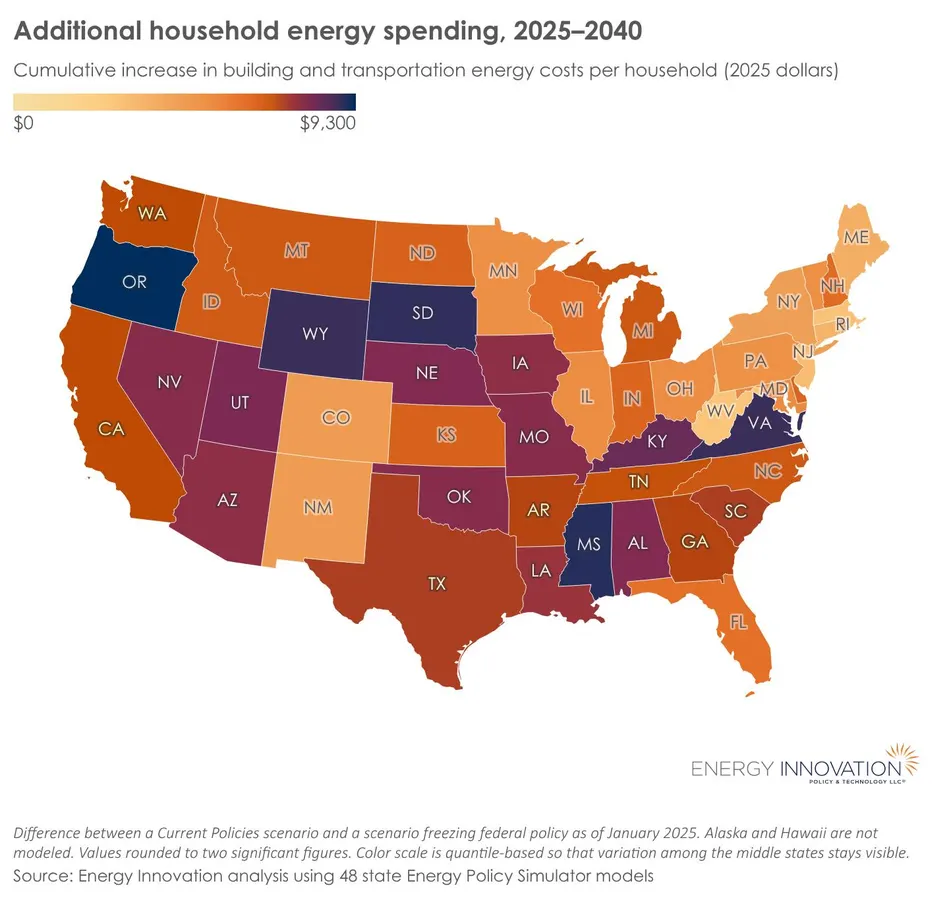
But smaller states will pay a large share of additional energy spending too. Oregon ranks worst with $9,300 per household, followed closely by Mississippi with $9,100, South Dakota with $9,000, and Virginia and Wyoming with $8,900.
Cumulative increased household energy costs by state by 2040 under energy policies enacted since January 2025
Energy Innovation
Ironically, the states that will face the highest household energy spending increases are the ones that most reliably vote for Republicans, and are among the most fossil-fuel dependent – once again showing clean energy isn’t driving energy price spikes.
Dirtier air will only Make America Sick Again
Higher energy bills aren’t the only toll federal policies will take on our families. Burning more gasoline, coal, and natural gas will force Americans to breathe dirtier air. Adding nearly 600 million tons of CO2e to our air every year from tailpipes and smokestacks will cause asthma attacks, respiratory diseases, and even premature deaths.
Sicker people will mean more trips to urgent care, their doctors, or the emergency room – it also means paying for more healthcare and medication along with lost time working to recover or take care of ailing family and friends.
Coal-heavy states or those with the most vehicles on the road will pay the largest price in additional healthcare costs: Texas will pay $11 billion more, followed by Indiana with $4.8 billion, California with $4.2 billion, Kentucky with $3.2 billion, and Georgia with $3.1 billion.
Every state will face increased healthcare costs due to more air pollution due to federal energy policies enacted since January 2025
Energy Innovation
By 2035, Americans will spend nearly $7 billion more annually on healthcare, and if the economic value of indirect costs like the value of a lost life is added in, the total cumulative cost of public damage from federal policies rises to $510 billion over the next 15 years.
Lost clean energy construction equals lost jobs and GDP
Federal energy policy decisions that intentionally slow down new clean energy construction and manufacturing will cost states 6.2 million job-years and $1.3 trillion in cumulative GDP by 2040 – in 2035 alone, federal policies will cost more than half a million jobs and $112 billion in lost GDP.
As with cumulative energy costs, the largest states will suffer the deepest economic losses with five states carrying 39% of all job losses: Texas will lose 820,000 job-years, followed by California with 660,000, Florida with 390,000, New York with 260,000, and North Carolina with 250,000.
The largest states also suffer the largest GDP losses, with five states carrying 42% of total GDP losses: California will lose $160 billion in GDP, followed by Texas with $150 billion, New York with $93 billion, Florida with $81 billion, and Georgia with $48 billion.
State governments can still protect their constituents with smart policy
While the current administration and Congress have chosen a more expensive and dirtier policy path forward, state governments still have options to help protect their constituents from these impacts through five no-regrets actions until federal policies change.
The “safe harbor” clean energy tax credit provisions of OBBBA have supercharged clean energy development, with 170-210 gigawatts of renewables under development through the end of this decade. State and local governments can help these projects qualify for the expiring tax credits by supporting developers aiming to place them into service by 2030 and pushing utilities to contract with and connect these resources where they can save consumers money.
Policymakers can also remove barriers to additional clean energy development by providing permitting certainty, improving how existing power grids are used, reducing soft costs, and cutting red tape for businesses and households to install clean energy.
State governments can help drivers save money at the pump through policies that bolster the market for electric vehicles, helping people purchase EVs, expanding charging infrastructure, and helping EV support the grid with flexible charging.
States can help businesses cut costs by doubling down on energy efficiency and electrified appliances in buildings and factories to provide affordable heating and cooling, adopting modern energy codes and standards, and unlocking financing for energy saving technologies.
Policymakers can also keep the nascent clean energy manufacturing boom growing by stimulating investment in new factories to build clean technologies and industrial parks designed to reduce infrastructure costs and energy price increases of meeting new demand.
While these actions can’t replace the pollution reductions and total affordability measures provided by strong federal policy, they can limit price increases, improve health, and add new capacity to the grid.















Leave a comment