


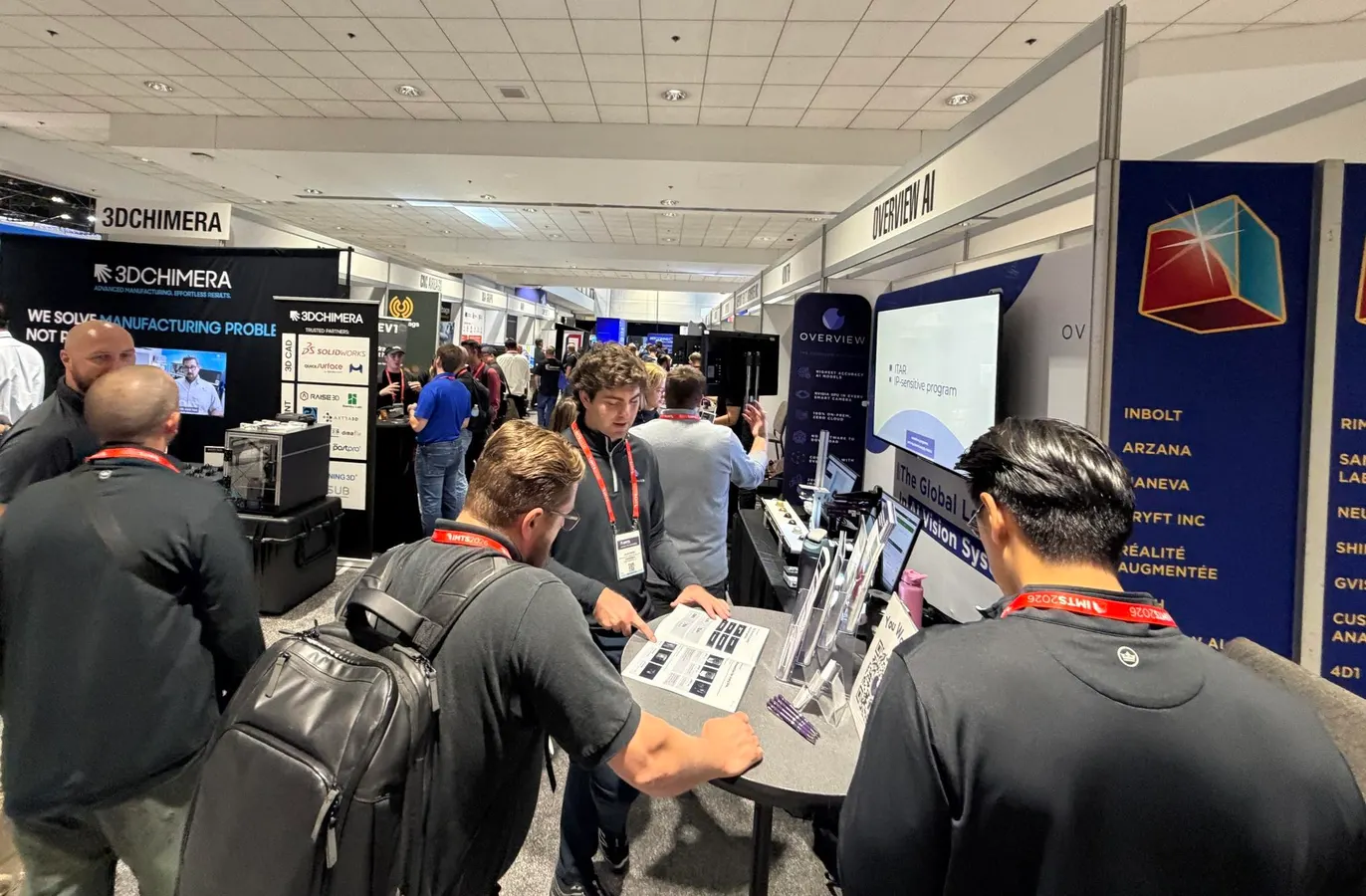

The International Manufacturing Technology Show 2026 featured a small AI for manufacturing pavilion.
Photo courtesy of the author.
For the first time since 2023, the Federal Reserve is raising interest rates.
On September 16, the Fed increased its target range by 25 basis points to 3.75% to 4%, responding to persistent inflation despite continued economic growth. Most Fed policymakers now anticipate at least one additional increase this year.
For additive manufacturing, the obvious question is whether history is about to repeat itself.
The answer is probably only partially.
The last Fed hike came on July 26, 2023, when rates reached 5.25% to 5.5%, culminating in a tightening cycle totaling 525 basis points since early 2022. The Fed itself acknowledged at the time that tighter credit conditions were likely to weigh on business activity.
AM subsequently experienced precisely the kind of capital spending slowdown one would expect from an industry selling machines that can cost hundreds of thousands or millions of dollars.
According to market intelligence firm CONTEXT, global shipments of industrial 3D printers fell 9% in 2023. In the fourth quarter alone, industrial shipments were down 13% year over year, including a 25% decline in industrial polymer systems. CONTEXT explicitly connected the weakness to reductions in capital expenditures associated with high interest rates.
The broader manufacturing equipment industry followed a similar trajectory. U.S. manufacturing technology orders totaled $4.94 billion in 2023, according to AMT – The Association For Manufacturing Technology, down 11.2% from $5.56 billion in 2022.
What Happened To AM Companies
Individual AM companies saw the pressure directly.
Desktop Metal reported in 2023 that rising interest rates were making access to credit more expensive for customers, contributing to delayed purchasing decisions and longer sales cycles. The company later described 2023 as a “challenging capital investment environment” characterized by elevated interest rates.
Stratasys told investors a similar story. Its 2023 revenue declined 3.7%, with the company saying macroeconomic pressure on customer capital expenditure budgets was lengthening sales cycles and causing some system orders to be deferred. Stratasys specifically identified increased interest rates as a headwind for the AM industry.
Interest rates were obviously not the only cause of AM’s downturn. The industry was also dealing with post-pandemic normalization, overcapacity, disappointing adoption rates in some segments and an increasingly painful wave of consolidation—which both Stratasys and Desktop Metal, now part of Arc Impact, know all-too-well.
But expensive capital aggravated almost all of those problems.
2026 Is Starting From A Very Different Place
This time, the Fed is tightening into what looks like an industrial investment boom.
AMT reported $605.8 million of U.S. manufacturing technology orders in July 2026, up 55.2% from July 2025. Through the first seven months of the year, orders reached $4.03 billion, 37.1% higher than during the same period last year.
The first half of 2026 was actually the strongest half-year for the value of manufacturing technology orders since AMT began collecting the data in 1998. Aerospace manufacturers ordered more equipment during the period than in any previous first half on record.
AM is participating in that rebound.
CONTEXT reported that industrial 3D printer shipments increased 18% year over year in the first quarter of 2026, while industrial AM hardware revenue climbed 23%. It marked the third consecutive quarter of growth following two years of contraction.
That means a quarter-point hike now is hitting a much healthier market than the tightening cycle of 2022-23.
Still, the recovery is vulnerable.
Watch The $100,000-Plus Machines
The clearest exposure is industrial AM equipment costing more than $100,000.
These purchases tend to require capital budgets, financing committees and relatively long payback calculations. Increase the discount rate used in those calculations and fewer marginal projects make financial sense.
Stratasys is a useful example. Its second-quarter 2026 revenue was essentially flat year over year at $137.6 million, although aerospace and defense revenue grew 17%. The company has $212.5 million in cash and no debt, limiting its direct exposure to higher borrowing costs. Its customers are another matter. Stratasys’ current forecast specifically assumes that relatively high interest rates do not further impede economic activity.
At IMTS 2026, Stratasys demonstrated the use of 3D printed end-of-arm tooling being deployed by Toyota.
Photo courtesy of the author.
Velo3D offers another interesting case. Revenue jumped 52.3% year over year in Q2 to $20.7 million, driven heavily by aerospace and defense demand. But the company plans $40 million to $50 million of 2026 capital expenditures, with that spending explicitly subject to sufficient financing.
The next stage of the rate cycle could therefore test whether AM’s recent growth is strong enough to overcome a rising cost of capital.
Meanwhile, low-cost machines may see a keen opportunity to increase entry into the market.
The Geography Of The Next AM Cycle
The consequences will also differ dramatically by region.
In the United States, higher borrowing costs are negative for small manufacturers, job shops and companies financing equipment purchases. A stronger dollar can also make U.S.-manufactured equipment less competitive abroad. At the same time, American manufacturing is benefiting from unusually powerful demand from aerospace, defense, data centers, energy infrastructure and reshoring. Those markets are less dependent on ordinary economic cycles, which could provide AM with a cushion that was weaker in 2023.
China may be in the strongest position. CONTEXT says industrial AM shipments in China increased 29% year over year in Q1 2026, compared with 9% in North America and 11% in Western Europe. Chinese vendors HBD, Farsoon and BLT have seen particularly strong metal AM demand, including titanium components for consumer electronics.
A 7-axis humanoid robotic arm was released by Huayan Robotics at IMTS 2026.
Photo courtesy of the author.
China’s monetary environment is also moving differently. The People’s Bank of China continues to describe financing conditions as accommodative even as U.S. yields rise. A widening U.S.-China interest-rate differential could pressure the renminbi, potentially making Chinese AM hardware cheaper in export markets, though tariffs and trade restrictions complicate that advantage.
Europe may face the toughest combination. The European Central Bank raised its own rates by 25 basis points on September 10, while forecasting 3% inflation for 2026 amid elevated energy prices. Eurozone industrial production declined 0.1% in July and was flat from a year earlier.
A weaker euro could benefit European AM exporters such as EOS and other equipment manufacturers selling into the U.S. market, but higher financing costs and expensive energy create a difficult environment for their domestic customers.
A Stress Test, Not Yet Another AM Winter
The most important difference from 2023 is what AM is being purchased for.
The previous tightening cycle arrived while the industry was still struggling to prove many production business cases. In 2026, some of the strongest demand is coming from defense, aerospace, drones, consumer electronics and data-center infrastructure, applications where AM has increasingly moved into serial production.
Metal powder bed fusion shipments grew 24% year over year in Q1. Polymer powder bed fusion shipments climbed 30%. Meanwhile, CONTEXT says Chinese industrial demand is accelerating and some Western metal AM suppliers are becoming supply constrained.
Higher rates will almost certainly eliminate some marginal equipment purchases and could stretch sales cycles again. If the Fed continues hiking into 2027, the effects will become more pronounced.
But unlike 2023, additive manufacturing is entering the tightening cycle with growing industrial shipments, record U.S. machinery investment and powerful demand from several strategic industries.
The coming year may therefore reveal something important about AM’s maturation.
If industrial additive can continue growing with money becoming expensive again, the sector will have passed a test it failed the last time around.
















Leave a comment