


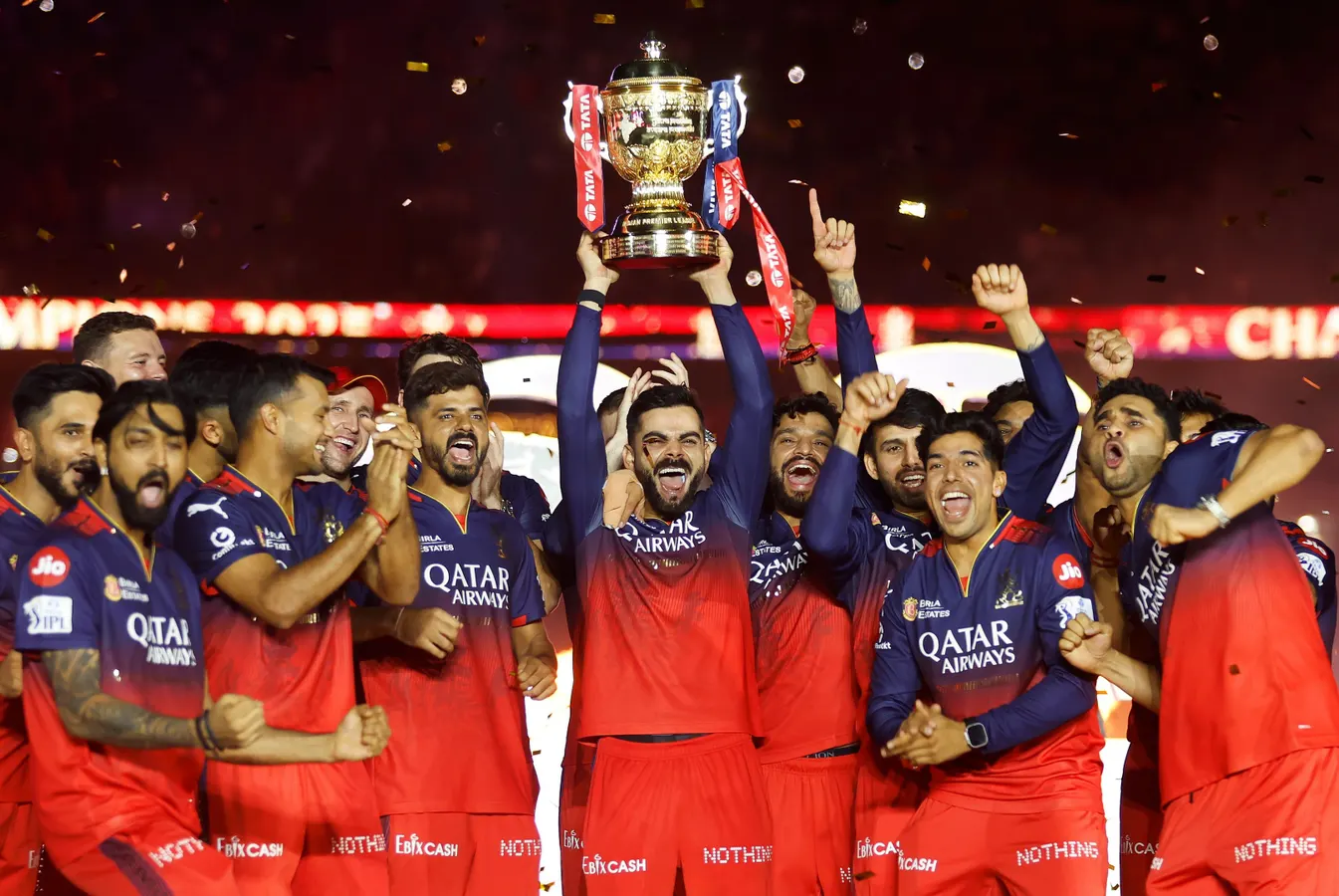
Team members of Royal Challengers Bengaluru celebrates the team’s victory in the 2025 IPL Final match at Narendra Modi Stadium on June 03, 2025, in Ahmedabad, India.
Photo by Pankaj Nangia/Getty Images
This story is part of Forbes’ coverage of India’s Richest 2026. See the full list here.
Two record-breaking deals rocked the world of cricket this year. Royal Challengers Bengaluru (RCB), two-time champions of the Indian Premier League (IPL), were acquired in March by a consortium for $1.8 billion, the single most expensive IPL franchise transaction ever, according to a 2026 IPL valuation study by Los Angeles-headquartered investment bank Houlihan Lokey. The buyers included commodities tycoon Kumar Birla’s Aditya Birla group and media giant Times of India’s owners as well as American billionaire David Blitzer and asset manager Blackstone.
Two months later, steel tycoon Lakshmi Mittal, executive chairman of Arcelor Mittal, teamed with Serum Institute of India CEO Adar Poonawalla, the son of vaccine billionaire Cyrus Poonawalla, to acquire Rajasthan Royals, valuing them at $1.65 billion. The team had earlier attracted a bid from a syndicate involving Rob Walton of the founding Walmart family and Sheila Ford Hamp, a descendant of the Ford Motor clan who owns the Detroit Lions U.S. National Football League team, but that proposal unraveled. Largely because of the two deals, the total business enterprise value of the IPL has rocketed to $20.6 billion from $15.4 billion in 2023, Houlihan Lokey estimates.
Explaining the reason for his big bet on cricket, Birla said in a statement that, “Over the past two decades, the IPL has morphed to become a global sporting powerhouse that has changed the face of Indian cricket, creating enormous value for India.” For Mittal, it was equal parts passion for the sport and ties to the team’s home state: “I love cricket and my family is from Rajasthan,” he said in a press release.
In India, cricket dominates all other sports, accounting for 89% of the country’s 223-billion-rupee ($2.3 billion) annual sports revenue, according to Houlihan Lokey. The yearly IPL tournament—which follows the T20 format, the shortest and fastest version of the game, designed to be played in three hours—is held over more than two months across the country. In 2025, it attracted a record 1.2 billion viewers on television and online, according to a March report jointly published by consulting firm EY and Indian industry association FICCI.
Cricket’s huge cachet has attracted tycoons to the IPL right from its start in 2007. That group includes Mukesh Ambani’s Reliance Industries, owner of Mumbai Indians; Mohit Burman of the Burman family and billionaire Nusli Wadia’s son Ness, with both holding stakes in Punjab Kings, and former liquor billionaire Vijay Mallya, whose financial troubles forced him to cede all control of RCB in 2016 to joint venture partner Diageo’s Indian unit, United Spirits, which then went on to sell the team earlier this year.
The prices they paid to acquire the teams at the time seem like bargains today. Mallya’s winning bid for RCB was around $112 million with Ambani bagging Mumbai Indians for a similar amount. “It’s been a win-win for early investors,” says veteran sports columnist Ayaz Memon. “It’s proved to be both a good investment and a vanity play as no other sport in India offers the kind of brand equity cricket does,” he adds.
Today, nearly all ten of the teams in the IPL have billionaire owners, including Lucknow Super Giants’ Sanjiv Goenka, Delhi Capitals’ G.M. Rao and Sunrisers Hyderabad’s Kalanithi Maran. Five years ago, two deals upped the stakes substantially when CVC Capital Partners, a global private equity and investment advisory firm, paid nearly 57 billion rupees for Gujarat Titans and Goenka forked out 70 billion rupees for the Lucknow team. CVC went on to partly cash out when it sold a two-thirds stake last year to the billionaire Mehta brothers’ Torrent group for 50 billion rupees.
KUMAR BIRLA: PRODIP GUHA/GETTY IMAGE; LAKSHMI MITTAL: JAN KRUGER/GETTY IMAGES; ADAR POONAWALLA: INDRANIL MUKHERJEE/AFP VIA GETTY IMAGES; MOHIT BURMAN: DABUR; G.M. RAO: ANINTIDO MUKHERJEE / BLOOMBERG VIA GETTY IMAGES; KALANITHI MARAN: SUN TV NETWORK
According to Harsh Talikoti, Houlihan Lokey’s Mumbai-based director of financial and valuation advisory and author of the IPL valuation study, consortium ownership is a clear sign that the IPL is becoming an institutional asset class. Record prices are partly due to the limited number of teams, he says. “What we are seeing is a scarcity premium with a genuine growth thesis behind it.”
While no team owners are looking to sell, a couple of them could be mulling partial exits, says Memon. New York-based asset manager Ares Management is reportedly negotiating to buy a minority stake in Kolkata Knight Riders, co-owned by Bollywood star Shah Rukh Khan. Memon says there’s also some talk that the Board of Control for Cricket in India, which announced at its September annual meeting that the 20th edition of the IPL in 2027 would be celebrated in “a grand way,” could be increasing the number of IPL teams to a dozen.
As for the future of the franchises, Memon points to the active involvement of the billionaire owners’ next generation. Ambani’s son Akash represents Reliance Industries at the players’ auctions and is regularly sighted at matches along with younger brother Anant. Maran’s daughter, Kaviya, serves as the CEO of Sunrisers. Birla’s new trophy is overseen by his 29-year-old son and former cricketer, Aryaman, who was named RCB’s chairman, while Mittal’s son, Aditya, a managing partner at the Boston Celtics, is on the board of the Rajasthan team.










Leave a comment